
Federal agencies banned traditional burns and starved the savanna. We up here on the sandy soil of Adams County know what happens when the people who have been reading the land for generations are kept from doing the work. The fire goes out of the woods, the underbrush chokes down the oaks, and the next spark takes everything instead of cleaning the floor. That is the lesson the Xerente people in Brazil’s Cerrado just forced their own government to relearn, and it is the same lesson Aldo Leopold spent the last decade of his life trying to get the University of Wisconsin to write into its forestry manuals.
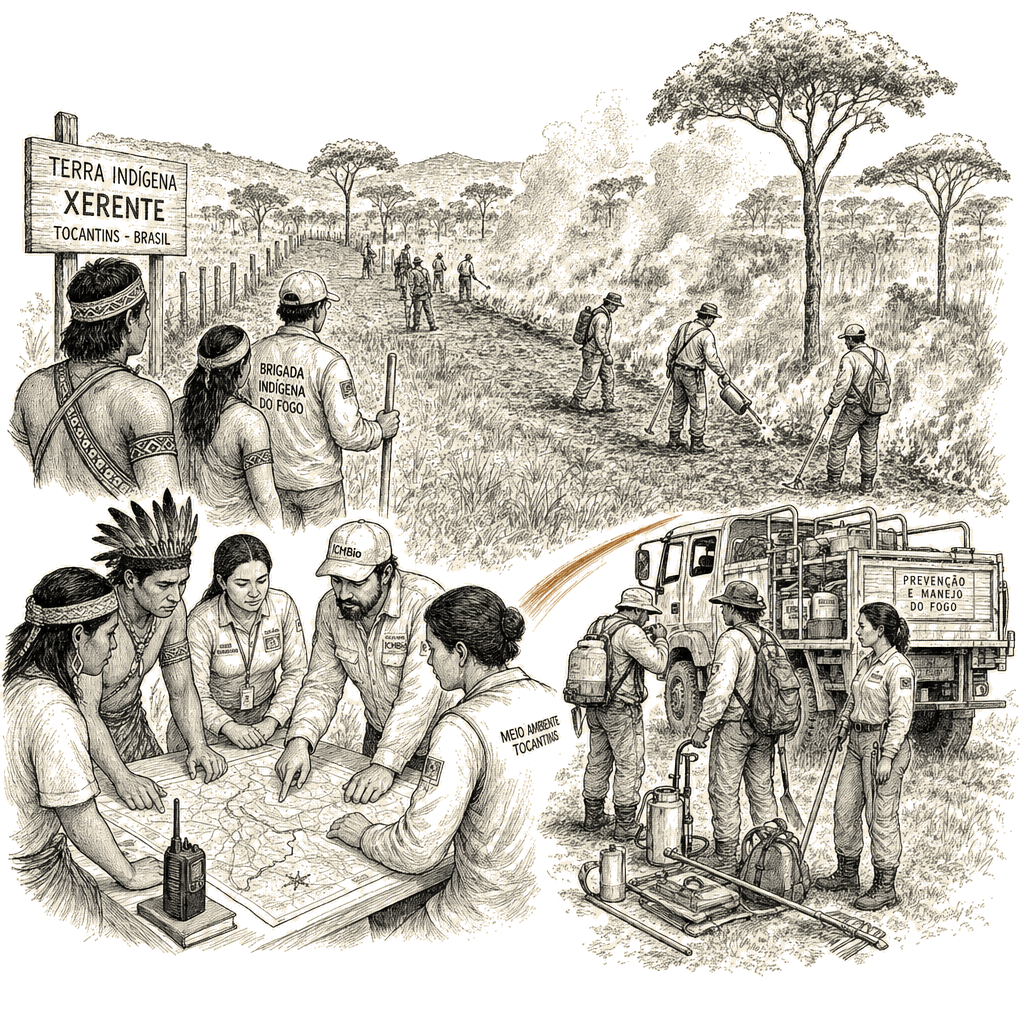
Report out of Tocantins this week shows the Xerente fire brigade, including a women’s contingent, working alongside environmental officials to lay down controlled burns ahead of the August dry season. The photograph from May shows them igniting palm leaves on ground their grandparents worked, doing exactly what ecologists now say saves the biome: clear the dry fuel before the heat arrives, so the land burns light and the soil survives. It took decades of prejudice, of government authorities dismissing Indigenous fire knowledge as primitive, before a federal environmental agency finally handed the drip torches back to the people who knew when to strike a match.
The timing is not accidental. El Niño is settling over the Southern Hemisphere this year, and forecasters have already warned that the drought will deepen and the fire weather will stretch longer than normal. When the air stays dry and the wind picks up, an uncontrolled fire does not read maps or respect property lines. It jumps the firebreaks, takes out the canopy, and turns a working savanna into charcoal. The Xerente strategy treats the dry season as a predictable hazard you prepare for in May, not a surprise you panic at in August. Yes, a controlled burn can jump its line if you are careless, but an escaped prescribed burn scorches a few acres; an uncontrolled wildfire that starves the biome to kill a biome. We used to understand that up here, before the county started treating every smoke column like an emergency instead of a tool.
Leopold wrote about this in the wildlife essays in A Sand County Almanac, the ones where he watched the Wisconsin hillsides turn brown under decades of fire suppression and figured out that the deer were starving because the oaks were drowning in brush. He had to argue with his own colleagues before the Forest Service would let him use light fire to clear timber and reset the mountain pines. The academic establishment treated his notebooks the same way Brazil’s agricultural ministries treated the Xerente’s oral record: local observation dismissed as superstition, to be corrected by centrally managed policy. The policy worked perfectly, right up until the Cerrado caught fire.
Cattle and soybean expansion into the savanna did not help. The same machinery that clear-cuts primary forest for export markets removes the buffer vegetation that traditional burning maintains, and then wonders why the remaining patches ignite like kindling when the rains stop coming. Brazil’s Amazon deforestation has finally slowed to a twelve-year low, but the climate pressure is still pushing the biome toward its drying point, and a savanna starved of fire is just waiting for a match. The Xerente are putting the match back under control, and the federal agencies are finally standing aside to let the work happen.
I keep a climate notebook on the bench in Friendship, and the dates inside it do not trend toward the old averages. Back in ‘17, when the county shut down the local burn unit after one smoke complaint off the highway, they locked the drip torches in a municipal shed and started treating every smoke column like an emergency instead of a tool. The ice went off Friendship Lake on March 18 this year; when I was a kid, it held firm until April 6 like clockwork. The dry spells stretch longer into autumn. The ground gets ready to burn earlier, and the wind comes from the wrong direction more often. We do not have a federal agency handing us drip torches to manage our own woods in Adams County, and we probably never will. But the principle is the same: the people who watch the land every day know when it needs to burn, and the people who write the regulations do not.
The Xerente are doing the work in the Cerrado because the alternative is watching their home turn to ash. The officials who spent thirty years keeping them out of the management plan should be grateful anyone is still there to hold a hose when the wind shifts. We can write the same discipline into our own county land-use policy, or we can wait for the smoke to tell us what we already know. The land does not lie about what it needs. It only waits to see if we are paying attention.