
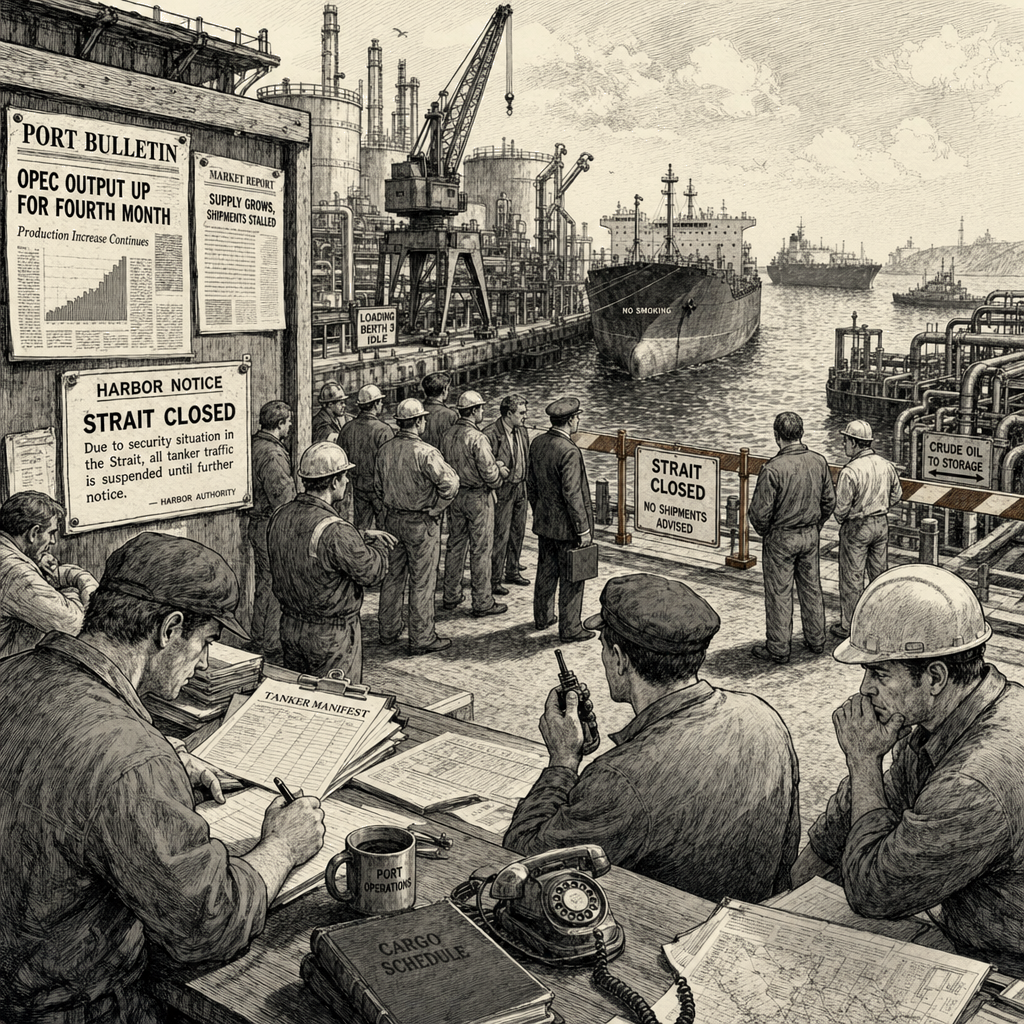
OPEC and Washington are staging a fuel phantom that bleeds rural operators on diesel. The announcement came out of Vienna on Sunday: an increase of 188,000 barrels a day for July. Saudi Arabia, Russia, Iraq, Kuwait, Algeria, Kazakhstan, and Oman all nodded to raise their output again, the fourth month in a row. The statement called it a commitment to market stability and a chance for the members to accelerate compensation. The diesel pump out on Highway 13 does not care about their compensation. The pump reads the blockage in the Strait of Hormuz.
Daniel Yergin wrote the long history of oil, and the first chapter of that history is geography, not policy. Roughly twenty percent of the world’s oil supply moves through that narrow corridor between Iran and the Arabian Peninsula. It has been shut since late February, when the United States and Israel began strikes and Iran locked the waterway as a countermeasure. You cannot pipe oil around a closed strait by writing a larger number on a quota sheet in July.
A mechanic’s eye, which is the only kind of eye I have, sees a manifold that someone welded shut at the collector pipe and a committee at the top end voting to flow more fluid into it. The committee says it is acting. The manifold says otherwise.
The committee’s official statement cited “commitment to support oil market stability” and called July’s increase a chance for member countries to “accelerate their compensation.” The compensation refers to earlier overproduction some members now owe back under the existing agreement. It means the member states are adjusting their internal ledgers to make up for volumes they pumped past their assigned baselines in previous months. It does not mean a wave of new crude is breaking for the Midwest. It means the internal discipline of the group is being recalibrated while the physical choke point does its work.
OPEC is not a parliament exacting tribute from an empire. OPEC is a dozen-odd oil exporters who coordinate the price of the product their economies run on. They meet, they count, they release a number that moves Brent crude and West Texas Intermediate on the screen in the CME pit. When the Strait of Hormuz is open, that number means something. When the Strait is shut, it means they held a meeting.
Some of the claim is real. Saudi Arabia and Iraq and Kuwait and Oman sit on the Arabian side of the Strait; Russia and Kazakhstan pump from wells thousands of miles north. The Kazakh and Russian barrels can leave by pipeline. The OPEC communiqué can distinguish them from the Gulf-barrels that cannot, and probably the internal spreadsheet does. But the difference between what leaves the port and what leaves the well is the difference every small operator who has ever run a parts-and-labor invoice knows in his bones: the billed hour is not the thing for which the billing was incurred. The barrel produced is not the barrel sold. The barrel sitting on a tanker anchored off Ras Tanura because the strait is mined and blockaded is a production statistic, a production cost, and a dead asset that is not paying the note on the well it came from.
The market calls the premium volatility. In Adams County, the premium is the surcharge on every mile the parts truck runs and every hour the test-stand burns. The mechanics of rural life run on the energy density Vaclav Smil keeps naming in his energy audits. Diesel stores far more power per unit of weight than batteries do, and the tractors, the harvesters, and the mid-size freight haulers that keep the county fed and built are wired to that fuel. When the logistical choke point is active, the price at the rack reflects the cost of moving product through longer routes or waiting it out, regardless of what the cartel says it will pour into the ground next quarter.
The shaky, weeks-long cease-fire the Trump administration is trying to negotiate would, if it holds, reopen the strait. The 188,000 extra barrels will sit in anchored tankers until the mines are swept or the blockading corvettes stand down. For the oil company executive in Houston whose refinery is running sour-crude tank-tops pre-positioned at the Louisiana Offshore Oil Port, the price of diesel is the price of what the local pipeline delivered. For the LP delivery driver who pulled up to my shop Thursday and topped off at $2.89, the price is Henry Hub and the Gulf Coast diesel rack price and whatever the diesel futures settled at when the contract last turned. For the wildcatter pumping out of the Permian and adding to the U.S.’s record 13.6 million barrels a day and wondering what this summer’s hurricane season will bring — it is none of those. It is the price the rig bills against, the price the note is written in, the price that either covers the note this year or does not, and right now it is swinging five percent every time a shell hits a tanker-berm on the Hormuz side and some satellite-detected oil-ignition flashes on the screen of a hedge fund’s terminal in Greenwich.
We covered this exact dynamic a month ago when OPEC agreed to a modest June output rise while Iran kept the Hormuz chokepoint, and the pattern has just repeated. The price spikes again when fresh strikes hit the region, uncertainty holds, and the administration works the diplomatic line, which pushed oil up over three percent on June 1 alone. The production numbers are the theater. The closed water is the fact.
The only way out is an open strait and a steady supply. Until the water clears, the quota announcements are just noise over the hum of a diesel engine that costs more to run than it did last month. The diplomacy determines the timeline. But the price of diesel today is set by the physical reality that the oil cannot move.
For me, on the bench in Friendship, Wisconsin with the invoice from the Co-op gas rack in front of me, the diesel price is a number the Co-op paid somebody for a gallon and sold to me at the pump. I grind out another week and mark what it cost. The same weekly rhythm a small-engine mechanic in a one-man shop has done everywhere since the first pump stations were run to the first rural electric co-op — and the Strip feeds the price and the Strait of Hormuz is shut now, has been since February, and the managers of the cartel met again and voted to open a tap to a pipe that dead-ends at a mine.