The Old West End festival is a community institution—a block party stitched into a neighborhood that has seen generations of disinvestment, redlining, and the slow strangulation of Black economic life that American policy calls “urban renewal.” It is what communities under structural siege do: they gather, they celebrate, they refuse to let the weight of the world crush their capacity for joy. Saturday night, it became a crime scene. By sundown, twelve people were bleeding on the pavement. Two were in critical condition. The deputy police chief announced that no arrests had been made and the search was continuing, which is the procedural reality of an American weekend. The suspect remains at large. The machinery that produced the suspect remains fully operational, fully funded, and fully protected by the people who profit from the bloodshed.
The gun industry and its political servants own the twelve people shot at that festival. They own the two still fighting for their lives. They own the terror that scattered families and children. They own the ritual of police press conferences with no arrests and no answers. And they own the next massacre, and the one after that, because the apparatus that produces these shootings is not a series of isolated tragedies—it is a business model, and it has been working exactly as designed for decades.
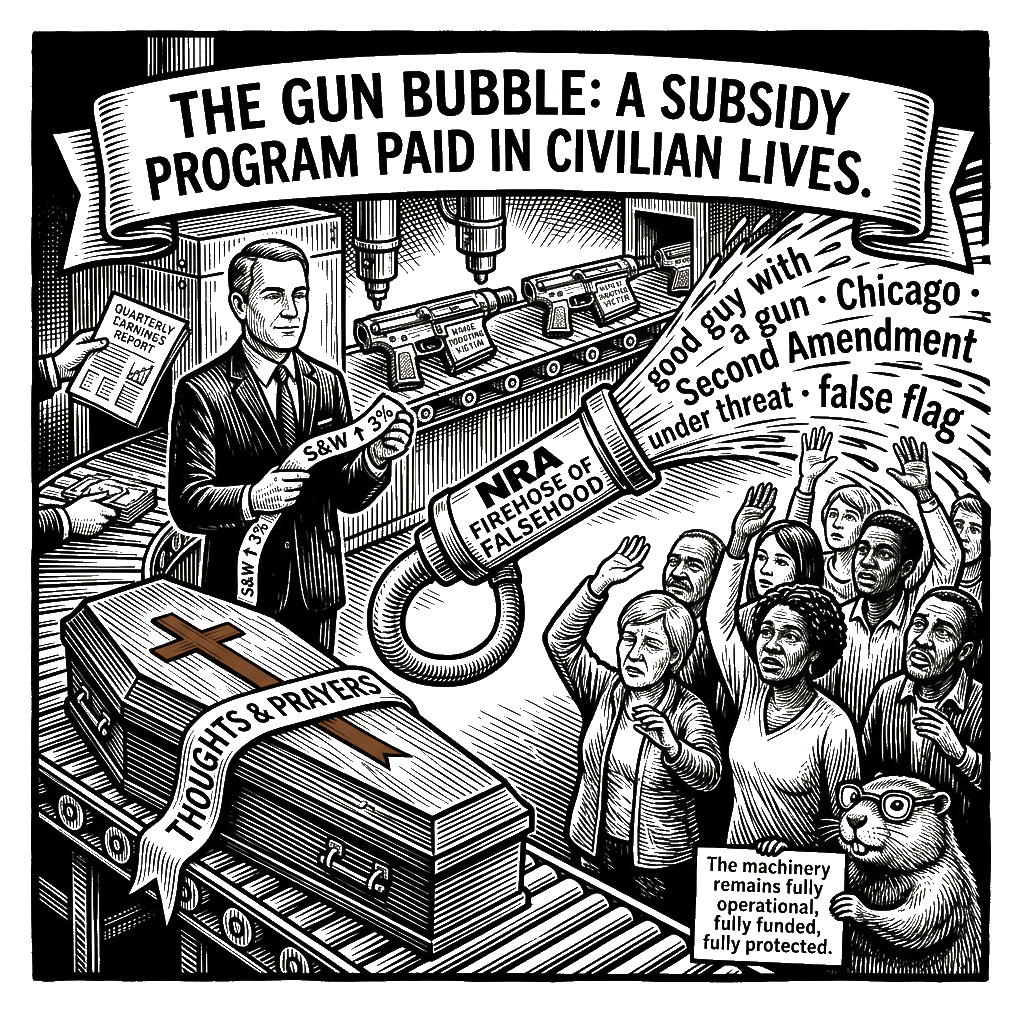
Do not accept the weather-report framing. The violence at the festival is not a meteorological event. It is the output of a policy architecture that was designed, funded at scale, and defended in the legislature and the courts by a concentrated donor class whose business model requires exactly this level of civilian slaughter. Trace the capital upward. The American firearms industry—Smith & Wesson, Sturm Ruger, the whole constellation of manufacturers and distributors whose trade association, the National Shooting Sports Foundation, lobbies to keep the bodies piling up—records a sales spike after every high-profile mass shooting. Fear moves product. The prospect of gun control moves product. The cycle is so predictable that market observers have called it the “gun bubble”: a massacre, a brief surge of public outrage, a spike in gun sales as the fearful arm themselves against the next one, and then the outrage dissipates and the industry pockets the profit. The United States is running a subsidy program for the arms industry paid out in civilian lives. Every politician who takes the donor-class check and then delivers the boilerplate “thoughts and prayers” statement at the next podium is executing a systematic, organization-wide discipline of agreed-upon language that manufactures the appearance of grief while performing exactly the legislative inaction the donor requires. The framing works by substituting a religious register for a political one—a deliberate move to shift the cognitive frame away from the legislative vote and toward a spiritual consolation that costs the politician nothing and costs the grieving everything.
When the framing is challenged, the apparatus defaults to presenting a manufactured choice between absolute constitutional liberty and total governmental confiscation, erasing the entire middle ground where the overwhelming majority of the public actually stands. The argument says you are either a patriot who defends the right to own a weapon or a tyrant who wants to disarm the population and enslave it. This is not an analytical claim; it is a procedural shield. It is the exact frame the lobbyist pays for because it makes a modest policy intervention—the closure of a private-sale loophole, the enforcement of a waiting period, the prohibition of a weapon explicitly designed for rapid mass casualty—look like the first step toward a gulag. The frame is a lie. The lie is documented. The lie is doing the work the donor paid for.
The catalog of techniques the National Rifle Association deploys is not subtle. It is the manufactured controversy of “good guy with a gun” against the overwhelming evidence that more guns mean more deaths. It is the whataboutism that points to Chicago every time a white gunman in a suburban school is the story, as if the slaughter of Black children in cities somehow excuses the slaughter of children anywhere. It is the flooding the zone with false claims that the Second Amendment is under imminent threat, that the government is coming for your guns, that every mass shooting is a false-flag operation—a “firehose of falsehood,” the term researchers Christopher Paul and Miriam Matthews gave in a landmark 2016 RAND report to a propaganda technique that overwhelms the public’s ability to discern fact from fiction, designed not to convince but to exhaust, to produce cynicism, to make the public give up on the possibility that anything can be done.
The late King, speaking at Riverside Church in 1967, warned us that a society which treats its own citizens as acceptable collateral damage for the preservation of a profit model is already in spiritual hospice. He was talking about the Pentagon budget and the napalm in Vietnam, but the diagnostic transfers without loss of force. A society that continues to arm its paranoia above its children, that continues to allow a single trade association to hold the legislative process hostage through a combination of campaign finance and manufactured terror, is approaching a spiritual death that no press release can mask. The numbers are a moral X-ray; you can read the country’s condition directly off the voting record of every representative who looked at the donor’s check and voted to keep the pipeline clear. King, in that same period, named the “giant triplets of racism, extreme materialism, and militarism.” The American gun crisis is all three, fused into a single instrument of death. Racism: the neighborhoods where these shootings are most frequent, where the daily toll of gun violence is treated as background noise rather than national emergency, are overwhelmingly Black and brown. Materialism: the quarterly earnings reports of the firearms industry are built on the bodies of those neighborhoods. Militarism: the weapons that dominate the civilian market—the AR-15 platform and its derivatives—were designed for the battlefield, and the industry’s marketing explicitly trades on the fantasy of military-grade lethality.
The remedies are known, and they are blocked by a specific, named coalition of senators and representatives who take money from the gun lobby and then vote as their donors require. Senator Mitch McConnell spent his career blocking gun legislation. Senator Ted Cruz has taken more than $440,000 from gun-rights groups, according to OpenSecrets, and responds to every mass shooting with calls for more guns. Senator John Cornyn, who occasionally postures as a compromiser, was a central architect of the 2022 Bipartisan Safer Communities Act—the weakest, most loophole-ridden piece of gun legislation imaginable, and it was celebrated as a breakthrough. These are the names. These are the people whose decisions made the Toledo shooting not just possible but inevitable. The deputy police chief, Joe Heffernan, told reporters that no arrests have been made. He did not say what every cop in America knows: that the gun used in the shooting was almost certainly manufactured legally, sold legally, and then flowed through the unregulated secondary market—the gun-show loophole, the private-sale loophole, the straw-purchaser loophole—into the hands of whoever pulled the trigger. The firearm industry has fought every effort to close those loopholes because the loopholes are not bugs; they are features.
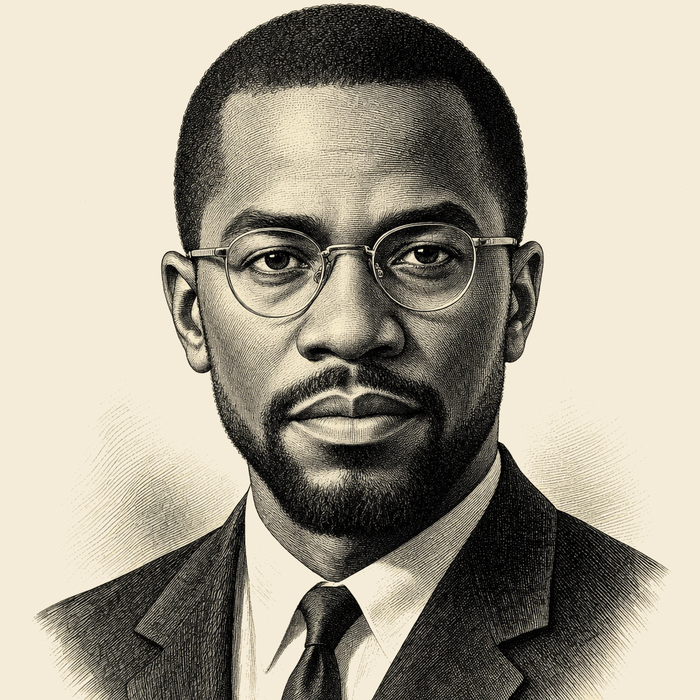
As Malcolm X taught, you do not take your case to the criminal. The gun lobby is the criminal. Its political servants are the criminal. The speaker who stood at the Audubon Ballroom in 1965, hours after firebombs had shattered his own home, refused to treat the violence as an isolated incident. He laid out the receipts. He named the apparatus. He said the structural diagnosis does not disappear because the target is comfortable. He traced the chain from the street-level harm to the institutional authorship that made the harm inevitable. We are bound by the same discipline when the target is an American institution and the harm is an American festival. The only adequate response is the one Malcolm named at the Audubon Ballroom in 1964: by any means necessary that are available to us—the means of political organization, of protest, of sustained pressure on elected officials, of divestment from the financial institutions that underwrite the gun industry, of building the kind of movement that makes the cost of inaction higher than the cost of crossing the NRA. The “by any means necessary” Malcolm X spoke of was not a call to violence; it was a call to seriousness, to the refusal to be confined by the methods preferred by one’s opponents. And the opponents here—the manufacturers, the lobbyists, the politicians who cash the checks—have made abundantly clear that they prefer thoughts and prayers because thoughts and prayers cost them nothing.
We must refuse the gradualism that asks the wounded to wait for the next election cycle while the donor class continues to purchase the next round of ammunition. The fierce urgency of this moment is not a rhetorical flourish; it is a structural fact. Every hour the legislature delays is an hour the pipeline remains open. Every vote that fails to close the loophole is a deliberate choice to externalize the cost onto the people standing at the festival. The arc of the moral universe does not bend by itself. It bends only when specific people, in a specific moment, apply enough force to overcome the counterforce of the gun lobby and its political machinery—when they break the joint that holds the apparatus upright. King knew this. He spent the last year of his life organizing the Poor People’s Campaign—a multiracial movement of the dispossessed—because he had concluded that moral appeals without organized power were insufficient. The movement King died building is the movement we still need: a coalition of the people who get shot and the people who refuse to accept that getting shot is the price of living in America.
The Beloved Community is not a destination. It is the direction the work points. And the work, this week, is to name the names—the manufacturers, the lobbyists, the senators—and refuse to let them hide behind the rituals of grief they have perfected. The gun lobby owns the blood in Toledo. The question is whether we will make them pay for it, politically and economically, until they can no longer afford to keep the killing going. We apply that pressure the moment the federal private-sale loophole is closed by statute—and we will not wait for the next vigil to demand it.