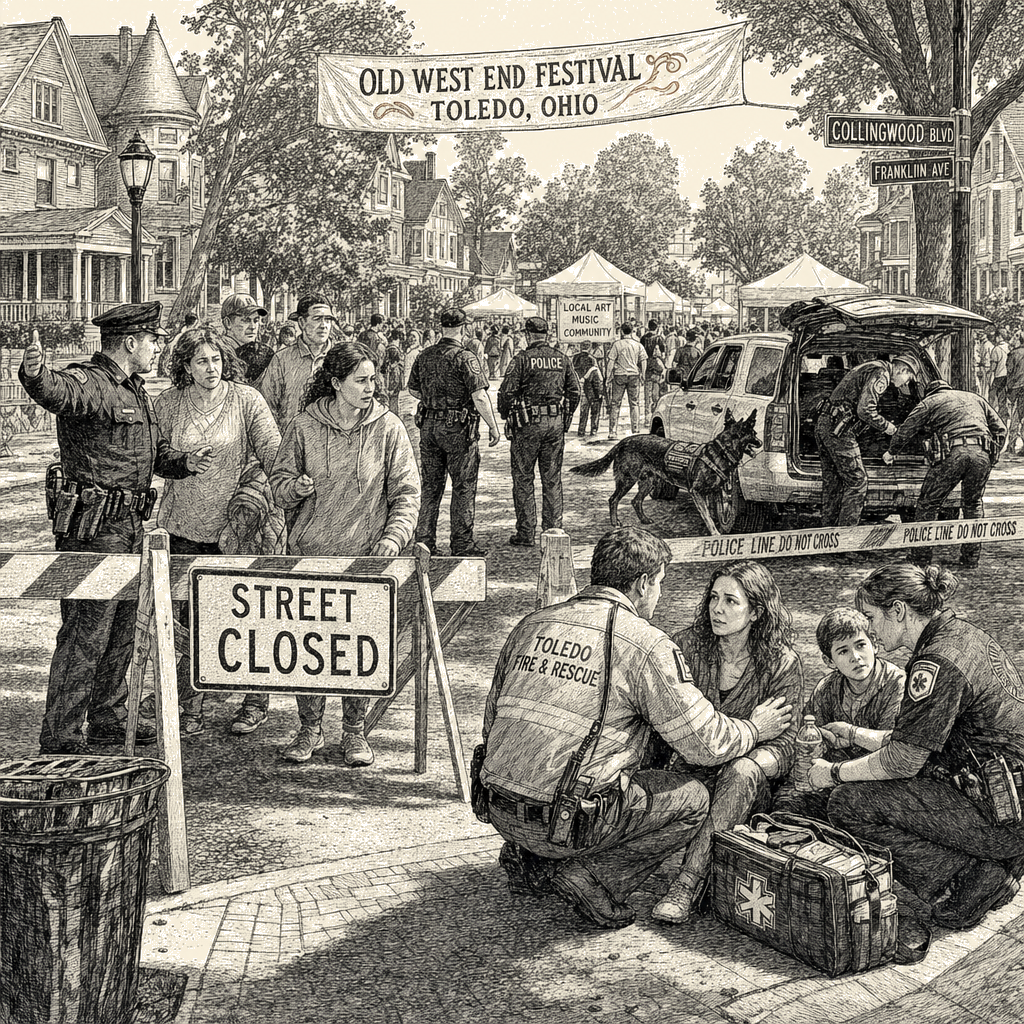
The gun lobby and its political servants made Toledo’s Old West End Festival a killing ground. On Saturday, police responded to gunfire near Delaware and Robinwood, found multiple shooting victims, and launched an active search for suspects still at large. A month earlier a lakeside party near Oklahoma City ended with one dead and twenty-two wounded. Before that, teenagers in Amarillo, students in Iowa. The specific intersections change. The structural pattern does not: a civilian gathering, an ordinary American attempt at community, and the sudden arrival of bullets that a concentrated legislative apparatus has chosen not to keep out of the public square.
The structural wrong is not a weather pattern. It is the result of specific people making specific decisions. The state lawmakers who draft the preemption bills, the committee chairs who kill the safety legislation, and the donors who fund their primary campaigns have constructed a revenue-collection apparatus that trades public safety for donor-class profit. They are not victims of a cultural accident; they are the named architects of a policy that floods the civilian environment with lethal capability because the market demands it and the donors demand the market.
Trace the chain. The National Shooting Sports Foundation, the firearm industry’s trade association, reported that the U.S. firearm industry made more than twenty-one million firearms available for the U.S. market in 2021. That volume is not accidental; it is the intended output of a political system engineered to ensure that any person with a pulse and a grievance can obtain a weapon capable of killing a crowd in seconds. Every one of those weapons represents a sale, a profit margin, a quarterly return, and a campaign contribution. The blood is on the pavement in Toledo; the benefit is concentrated in the bank accounts of a small number of people who will not be asked to clean it up.
The political mechanism is not invisible. In Ohio, the Republican-controlled legislature has spent years stripping away any impediment to firearm access. Permitless carry became law in 2022 via Senate Bill 215; local governments are legally barred from passing their own gun regulations under a firearms preemption statute that the legislature has strengthened repeatedly. A city like Toledo cannot require a festival’s permit to include crowd-safety restrictions on firearms, because the state has made it illegal to do so. The National Rifle Association, even weakened by corruption scandals, still funnels millions into state-level races, and its successor organizations function as a conveyor belt translating industry cash into legislative votes. This is not negligence; it is affirmative policy, built and maintained by named elected officials who have taken the money.
The response cycle after a festival becomes a casualty list is a practiced two-step. Step one: “thoughts and prayers,” a sentiment diversion that substitutes emotive performance for action. Step two: declare that it is “too soon” to talk about policy, a temporal deferral that exploits the news cycle to drain the window for legislative pressure. Both are the red-herring pattern the bad-faith-techniques catalog identifies — the introduction of irrelevant material to divert attention from the issue at hand. The prayers, sincere or not, are irrelevant to how the shooter obtained the weapon. The “too soon” move, repeated after every shooting, is a calculation that if the policy conversation can be delayed by forty-eight hours, the public’s attention will move and the window will close. The gun lobby has spent decades refining this rhythm. The mourning phase buys time; the deflection phase drains energy; the window closes; the next shooting opens it again. The people who run this machine are disciplined and effective.
The cost-bearers are, as always, the ones this column is built to defend. Toledo is a majority-minority city with a poverty rate near twenty-four percent — nearly one in four residents. The festival was a community event in a historic district that has survived deindustrialization, disinvestment, and the same concentrated-poverty dynamics that make violence predictable in every American city hollowed out by the flight of capital. The victims are not yet named, but the geography of gun violence maps onto the geography of structural neglect. The same streets that lack jobs, grocery stores, and functional schools are the streets where the guns are most available and the police response is most paramilitary. The cui-bono trace surfaces the donor who profits from the weapon and the politician who profits from the donor; the cost trace, followed down, surfaces the family that will bury a child tonight in a neighborhood that has been abandoned by every institution supposed to protect it.
Martin Luther King Jr., at Riverside Church in 1967, named the triple evils of racism, extreme materialism, and militarism as a single interlocking pathology. The gun industry is the clearest domestic expression of all three: it markets its products with racist imagery of urban threat; it pursues profit as its sole organizing principle; and it militarizes civilian life to a degree that any honest observer would call a low-intensity war. King’s call for a “radical revolution of values” was structural and unsentimental. Genuine public compassion does not consist of holding vigils for the casualties of a broken machine, nor of managing the damage with underfunded social programs after the shooting has occurred. The real work is restructuring the edifice that keeps producing funerals in the first place. The legislature that permits the donor apparatus to write the firearm laws is the same legislature that permits the apparatus to write the labor laws and the housing laws. The machinery is one machine.
Tyranny requires constant effort, as the resistance manifesto in Andor put it; authority is brittle, and it leaks. The same is true of legislative paralysis in a democracy. The gun-violence epidemic does not sustain itself; it is sustained by the relentless, heavily funded legislative effort required to block the regulatory measures the public broadly supports. It requires constant donor money to bribe the committee chairs, constant dark-money threats to primary any legislator who wavers, and constant legal warfare to strike down local ordinances. The apparatus is working exactly as it was engineered to work: it takes the public’s outrage, metabolizes it into committee hearings, and returns the status quo.
The prophet Amos, whom King quoted relentlessly, said to let justice roll down like waters and righteousness like an ever-flowing stream. The stream in Toledo is running with blood this morning, and the people who profit from the flood are still writing the laws that keep the water coming. The Beloved Community that King preached is not a fairy tale; it is the standard against which every policy, every budget, and every legislative vote is measured. A community in which a music festival does not become a killing field is possible — other nations have built it, and the evidence is not ambiguous. The obstacle is not feasibility. The obstacle is a political apparatus that has been paid to treat the preventable deaths of its own constituents as the cost of doing business. The arc of the moral universe does not bend on its own. It is bent by people who refuse to let the conversation be delayed by another cycle, who name the apparatus by name, and who demand that the people who made these deaths predictable be held to account. The gun lobby made this festival a killing ground. The naming is the column. The rest is what gets done after the naming.