
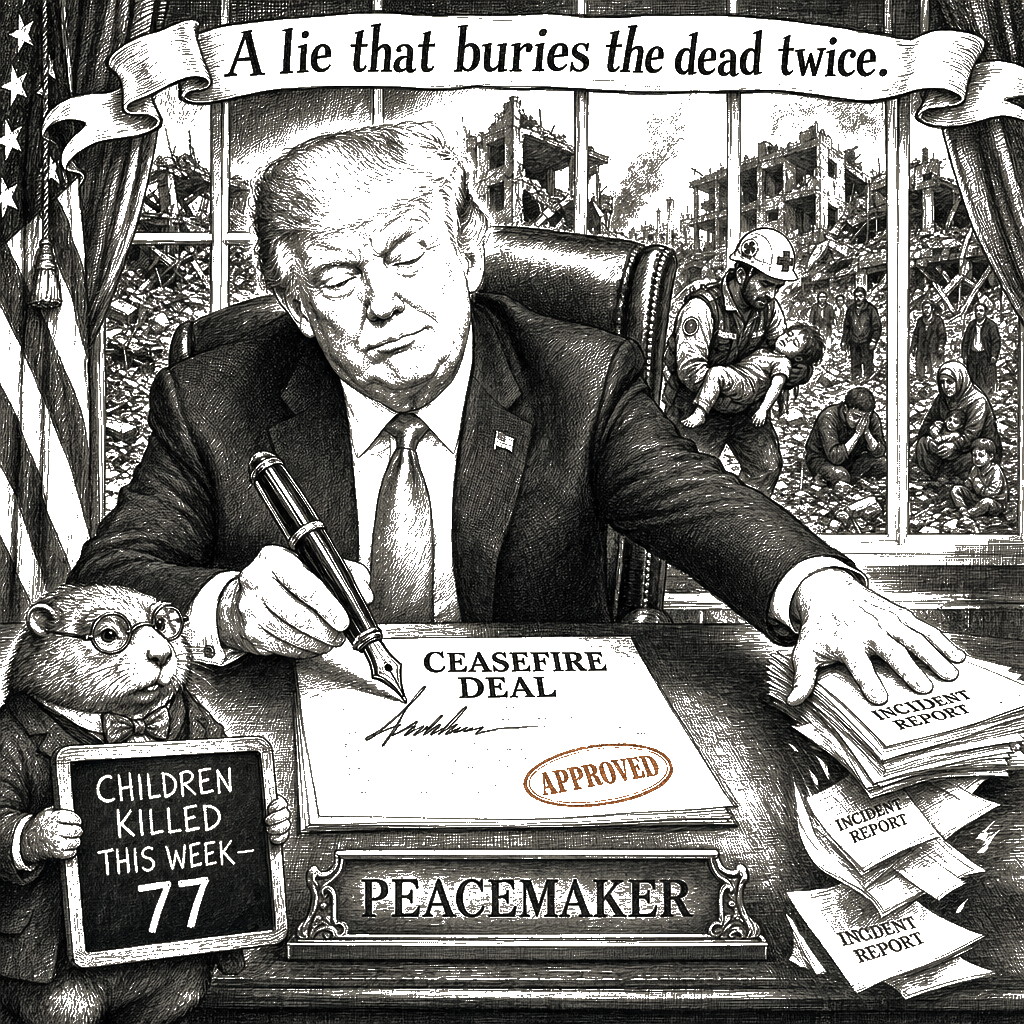
Donald Trump is killing civilians across the Middle East and calling it diplomacy. The president who professed to being “a little bit perturbed” by Israel’s assault on southern Lebanon has spent months fueling the very wars whose civilian death tolls he now disclaims. And the numbers are no abstraction — 77 children killed or wounded in Lebanon in the last week of May alone. Over 3,400 dead inside Iran since the U.S. bombing campaign began in February. A school in Minab reduced to rubble with more than 100 children inside. This is not the work of a bumbling negotiator. It is the predictable outcome of a foreign policy that has substituted brute force and amateur deal-making for any serious peacemaking. The operational tempo — the relentless pace at which a military consumes resources and generates demand — never stops. Only the press releases do.
It is a clean 0-for-3: Ukraine, Iran-Lebanon, Israel-Palestine. In Ukraine, Trump’s petulant siding with Moscow and his dispatch of clueless envoys — Steve Witkoff and Jared Kushner, who have still not set foot in Kyiv — handed Vladimir Putin every advantage he needed to stall and strike. The Kremlin read the amateur hour instantly and acted accordingly. Now, with Trump’s interest evaporated, a weakened Zelenskyy is left proposing a ceasefire the Russian leader can safely ignore while artillery continues to tear through Ukrainian neighborhoods. The diplomatic void is not an accident. It is the plan.
The gap between actual diplomacy and this administration’s slapdash instincts is the distance between a professional envoy like Richard Holbrooke, who helped settle the Bosnian war by sitting across tables for months, and the Sunday-park calibre of Witkoff and Kushner, who treat sovereign conflicts like distressed real estate portfolios. The administration’s casual disregard for the craft of peacemaking — sidelining European allies, chasing quick wins, reducing negotiation to a market-moving soundbite — has produced a cascade of broken ceasefires from Gaza to the Gulf. The Strait of Hormuz remains largely shut, choking global shipping, because Trump’s Iran ceasefire was a press-release fig leaf that satisfied none of the objectives he set. Violations occur daily. The half-hearted talks through shadowy third parties lead nowhere. Trump overestimated the power of brute force to change political reality, and underestimated the one thing that matters: a permanent crisis in which civilians pay the toll.
The current escalation across the Middle East follows a procurement logic that is older than this administration but finds its purest expression here. Andrew Bacevich warned decades ago that when Washington confuses military dominance with political wisdom, the result is a closed loop of violence that sustains itself by consuming the very populations it claims to liberate. Dwight Eisenhower told us in 1961 that the conjunction of an immense military establishment and a large arms industry carried an unwarranted influence, and that the potential for the disastrous rise of misplaced power must never gain weight. Sixty years later, that complex does not need unwarranted influence. It has total execution authority. When a theater like Iran produces thousands of dead and tens of thousands of wounded, the defense apparatus does not register it as a failure of strategy. It registers it as a demand signal. The Pentagon buys more munitions because the conflict creates a permanent market for them. Airstrikes on Nabatieh or the suburbs of Tehran are not tactical maneuvers meant to secure peace. They are industrial throughput.
Michael Walzer’s just-war doctrine establishes that proportionality and discrimination are the absolute baseline for any claim to legitimate force. That baseline has been erased here. The Minab primary school bombing on 28 February — where U.S. forces allegedly killed more than 100 children — and the relentless bombardment of Lebanese villages are not collateral damage. Unicef reports that in the last week of May alone, 77 children were killed or injured in Lebanon — 77 reminders that ceasefires are not self-congratulatory political theater but urgent matters of life and death. These deaths are not accidental byproducts of warfare. They are the direct output of a doctrine that treats civilian life as a rounding error in a grand-bargain negotiation. The machinery does not distinguish between negotiation and slaughter because it requires both to survive. The administration signs documents while the ordnance moves, because the system feeds on the interval between the signature and the strike. Civilians die in the gap.
In Lebanon, as Israel and the government agree to renew a ceasefire that was never observed in the first place, the administration’s diplomatic void is filled by Marco Rubio, a secretary of state who is smoothly ambitious and untroubled by principle. He stands back from the fray, telling the president he is right when he is wrong, while Hezbollah, excluded from peace talks by their U.S. hosts, rejects the latest ceasefire. No one in Washington seems surprised. Such fecklessness is not an aberration. It is the operating logic of a White House that treats diplomacy as a reality-show subplot — a logic that produces one inescapable result.
Dead children. The U.S. military’s own reported civilian casualty figures, fragmentary as they are, make plain that the distinction between combatant and civilian has collapsed under the weight of a bombing-first policy. This is not a failure to avoid civilians. It is a systematic disregard for their lives, a willingness to accept their deaths as the cost of appearing tough. A president who presides over airstrikes that kill children is not a peacemaker. He is a killer. Claiming he seeks peace while children are blown apart is not a contradiction resolvable by more spin. It is a lie that buries the dead twice.
The answer is not a better negotiator. It is to stop dropping the bombs. That remains the one step this administration will not take. So the ceasefires will keep breaking, and more children will die, and Trump will keep talking about his Nobel Prize. The rest of us should call the ledger what it is — a body count dressed up as statecraft, and a president who presides over it with the casual indifference of a man who has never had to look at what his signature costs.