
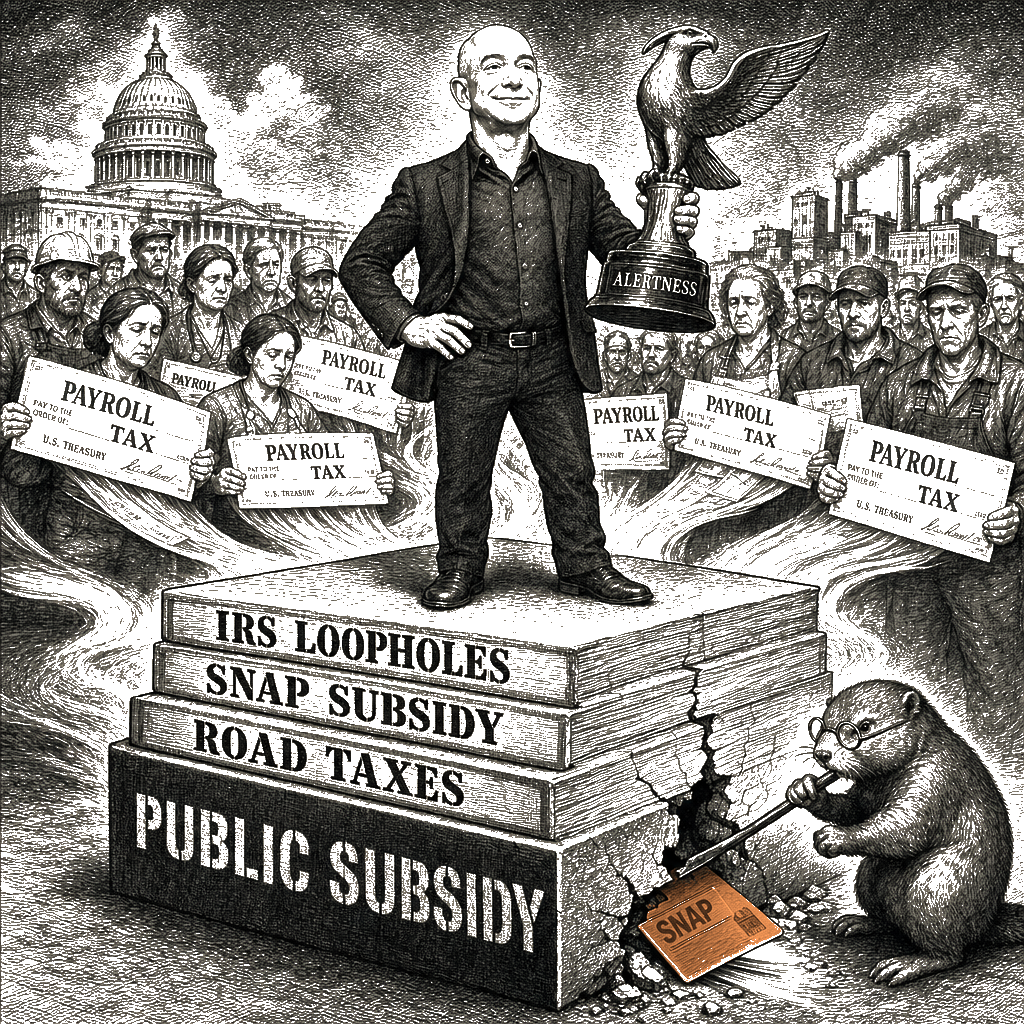
Jeff Bezos’s fortune is not a reward for alertness. It’s a public subsidy so vast it could fund universal pre‑K for a decade — and the rest of us wrote the check. In “A Moral Case for Jeff Bezos’s Wealth”, published by National Review on June 6, 2026, Marian L. Tupy argues that Bezos earned his riches through entrepreneurial insight, that taxpayers can’t claim a cut because they already paid for the roads and the internet, and that even Bezos’s innate talents are his own. The argument is clean, confident, and leaves out exactly the question it needs most.
I’ll grant what the piece gets right. Amazon saved its customers time and money. Bezos saw something most people missed. The company’s logistics were genuinely impressive. But the moral case collapses the second you ask the question the column is built to dodge: Who actually paid for this?
The first omission isn’t the internet; it’s the tax code. Tupy writes that public inputs were “funded by taxpayers,” so the state gets no second bite. The problem is, Jeff Bezos often wasn’t one of those taxpayers. ProPublica’s IRS data showed he paid zero federal income tax in 2007 and 2011 — years he was already a multibillionaire. The piece leans on a concept from the economist Israel Kirzner: “entrepreneurial alertness.” I love that phrase. It sounds like a birdwatcher spotting a rare warbler, not a man building an empire on paychecks you’d need a telescope to see. Alertness didn’t write the tax code that let Bezos pay nothing while nurses and teachers funded the roads his trucks use. You can’t argue “the public already got paid” when the richest man on earth didn’t pay. That’s not a moral case; it’s a moral dodge.
The second omission is the labor subsidy. Amazon’s warehouse wages are low enough that many workers need SNAP and Medicaid. In 2018, the New Food Economy reported that in five states Amazon was among the largest employers of food-stamp recipients. The taxpayer is topping off Bezos’s payroll every month — a direct transfer from the public to a single company’s bottom line. When Tupy says Bezos “exercised his endowments productively,” he’s leaving out the part where the productivity depends on the rest of us filling the gap between what Amazon pays and what it costs to live. The cost isn’t on Amazon’s income statement. It’s on yours. Anyway.
Then there’s the ownership structure. Tupy treats Bezos as the sole author of Amazon’s value, a lone genius to whom the gains naturally flow. But Amazon’s value was built by hundreds of thousands of people — many of whom get no equity, no share of the upside, just a wage and a quota. In a worker cooperative, those gains would be distributed among the people who created them. At Mondragon, the pay ratio between the top and the bottom is around 5 to 1. At Amazon, the ratio between Bezos’s net worth and a warehouse worker’s annual pay is about 200,000 to 1. That gap is not a law of nature; it’s a set of legal and financial choices, and the choices are the news.
Then comes the most elegant dodge in the piece. Tupy acknowledges Bezos didn’t earn his native intelligence, drive, or luck, but because his attributes are inseparable from him, the returns belong to him. So if a billionaire’s brain is his own, but his fortune required tax-funded infrastructure he didn’t pay for, remind me again who else wrote the check? The question isn’t who “owns” Bezos’s brain. It’s why a society should let that brain capture nearly a quarter-trillion dollars while the people who stock the shelves rely on food stamps. You can believe in private property and still want a tax code that doesn’t treat a billionaire’s gains more gently than a mechanic’s wages.
So what gets built instead? The simplest fix is the one we already tested. In 2021 we expanded the Child Tax Credit. Child poverty fell by nearly half. We know what it costs to lift kids out of hunger, and it’s a rounding error on a single Bezos‑sized fortune. Fund that permanently by taxing extreme wealth the way we tax work — treat billions in stock gains as income, not as an untouchable asset class. Require companies that depend on public subsidies — in the form of low‑paid workers on public assistance — to reimburse the public for the cost, or better yet, pay a wage that doesn’t require the subsidy. And let workers own a share of the companies they run: ESOPs already cover 15 million Americans, and they aren’t exactly Bolshevik cells.
If Tupy disagrees, he can show me the tax returns and the payrolls. Until then, the moral claim is hollow. Bezos’s alertness is real. So is the extraction. A decent society notices both, and builds from the truth, not from the half.