
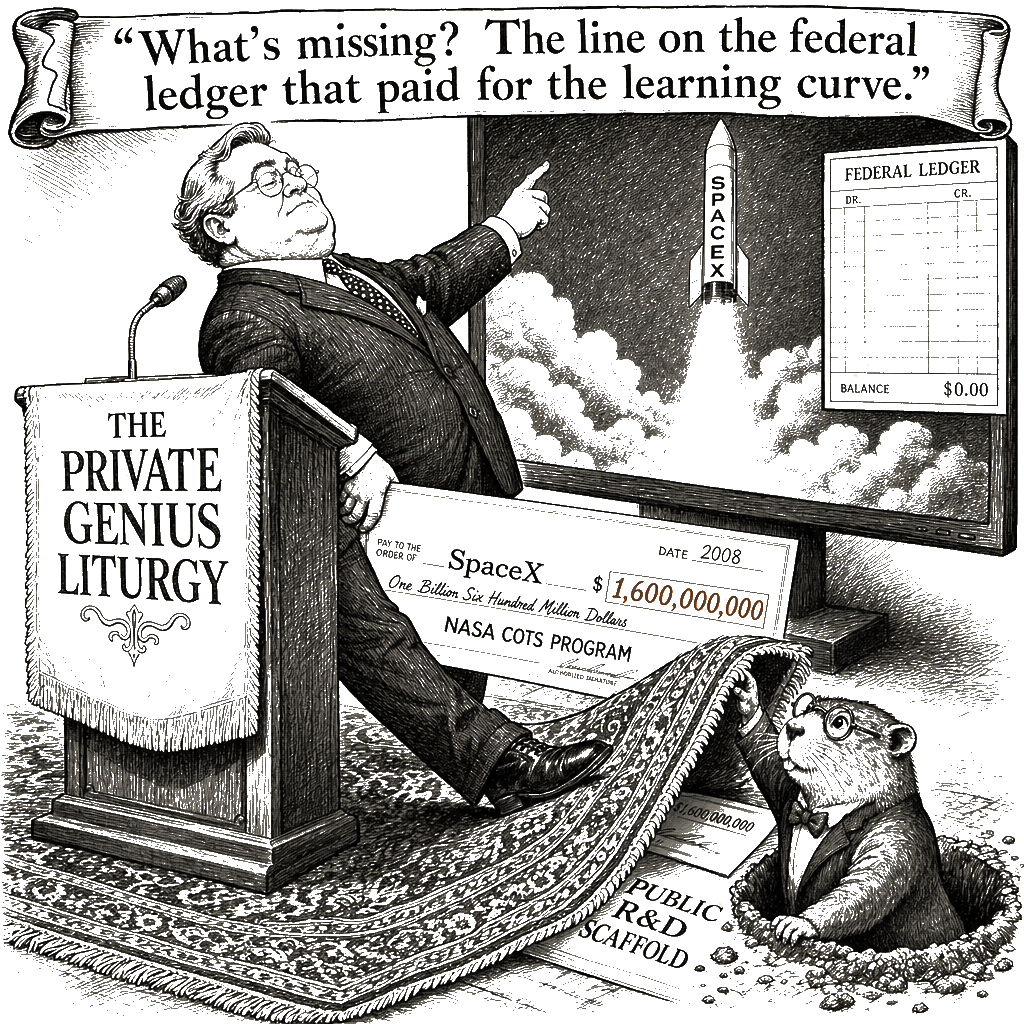
Ryan Whitley wants you to believe that America’s next giant leap depends on the freedom to blow up rockets. The last one depended on a check the public wrote. In “Space to Fail”, published by National Review on June 4, Whitley argues that a risk-averse NASA culture is the real obstacle to progress, and that the recent Blue Origin explosion is just the price of admission for the “fail-fast-forward” innovation SpaceX has perfected. It’s a clean story: private-sector genius runs circles around bureaucratic bloat. It’s also the same story the comfortable tell whenever they need the public to forget who paid the bill.
I’ll grant what Whitley gets right. Rapid iteration and the freedom to blow up a rocket without ending a program is a genuine innovation engine. The “failure is not an option” culture that calcified after Apollo 13 was a real drag, and the distinction between that mindset being appropriate for a live mission and poisonous for development is a good, clear point. None of this is false.
But the second you frame this as a fable about private-sector audacity versus government sclerosis, you’ve told a half-truth so loud it drowns out history. What’s missing from the story is the line on the federal ledger that paid for the learning curve. Whitley writes that SpaceX “learned faster than anybody else in the industry,” and that’s true. He does not write that in 2008, the company’s survival was bought by a single, critical $1.6 billion NASA contract for cargo resupply flights. The “rapid do-learn loops” of Falcon 1’s early failures weren’t funded by an infinitely tolerant VC with a passion for orbital mechanics. They were funded by a NASA contracting approach, the Commercial Orbital Transportation Services program, that explicitly socialized the R&D risk. The public wrote the check for the explosions. Without 2008, there is no Falcon 9. Without Falcon 9, there is no Starlink. The agency the piece dismisses as a museum of “known legacy hardware” is the reason his hero didn’t close. Anyway.
This is the catechism of the comfortable at work: private innovations are acts of heroic genius; public investments are vacant line items. The argument proceeds by treating the government as a burden to be escaped, not the foundational partner it has always been. The microchip inside your smartphone was born from the Apollo Guidance Computer, a NASA-MIT partnership. The internet you’re reading this on was a DARPA project. Commercial aviation, jet engines, and the entire satellite communications infrastructure that makes “new space” capital flows possible were all built on a vast, patient, federal R&D scaffold. The private sector, given a working, de-risked platform, can commercialize it with breathtaking speed. But treating the platform as if it emerged from a garage isn’t insight; it’s the private-genius liturgy, and it requires historical amnesia to recite.
Then there’s the other balance sheet the fable omits — the one belonging to the company that actually did explode. Blue Origin is not a bootstrap start-up eating ramen and iterating toward glory. It’s a company that has been steadily funded by Jeff Bezos for over two decades, with an initial annual investment described by Bezos as selling roughly a billion dollars in Amazon stock per year to fund it. Whitley’s article mentions this in passing: “who has been working on a large robotic lunar lander for many years on its own dime.” But the point is not whether it’s a literal dime. The point is what kind of dime. A dime from a quarter-trillion-dollar fortune built on labor practices that required the public to pick up the tab for food and healthcare isn’t a private risk in any meaningful sense. The cost was externalized long before the rocket left the pad. The billion-dollar-a-year patience that allows Blue Origin to “fail-fast-forward” is a luxury purchased by subsidized wages and untaxed capital gains, not just a plucky tolerance for explosions.
So let’s talk about the real, working lesson from the space program, because it’s not “leave it to the billionaires.” The lesson is that a specific institutional arrangement — a capable, mission-driven public agency acting as an architect, funder, and demanding customer — can deploy a mix of public and private entities to achieve a goal thought impossible. NASA didn’t just sign a check and step back. It specified the problem so clearly and held the technical milestones so ferociously that a scrappy company could solve it. The agency provided the vision, the funding, and the technical standards. The contractor provided the ingenuity and the speed. This is social democracy with a trajectory, not a master plan. It’s a model, and it works for things that are not rockets.
What gets built instead? The same model can be applied to the missions our economy treats like abandoned Apollo programs. Childcare is one. An affordable, universal system where the math doesn’t crush workers or parents is the rocket no single market actor will ever build on its own — but a public mission, with clear specs and funded contracts with local cooperative providers, can make it fly. The energy transition is another. The public sector already did the initial R&D on photovoltaics and battery storage; it just hasn’t been given the mission lead to buy down the deployment curve the way NASA bought down the launch-cost curve. Instead of writing another tax break for a developer and hoping for the best, the Treasury could fund state-level public banks — modeled on the century-old, consistently profitable Bank of North Dakota, in the black since 1919 — to provide patient, low-cost capital for community-owned energy co-ops. That’s how you do a “rapid do-learn loop” on grid modernization without asking a family to bet their pension on the outcome.
The private sector, given a working, de-risked platform by the public sector, commercializes with breathtaking speed. The story of SpaceX is the proof. An honest reading of the receipt doesn’t minimize the spectacular risk and talent of the people inside the company. It simply adds the line item the fable leaves out. The innovation was real. So was the check the public wrote to make it possible. A society that can see both is the society that can decide to fund the next mission on purpose.