
If you sort kids into different life paths when they’re twelve years old, you have committed a sin in the American educational catechism. We recoil from it. We are horrified by the idea of testing a middle-schooler and deciding they aren’t bound for a university. And yet, while the Dutch track twelve-year-olds and build a floor under them, we refuse to track them, keep them in the same classroom for six years, and build a cliff instead. The Netherlands has a “not in education, employment, or training” rate among 18‑to‑24‑year‑olds of 4.9%. In the United Kingdom, it’s 15.1%. The United States doesn’t track its own disconnection rate with any consistency—which is its own indictment—but every available yardstick shows we produce a larger crop of disconnected young adults year after year than the Dutch do, and we spend less effort tracking the damage. The Dutch have decided, as a matter of policy, that a young person with no qualification and no pathway is a system failure. We have decided to call it the weather.
Let me concede the honest half first, because it’s real. The Dutch model is not frictionless. Sorting children into academic, pre-vocational, and vocational tracks at age twelve is a blunt instrument, and blunt instruments leave bruises. Some educators are right to point out that early streaming can damage confidence, especially for kids placed on the lower tracks; a twenty‑year‑old named Amelie in The Hague was told at age ten to pursue the vocational route, and she says it took a toll on her. If that was the whole story—if the Dutch just streamed a kid at twelve, handed them a textbook in carpentry, and told them to enjoy it—the system would be a machine for reproducing class stratification. The critics have the moral high ground on the risk, and I am not here to take it away. Yes, the Dutch system leaves bruises—but a fracture is worse, and that’s what our refusal to track guarantees.
But the American critique always makes its true point and then stops. We name the bruise and walk away, implicitly telling ourselves that our alternative produces better outcomes. It produces nothing of the kind. What we produce is a cohort of eighteen-year-olds who have sat in the exact same chairs as their future neurosurgeons, learned to hate the subjects they aren’t good at, and aged out of the system with a high school diploma they cannot monetize. The reason the Dutch 4.9 percent number works is not that their sorting is flawless. It is that they pair the sorting with the kwalificatieplicht—a legal requirement that forces the state and the kid to stay engaged until a qualification is earned or the kid turns eighteen—and they build the plumbing underneath it.
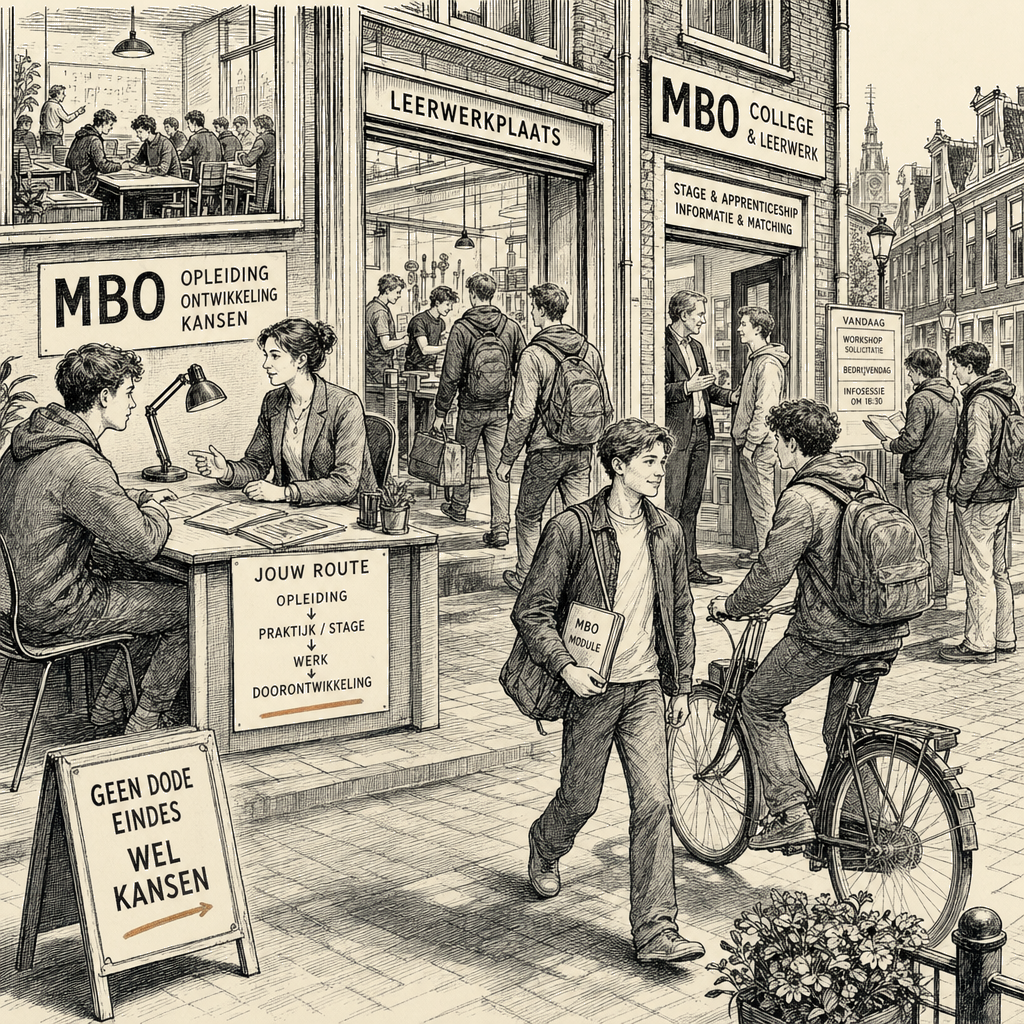
Follow the cost of what they built. Schools in the Netherlands don’t get a single budget for “education” and get left alone with the kids who don’t like algebra. They get layered funding for health and wellbeing, which they use to hire intervention teams. This is a plumber’s blueprint: when a student starts drifting, a local outfit like the Mooi Jong Academy steps in as the net that catches the kid before the drain. Truancy logs trigger conversations with specialists, not automatic suspension letters. At sixteen, a kid who is done with the traditional classroom can enter the beroepsbegeleidende leerweg, the Dutch work‑study pathway: they work most of the week, they go to class one or two days, and businesses request customized college programs because they need the workers. This is infrastructure, not paradise—the Dutch admit youth unemployment is rising enough that the government had to have its benefits agency, the UWV, ease access to support anyway. The point isn’t that the system is flawless. The point is that the vocational track isn’t a consolation prize. It’s a paycheck. When a Dutch kid falls off the academic path, they hit a vocational net that pays well enough to be called aspirational.
That is the suppressed variable in the American argument. We think the problem is the tracking, so we refuse to differentiate, and our alternative to a university track is… what? A low-wage shift at a logistics warehouse we euphemistically call “the real world”? The U.S. youth NEET rate consistently hovers around 12 percent, far closer to Britain’s grim cliff-edge than to the Netherlands’ floor. We refuse the twelve-year-old test because we want equity, but we deliver abandonment and call it the comprehensive high school.
The catechism fires back: “We can’t compel kids to stay in school past sixteen—that’s statist.” “Vocational education is a consolation prize for the kids who can’t cut it.” “Europe is small and homogeneous; it wouldn’t work here.” The catechism is a weather report, and it’s wrong on every count. The United States already runs a massive, if underfunded, career and technical education system. We already have apprenticeship programs in construction, manufacturing, and healthcare. We already have a post‑secondary system—community colleges, technical institutes—that could, with the right investment, become the flexible pathway the Dutch have built. The missing piece is not the machinery; it’s the will to stop treating the million‑plus young Americans who disconnect every year as a natural catastrophe.
Walk me through the obstacle. The Dutch spend public money to catch a kid before she disappears. They log the absence and send a person, not a letter. They make staying in the system the default, and the system is designed to be something a kid can actually stand to stay in—a textiles class, a blacksmithing area, a paid job that counts as school. The result is a youth disconnection rate that is a fraction of what it is in the United Kingdom, a country that has spent the last decade wringing its hands about the same problem while systematically underfunding the youth services it claims to champion. The Dutch are not a miracle; they are a policy choice.
The reason it’s harder here is real, and I’ll say it plainly. The American education system is fifty different systems, funded by local property taxes, and the federal government cannot compel a national curriculum or a national school‑leaving age. The stigma against non‑college pathways is deep, and the advocates for the “college for all” gospel have, for decades, treated vocational education as a dumping ground. But the obstacle is not the same as the excuse. We can build the pathways without a federal mandate. States can raise the compulsory school age, as several have already to eighteen. We can fund career and technical education at the level we fund the football stadium. We can attach the paycheck to the diploma, as the Dutch do, and we can stop pretending that a third of students feeling their degree wasn’t worth the debt is a personal failing rather than a system telling them the truth.
The Dutch blueprint is not a carbon copy. The American version will be messier, more decentralized, and slower to build. But the core insight—that a disconnected young person is a policy failure, not a demographic inevitability—is transportable. The proof is the 4.9% rate they have and the multiples we have. The difference is not a moral one; it’s a set of choices. Somebody made the decisions that gave Britain a 15.1% disconnection rate and the Dutch a floor. We already know how to build the floor. We just haven’t decided to pay for the concrete.