
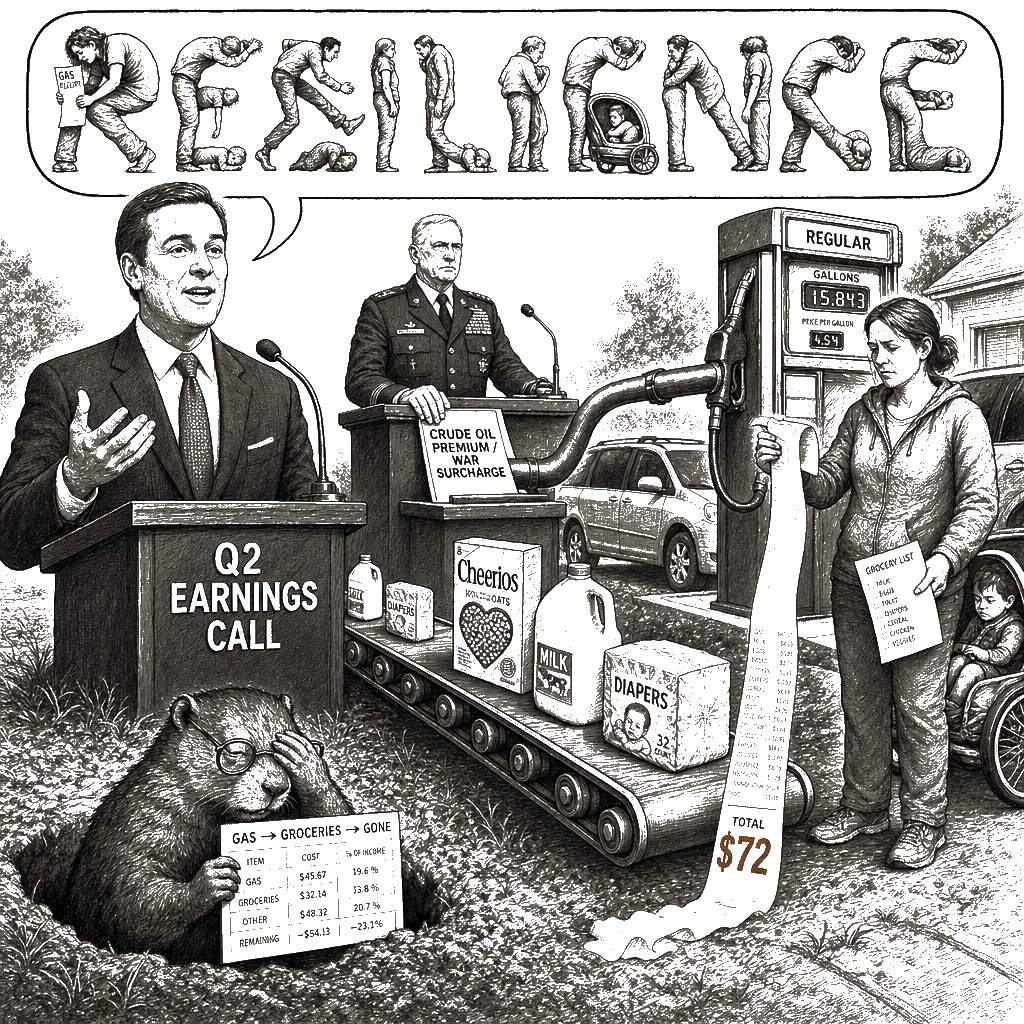
Last month I filled the tank on the Honda, and the receipt came to $72. The month before that, same station, same pump, it was $66. That difference is ten bucks. Ten bucks is a box of Cheerios and a gallon of milk, or two packs of diapers if I buy the Target brand. John David Rainey at Walmart called it “resilience” on the earnings call. Chris Kempczinski at McDonald’s, Todd Vasos at Dollar General, and Costco’s Gary Millerchip all reached for some version of the word — “pulling back,” “careful,” “trade-down,” “uneven.” The National Association of Convenience Stores’ Jeff Lenard explained it as buying less per visit, switching to cheaper stations, consolidating trips, because the pump price was forcing the arithmetic. The Pentagon and Walmart executives are bleeding working families to feed the war, and they are calling the blood loss a consumer adaptation.
Anne Helen Petersen’s Can’t Even diagnosed the underlying metabolic trap years ago: a cohort told to convert administrative and financial exhaustion into a personal virtue, and doing it because the alternative is not surviving a quarter. Taylor Swift’s “I Can Do It With a Broken Heart” is the exact diagnostic instrument for this moment because the song is a labor text about a worker whose performance of solvency is the thing keeping the lights on. The speaker is miserable, but she is “the best at it,” performing the nightly act because the alternative is cancellation of the contract and loss of the paycheck. When a corporate executive praises consumer resilience, he is praising the household’s willingness to keep performing the broken-heart act while the gas tank fills with cheaper fuel and the credit card bill posts in the other tab. He is praising the refusal to stop spending money the household does not have.
The tax-refund checks that arrived in spring masked the bleed for exactly as long as they took to clear. As our coverage has already tracked since shoppers began cutting back in April, the checks are gone and the cumulative weight of elevated gas, food, and insurance costs has hit the bottom tier of the income ladder first. The EIA’s weekly petroleum status report shows a forty-cent-a-gallon jump since the war started, and that translates to about forty dollars a month our household didn’t plan for — the difference between buying the replacement bike trailer for Ben’s daycare transport or wedging him back into the too-small one for another two weeks. The parents at drop-off in the parking lot have been talking about gas in the morning, a sentence I didn’t think I’d be writing in 2026. One neighbor adjusted her pickup schedule so she only makes the drive four times a week instead of five. Another local dad canceled his gym membership, not because he doesn’t need it, but because the membership and the extra trip occupied the same mental budget column as the fuel surcharge. He is now running in the dark after the kids are asleep, a choice between two different kinds of exhaustion.
The convenience-store data and the retail earnings calls line up with what Pew has been measuring for a decade: roughly four in ten millennials and Gen Z adults consistently say it is harder to feel financially secure than their parents at the same age, and the line has not bent. The war premium on crude oil is the structural shock layered on top of wage stagnation, and the executives’ “careful choices” language is a polite way of describing what a middle-class family does when the discretionary column hits zero. You do not go to the furniture store. You buy fewer groceries. You consolidate errands to save a dollar at the pump. You skip the meal out. You stare at the receipt pile on the counter, which is taller now because I am saving them — partly out of habit from my mother, who saved receipts her entire adult life, and partly because I need to see where the money is going before it leaves.
I am writing from the structural privilege of a household that received a grandmother’s estate toward a down payment, and even this anchor does not absorb a Pentagon-set gasoline premium without triage. My parents ran their household in Lansdale on my father’s single USPS salary, and the St. Stanislaus parish women’s sodality organized the heating-oil fund because the corporal works of mercy were operational infrastructure, not an abstract theological concept. The parish network caught the families who fell through the cracks of a local economy that was already contracting; it did not have to catch them when the federal government was actively setting the price of gasoline on fire. Heather McGhee’s drained-pool thesis did not just close community swimming pools in New Orleans. It drained the household buffers that kept a war premium from becoming a starvation event, and now a skipped tank fill-up is the difference between buying groceries for the week or waiting for the next pay period.
The retail analyst quoted in the AP piece called the pullback “uneven,” which is a polite way of saying that if your household was stretched before the war, it is now being pulled apart from the same corner that has been pulling it apart for two and a half years — the energy and food corner, the things you cannot cut, the items that are not optional no matter how many household budget lists start with “cancel the streaming services.” I don’t have a streaming service to cancel. I have a gas tank, a childcare invoice, and the same grocery list my mother used to fill on ninety dollars a week at the Lansdale Acme.
One big car repair, one pediatric emergency-room co-pay, one month where the gas price jumps another dollar instead of forty cents, and the adaptation stops being a micro-adjustment and becomes a crack. The economists in the AP piece called it a “wider retrenchment.” The kitchen-table version is that the math is getting harder to do in my head. I’m running a spreadsheet, which means the people who aren’t running spreadsheets are going to hit the wall on a Tuesday.
The cost objection is the oldest trick in the austerity playbook — the same Congress that found trillions for the war can find the funds to stop the bleeding it caused. The affirmative policy is the one the political class keeps walking away from: a federal job guarantee indexed to a living wage, a national childcare subsidy that caps family costs at seven percent of income, and a strategic petroleum reserve used to blunt geopolitical shocks instead of pricing them into the pump. The Pentagon does not get to use the word resilience for a mother skipping a tank fill-up. The war is the cause, and every month I sit at the kitchen table at eleven at night moving the same numbers between the same two columns in Google Sheets, trying to make a single week’s math feel less like a sentence, because the sentence has already been written by people who will never see the receipt pile on my counter.