
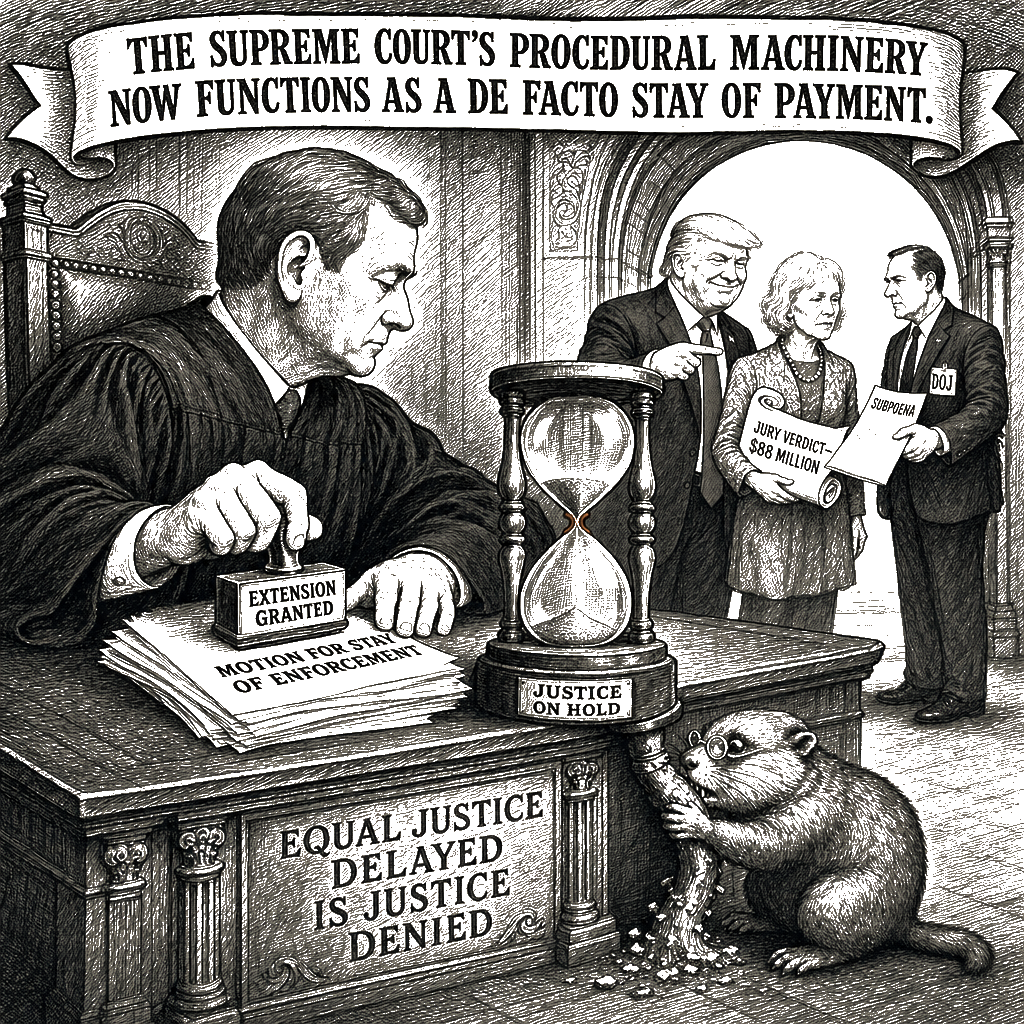
The Department of Justice has now turned its full weight against an 82‑year‑old woman who won two jury verdicts against Donald Trump. E. Jean Carroll proved in federal court that Trump sexually abused her and then defamed her for speaking the truth. She secured judgments totaling over $88 million. Trump still hasn’t paid her a cent; instead, he’s deployed the government to go after her again.
As we reported yesterday, the Justice Department has opened probes into Carroll, Jerome Powell, James Comey, and Jack Smith—a chilling sweep that transforms federal law enforcement into a personal retaliation squad. But the Carroll case is distinct in its cruelty. The legal pretext is paper‑thin: prosecutors are sniffing around whether Carroll misstated her litigation funding in a 2022 deposition, a trivial inaccuracy that would rarely raise an eyebrow in civil litigation. The real engine is Trump’s sadistic obsession with the women who have accused him.
This investigation merges two longstanding pathologies. The first is Trump’s habit of using the state to crush his critics: Letitia James was targeted after winning a civil fraud judgment; Jerome Powell drew a criminal inquiry after clashing with Trump on interest rates; John Bolton was indicted over leaked information; and James Comey became a target over a seashell photo. The second pathology is the post‑#MeToo playbook of abusive men who sue their accusers into silence. Johnny Depp’s campaign against Amber Heard was merely the most visible example of a strategy that keeps the accuser trapped in court, drains her resources, and punishes her for speaking.
The Supreme Court’s posture completes the architecture of impunity. Carroll secured a $5 million judgment for sexual abuse and defamation, and an $83 million defamation judgment for subsequent attacks. The President’s appellate campaign to vacate those findings has stalled at the Supreme Court, which has delayed disposition on his petitions to hear the appeals at least twelve times. The Court’s procedural machinery now functions as a de facto stay of payment, allowing the judgment debtor to retain liquid assets while his political appointees at the Justice Department open a criminal perjury inquiry into the judgment creditor.
The perjury pretext does not bear the weight of a criminal prosecution. Civil-litigation funding discrepancies are routinely corrected through civil sanctions when they are pursued at all; they are almost never criminally prosecuted. Yet the Department of Justice is deploying its subpoena power and grand‑jury authority to inflict a financial and psychological ordeal that mirrors the private harassment campaign the President has waged against Carroll for years.
The Court’s shadow‑docket bias—its practice of granting emergency relief or delaying merits disposition without full briefing—is empirically documented in the disproportionate grant rate for the current administration’s emergency applications, which favors executive convenience over adjudication. In the Carroll matter, the shadow docket does not issue an order overturning a jury verdict; it achieves the same substantive outcome by withholding merits disposition until the criminal investigation exhausts the victim’s capacity to pursue the civil judgment. The Court does not need to reverse the factual finding of sexual abuse to erase its consequence for the President. The procedural delays clear space for the executive branch to criminalize the plaintiff.
What the administration is really litigating is a war on verifiable truth. Trump lost in court because a jury believed Carroll. The state’s response is not to accept that verdict but to manufacture a criminal case against the victim, sending a message that even a courtroom victory can be reversed by raw executive power.
The Justice Department is not serving its constitutional function of impartial criminal enforcement. It is operating as the President’s errand staff in a weaponized criminal inquiry. The Supreme Court is not merely managing a complex appellate docket. It is facilitating a retaliatory delay. The Court and the Justice Department are not checking executive overreach. They are enabling it.