
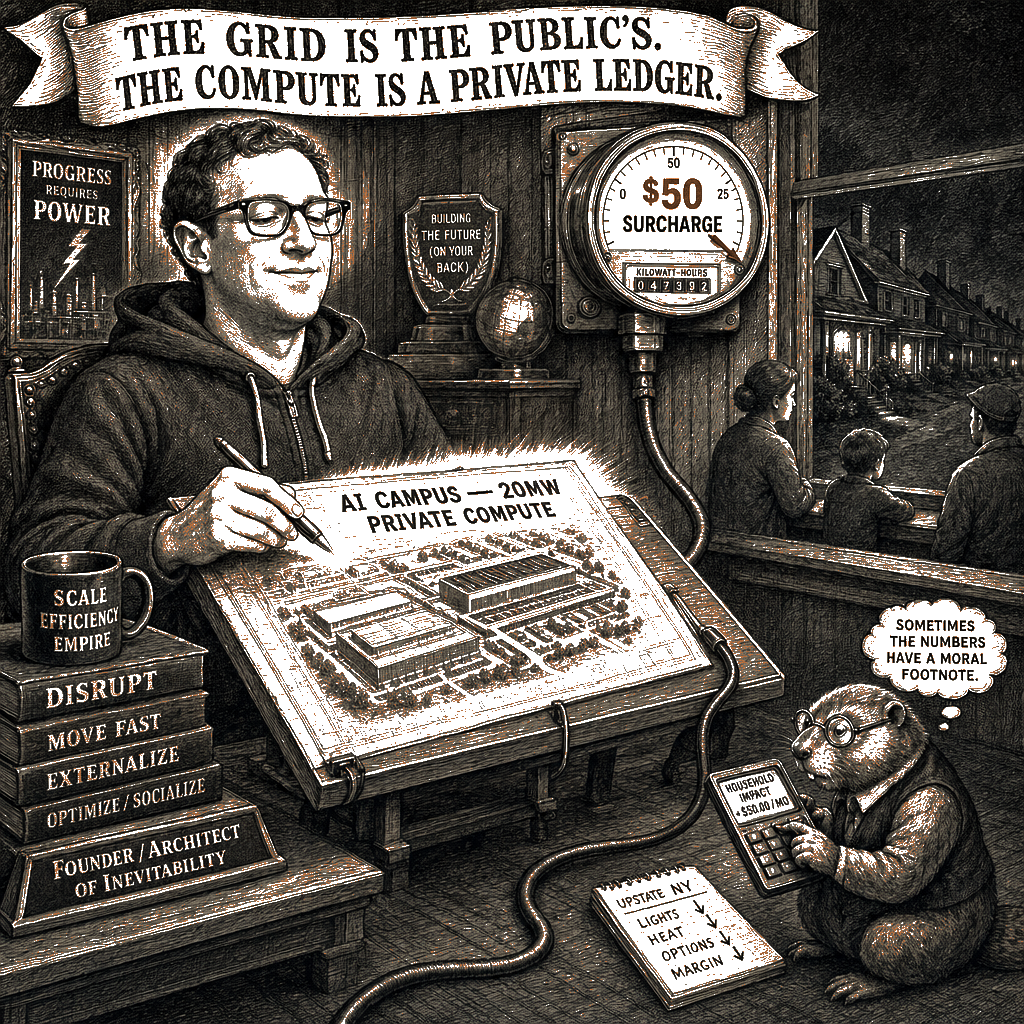
Big Tech is trying to seize New York’s energy grid and bill you for it.
It is true that data centres are the physical substrate of the digital economy — remote work, telemedicine, cloud storage — and that the industry’s trade association will tell you as much. The trouble is that the hyperscale facilities now being proposed across upstate New York, the ones the state legislature moved to pause on Thursday, are not primarily serving remote work. They are the compute layer for the AI training bubble, and they are arriving at a scale that the state’s already-constrained and aging grid cannot carry without someone else picking up the tab.
The moratorium bill, now awaiting Governor Kathy Hochul’s signature, would pause new permits for any data centre larger than twenty megawatts. Its author, State Senator Kristen Gonzalez, put the arithmetic on the record: at least twenty-eight large facilities are currently under review, and if built they would add 9,682 megawatts of new demand — roughly the peak output of nine large nuclear reactors, or the residential load of several million homes. That is not the cloud serving Zoom calls. It is a single-purpose factory consuming more electricity per square foot than aluminum smelting, and it is arriving at a moment when the state has spent a decade trying to decarbonize a grid that the hyperscalers are now asking to reverse in a single permitting cycle.
The opposition arrived on cue. The Data Center Coalition warns that a pause would “discourage investment” and signal that New York is “closed for business.” Assemblyman Paul Bologna called the bill “environmental overreach from Albany” and insisted that “markets and local governments should drive this policy.” It is a coordinated rhetorical operation, relying on the same frame-engineered relabeling that industry deploys whenever a polluter wants to avoid a cap. The Data Center Coalition presents itself as a grassroots coalition of local stakeholders; it is a trade association. Bologna’s demand that local governments fight the policy battle is an asymmetrical application of power that asks a rural town board to negotiate interconnection agreements and power-purchase contracts with firms whose market capitalizations exceed the GDP of Canada. “It’s an abdication of our responsibility to ask a local government to engage and take on the wealthiest companies in the world,” Gonzalez told the Guardian, and she is right, and the reason she is right is not merely a matter of scale but of infrastructure economics.
A single twenty-megawatt data centre draws enough power for roughly sixteen thousand households. When a hyperscaler signs a power purchase agreement with a utility, the new load does not materialize out of new generation; it pulls from the same pool, and in a capacity-constrained grid it drives up the wholesale price for every other customer. The cost is socialized. The profit is private. This is the part that the industry’s defenders — the assemblymembers who rose in Thursday’s floor debate to decry a “one-size-fits-all” ban and to insist that “markets and local governments” should drive policy — are careful not to say aloud. Their playbook has worked before. When Maine’s legislature passed an almost identical moratorium this spring, the governor vetoed it, citing the very same growth-fear argument. The town of Monterey Park, California — a community of sixty thousand — recently became the first in the nation to impose a permanent ban, but at the municipal scale the fight is asymmetrical: a small town against a trillion-dollar corporation.
Cheryl Cordes, a retired nurse living half a mile from one of the proposed sites, has spent months surveying her neighbors in Genesee County. One told her that a fifty-dollar monthly increase in her electric bill would force her to sell her home. She is “not a person who’s about big government,” she told the Guardian. What she wants is for the state to do the one thing her town cannot: make the wealthiest companies in the world answer a few simple questions before they break ground. That is not environmental overreach. It is the basic due diligence that would be required of any other utility-scale project.
The engineering reality is straightforward. Ratepayers underwrite the grid upgrades. The hyperscalers capture the compute margin. When a tech giant signs a twenty-year power purchase agreement for an entire nuclear plant, or when it taps into a constrained regional transmission organization’s capacity, the capital cost of that integration is spread across the rate base. The model weights and the ad revenue stay private. Cory Doctorow has tracked this pattern through digital platforms — the extraction of value from locked-in users and suppliers — but at the physical layer, the extraction runs through the utility meter. The hyperscalers are not building a public resource. They are building private compute fiefdoms and attaching them to a public grid.
The bill’s ratepayer protections — the requirement that new data centres not push utility bills onto existing customers — are as important as the moratorium itself, and the one-year pause is not an end but a precondition. Without an environmental impact study documenting exactly how much water and electricity each proposed campus will consume, and without transparency about who will pay for the necessary transmission upgrades, the state is being asked to approve an irreversible buildout on the basis of the developer’s own projections — projections that, in the case of the AI sector, have a track record that is, charitably, aspirational.
Hochul will sign the bill or she will not. The energy demand behind the AI buildout is not going away. What is not yet settled is whether the bill for that demand lands on the companies that are creating it or on the households that never asked for it.
The grid is the public’s. The compute is a private ledger. The bill asks the state to remember the difference. Right now, the industry’s plan is that it lands on you.