
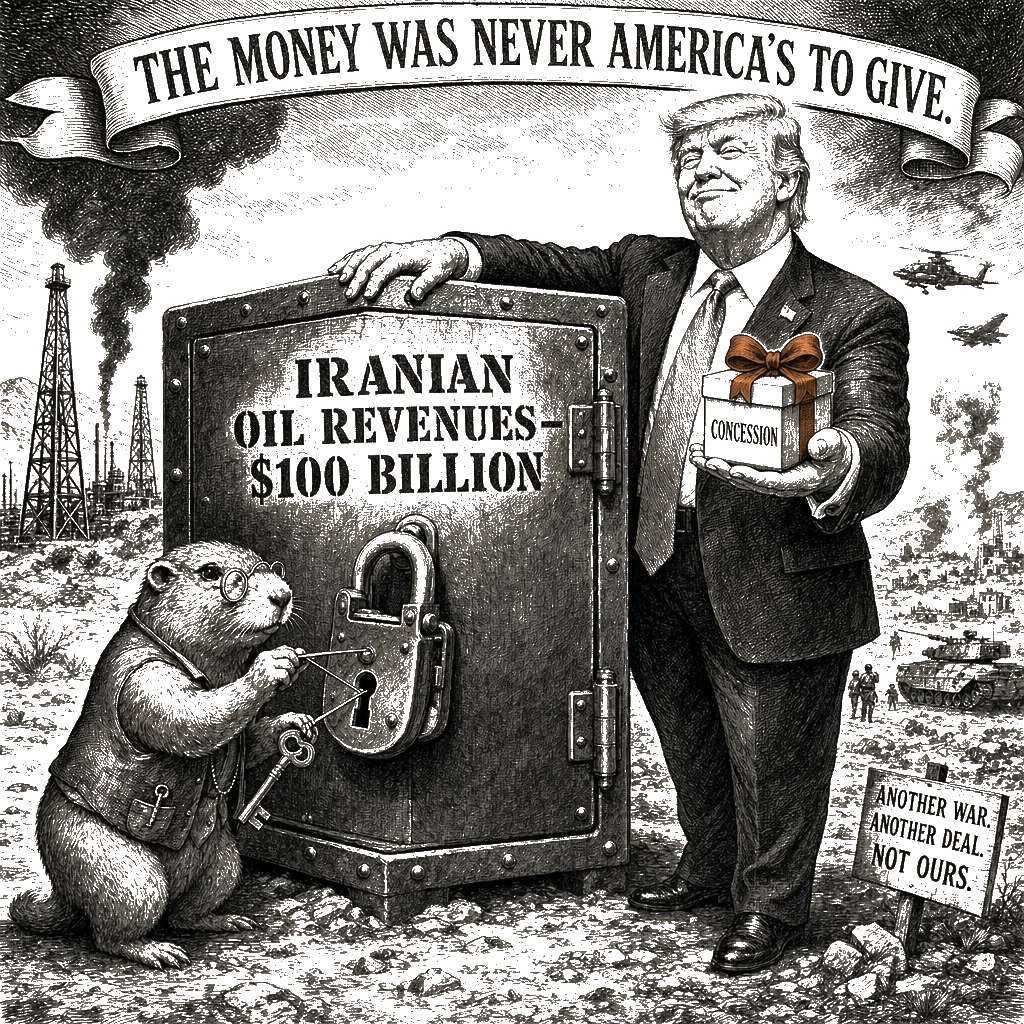
The United States is holding $100 billion of Iran’s money hostage.
The assets, frozen under U.S. sanctions, are scattered across several jurisdictions. The bulk sits in China, proceeds from years of oil sales that cannot be transferred to Tehran’s sanctioned banks without risking U.S. penalties. There is $6 billion in Qatar, restricted to humanitarian purchases—a Biden-era arrangement that was informally blocked after the October 7, 2023, Hamas attacks. Another $1 billion in Oman is similarly frozen. And an estimated $15 billion, according to a former U.S. Treasury sanctions official, sits in Iraqi banks for Iranian electricity and natural-gas exports. None of this is U.S. taxpayer money. It is Iranian revenue that Washington has rendered inaccessible.
The White House is staring down the political nightmare President Trump spent years warning Americans about, and the regime in Tehran is cashing the check he once promised to tear up. After weeks of fruitless negotiation, the primary obstacle to ending a deeply unpopular war is brutally simple: Tehran wants cold, hard money upfront, and Washington is terrified of paying it. Iran is demanding $12 billion in frozen assets before any deal is signed, with another $24 billion released during a sixty-day negotiation window. They aren’t asking for a diplomatic favor. They are treating their own estimated $100 billion in trapped oil revenue as a guaranteed down payment for peace.
This isn’t statecraft. It is a hostage negotiation where the American taxpayer is the collateral. For weeks, back-channel mediators have shuttled between Washington and Berlin, trading proposals that go precisely nowhere. Trump wants an exit ramp from a conflict that has bled his domestic support. Iran knows it holds the throttle. Every time the administration predicts an imminent breakthrough, sporadic fighting flares, reminding everyone that the current stalemate costs American capital, credibility, and blood on a daily basis.
The Trump administration now describes releasing these funds as a concession it might make in negotiations. That policy reframing is an administrative recharacterization: the Treasury’s Office of Foreign Assets Control blocks the funds, but in public the block is recast as discretionary executive leverage—a diplomatic gift rather than a return of seized property. The administration is using Iran’s own money as a bargaining chip, then presenting the return of the assets as a generous offer. The money does not become a U.S. asset because OFAC has blocked it; it becomes a U.S. liability, held under threat of penalty.
Unfreezing Iranian funds isn’t a neutral financial transfer; it is a direct injection into the war chest of a regime that actively bankrolls Hamas, Hezbollah, and a sprawling network of regional militias. Washington’s official line is airtight: no money moves upfront, no specific amounts are promised, and blanket sanctions relief remains completely off the table. But Tehran isn’t looking for promises. They see the frozen billions—mostly oil revenue trapped in Chinese, Qatari, and Iraqi banking systems—as legitimate state property being illegally withheld. To the Iranian leadership, unlocking these pots of cash isn’t a sweetener for peace. It is the only tangible proof that diplomacy is worth the political risk.
The domestic optics of any payout are catastrophic for the administration. Trump built his first-term foreign policy by lambasting the Obama-era nuclear deal as the “dumbest” in history, specifically citing the infamous $1.7 billion in cash flown into Tehran. Now, trapped in a conflict he vowed to handle better, he faces the identical political hazard. The Republican coalition that backed his withdrawal from the 2018 nuclear deal is already restless, echoing the sharp Republican criticism leaking through the party ranks over his negotiating posture. Critics inside his own base are watching closely, waiting for the moment the administration looks like it’s funding the very adversaries it promised to crush.
Tehran’s calculus is brutally pragmatic: hand over the money, or the war grinds on. They have zero reason to trust Washington’s word after the U.S. unilaterally abandoned the 2015 agreement and reimposed crippling sanctions. Why should they concede on the nuclear program or regional influence if they don’t see the cash moving first? The financial plumbing to unblock these funds already exists. Credit lines collateralized by Qatari banks, targeted humanitarian waivers for funds sitting in Oman, or oil waivers for Chinese purchases could theoretically open the floodgates. But every single mechanism requires Washington to swallow a heavy pill: officially legitimizing a financial pipeline to a hostile regime that wants nothing less than American strategic withdrawal from the Middle East.
Secretary of State Marco Rubio has drawn a rigid line in the sand: no economic relief whatsoever until Iran curtails its nuclear program and surrenders its stockpile of enriched uranium. Tehran’s rejection of maximalist uranium demands proves exactly why that stance is a dead end. Hard lines don’t end wars. They just fund new frontiers for attrition. If the White House continues to refuse even restricted humanitarian access to funds held abroad, these talks will remain permanently stalled in the same political mud that doomed previous administrations.
This is the inescapable price of the trap. Trump inherited the conflict, inherited the frozen assets, and inherited the political impossibility of paying Iran without paying a steep domestic price. The trap is self-made because the 2018 withdrawal converted frozen compliance receipts into geopolitical leverage, closing off the very off-ramp the administration now demands. The regime knows this. They will wait until the political cost of continued warfare completely eclipses the outrage of a cash transfer.
The actual policy question is whether the sanctions should be lifted, not whether the United States should “give” Iran money. The frozen assets are not a grant; they are blocked receipts. The administration’s own past rhetoric has made it nearly impossible to acknowledge that distinction in public. The administration will either continue holding the assets hostage, prolonging the war, or release them and absorb the same attacks it once leveled. Either way, the money was never America’s to give.
Until the administration finds a way to swallow the pill or accept the domestic blowback, that $12 billion down payment will remain the only wall standing between Washington’s desperate exit and Tehran’s calculated victory.