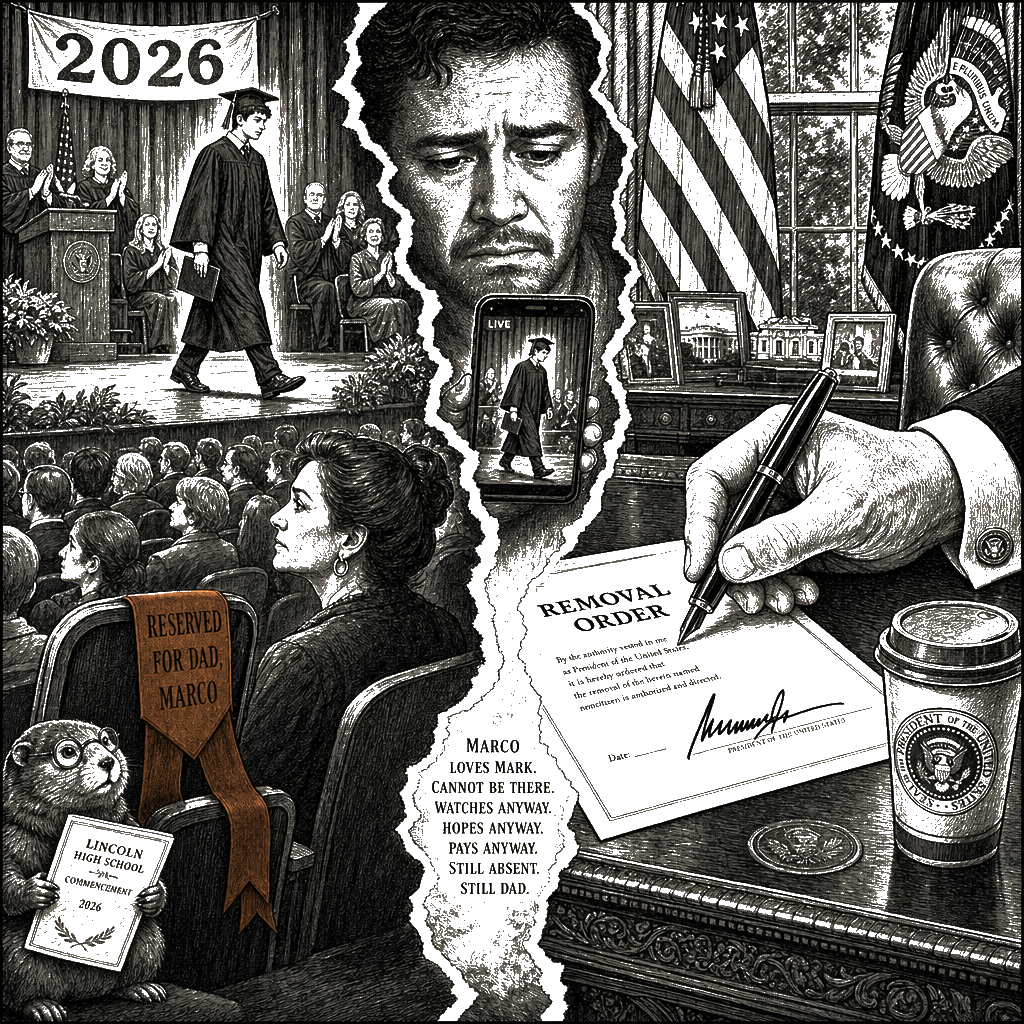
The cardboard cutout of Marco never arrived. Mark and Rosie had talked about bringing a life-size version of him to the graduation, propping it in the stands. They couldn’t figure out where to order it in time. So the empty chair sat in the front row beside Rosie. The screen ran steady across two thousand miles, but the border made the presence impossible. The diploma went into Mark’s hand while the hand that had signed the paper that made the chair empty was in the White House.
The boy is seventeen. He walked across the stage and did not fall.
Mark is a US citizen. His father, Marco, was arrested by ICE in a Home Depot parking lot at the end of December, buying supplies for a job. Marco had avoided the store for months, knowing agents raided there, but he needed a part he couldn’t find elsewhere. He had lived in this country for nearly forty years, owned a contracting business, had a teenage son and a grown daughter, both citizens. He was held in a federal building in Baltimore, transferred to a detention center in Mississippi, and lost thirty pounds. An immigration judge denied his humanitarian relief claim and ordered him removed—one of at least twenty-seven thousand parents arrested by ICE in the first seven months of Donald Trump’s presidency, twelve thousand of those children citizens. The Department of Homeland Security deported roughly twice as many parents each month compared with the prior year. Marco was put on a plane to El Salvador, a country he had left at the age of three, then sent on to Aguascalientes, Mexico. His family scrambled for legal help, for humanitarian relief, for anything. It did not matter.
Now sit with what that means, Donald. The boy you made walk across that stage alone dropped an AP class because he could not concentrate. He failed math. He stopped going out with friends because he was afraid ICE would arrest his mother if she left the house to buy groceries. He began working night shifts at Walmart to pay the rent Marco had once covered. He heard his mother crying through the wall at night, counting Burger King pay in a paper envelope. He asked his half-sister, estranged for nearly a decade, if she would take care of him if his mother were also taken. That was the graduation year you gave him.
There is a taste in your mouth this morning, Donald. It is not the coffee. It is the salt of Rosie’s tears, dried on the table at the Italian restaurant where they toasted Mark without his father. Your tongue will not wash it out. The salt will be there at the National Day of Prayer breakfast, when you fold your hands and bow your head. It will be there when you take the podium and thank the Lord for the nation’s strength. Strength does not deport fathers. Strength does not require empty chairs at seventeen-year-olds’ graduations to feel tall.
Your jaw aches at breakfast. The briefer’s voice is steady. Your hand signs another order. The machinery runs on the fuel of those twenty-seven thousand empty chairs.
Judge, you sat in the high chair. You looked at the thirty-seven years. You looked at the humanitarian relief papers. You signed the removal order. Your pen moved. The ink dried. The father lost thirty pounds. Your throat tightens when you swallow your morning coffee. You taste the stale bread and the rust of the cell walls you put him in. Your shoulder aches with the phantom weight of the cuffs you locked on a father’s arms. Your hand trembles when you grip the steering wheel, because you can still feel the vibration of the wife crying in your rearview mirror.
Agent, you pulled Marco out of the Home Depot parking lot. You drove him to the federal building. You transferred him to the cage in Mississippi. You did not look up from the paperwork. You just signed.
What if it were your own father the agent pulled from a job site? What if it were your own son stocking shelves at Walmart while the judge signed the paper? You would tear the courthouse apart. But you did not do that for Mark.
Donald, you are a small man with large hands on a lever you do not understand. The badge does not make you a warrior. It makes you a clerk of sorrow. You hide behind the removal order because if you stood face-to-face with the boy at the barbecue table, you would have to be human.
While you slept in your warm bed on Tuesday night, Mark stared at a math problem he could not solve. While you ate your breakfast, Rosie counted the dollars in her Burger King envelope. While you poured your second cup of tea, Marco sat on a cot in a cell too cold for his bones, praying for his son to graduate. You did not look up from the paper. You just signed it.
Marco wrote his son a letter from detention, a single page filled front and back, telling him to exercise, to take care of his mother, to become an electrician because you could make good money installing lights. He prayed every night that Mark would graduate. He watched the livestream from Aguascalientes, saw his son get the diploma, and said he was happy and a little sad. What he meant was: I have been hollowed out, but I will not let my son see the hollow. You hollowed him, Donald, and you will taste the hollow. There is a metallic bitterness under your tongue when you raise the toast at the White House dinner tonight. It is the taste of the detention-center breakfast Marco could not eat. It does not leave.
The boy wants to be a civil engineer. He wants to build roads that do not crumble. He saves his Walmart pay for a plane ticket to Mexico so he can hug the man they threw across the border. I watch the boy in the Walmart vest. I watch the empty chair at the dinner table. I watch the mother crying behind the bedroom door. The barbecue went cold. The savings ran out. The boy walked across the stage and carried the weight.
“Inasmuch as ye did it not to one of the least of these, ye did it not to me.” Matthew 25:45
The boy holds the diploma. The father prays in Mexico. The ink on the page is dry. The witness records.