
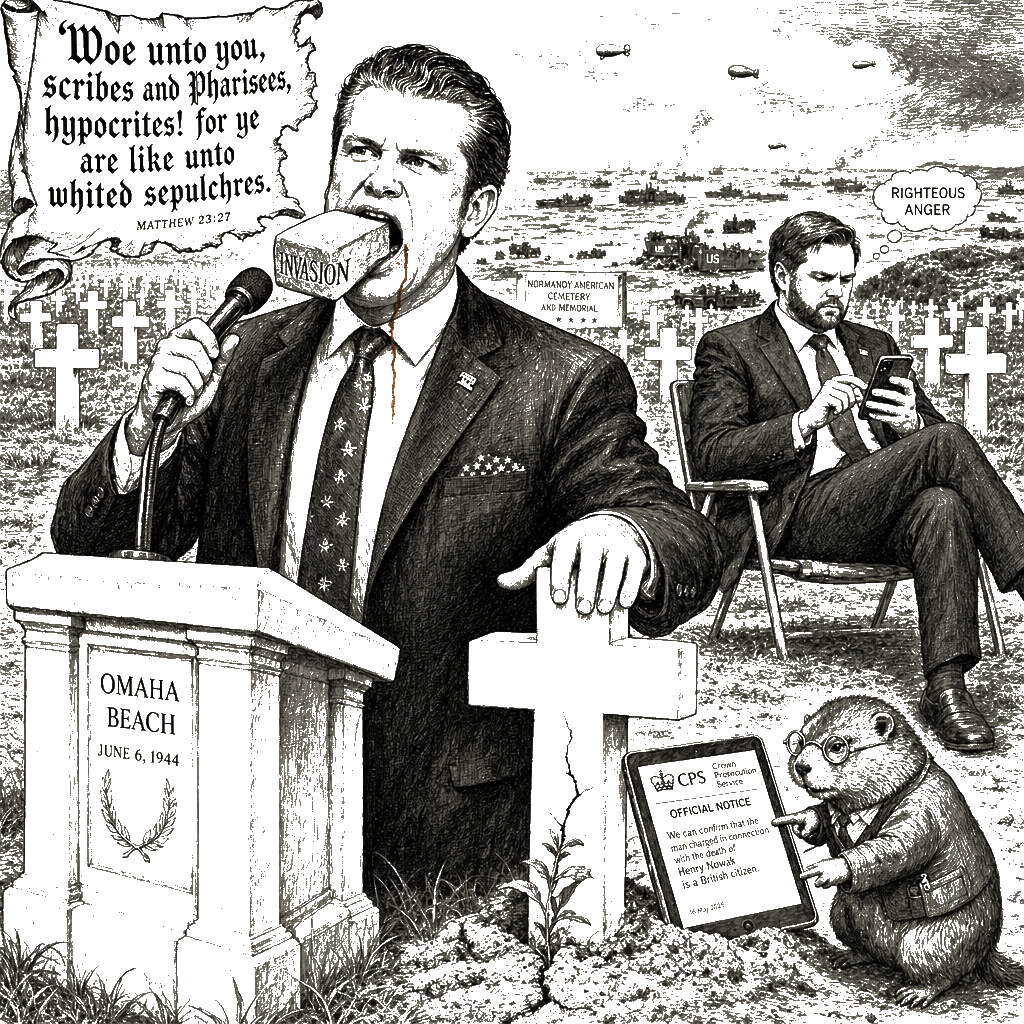
Pete Hegseth and JD Vance weaponized Henry Nowak’s corpse to sell a migrant lie.
Pete, you stood on the sand where the boys of 1944 died. You brought a murdered boy’s name to your mouth and called it an invasion. JD, the boy’s passport matches the killer’s. The lie is heavy. You swallow it anyway. The tide is coming in. The tide does not care what you said. The sand is already washing your footprints away.
On Saturday, marking the 82nd anniversary of the D-Day landings, U.S. Secretary of Defense Pete Hegseth addressed a ceremony in Normandy, France. Hegseth told the assembled delegation that the beaches of Spain, Italy, Greece, and Bulgaria are “stormed by different dangerous ideologies” and asked when European capitals would “do something about that invasion.”
The following day, Vice President JD Vance invoked the fatal stabbing of 18-year-old British student Henry Nowak, killed last year in Southampton. Vance posted on social media that the killing was the result of a “mass invasion of migrants” and said the only appropriate response was “righteous anger.” Downing Street rebuked the interference, noting the Nowak family has asked that Henry’s death not be used to create division. The Crown Prosecution Service has confirmed that the man charged in Nowak’s death, Vickrum Digwa, is a British citizen, born in Britain.
Sea arrivals to mainland Europe from April 2025 to March 2026 totaled 169,341 across five nations. In the first half of 2026, Channel crossings to the UK dropped 38 percent from the prior year. The Trump administration’s National Security Strategy, published in December, warned that continued migration would leave Europe “unrecognisable in 20 years or less” due to “civilisational erasure.” While you stood in Normandy telling Europe they must do something about the invasion, Pete, your own agency is arresting the children who cross the same water to reach Texas — your own detention figures record thousands of minors among those arrests. Your administration was told the person charged in Henry Nowak’s death was born British before your vice president posted. You used it anyway. You used a dead boy to dress cruelty as principle.
JD, your throat does not close when you type the boy’s name. The salt does not rise in your mouth when you borrow a grieving mother’s son. You have hollowed out the place where sympathy would sit, and you fill the empty space with poll numbers. The boy is a prop. The grief is fuel. The British subject who killed a British subject is erased from your ledger so the fiction of the invasion can balance. You swallow the lie, and your stomach does not reject it. The nausea you should feel has been traded for the heat of the base. You sleep in a warm bed and the boy’s blood is not on your hands, because your hands never touched him, but the lie is in your throat, JD, and it tastes like copper.
Pete, your jaw hurts. You have been speaking for several minutes now in the salt air, and the joint at the hinge of your mandible has begun to ache. The ache is not from the speech. The ache is from the weight of what you are carrying in your mouth. The word invasion sits on your tongue like a stone you swallowed at breakfast. You cannot cough it out. You cannot wash it down. It sits there, lodged, while you talk about freedom.
There is a metallic taste under your tongue. It is not the salt of the Channel. It is the taste of the word invasion dissolving into the tissue of your mouth. The taste will not leave. When you brush your teeth tonight in the hotel room in Normandy, the taste will still be there. When you kiss your wife in the morning, the taste will still be there. The taste is the moral residue of using the graves of the dead to justify a lie.
Your hands have not been washed since the speech. You handled the podium. You handled the ceremony program. You shook the hands of the French officials and the American veterans and the families of the dead whose stones you used for your backdrop. The hands that handled the ceremony are the hands that typed the word invasion into the remarks your staff wrote and you approved. The word is on your fingers now, Pete. It is on the grip of the hand you offered to the widow. It is on the fabric of the uniform you wore to honor the dead and then used to dishonor the living.
The uniform does not make the bone underneath it large. The suit hangs loose on the posture of a boy playing soldier. You looked at the Channel and you saw a Wehrmacht division, because you need the uniform to be big and the enemy to be terrifying so your office can matter. Your shoulders do not ache under the weight of the men you are invoking. They are not resting on you. You are standing on their spines, and you are so light they do not even notice.
You were not at D-Day. You were not even born. The boys who died on those beaches were younger than you are now. Some of them were eighteen. Some of them were nineteen. They died to stop a man who built his power on the idea that some people are not fully people. They died to stop an invasion — a real one, with tanks and artillery and a plan to exterminate whole populations. You stood on their graves and used their sacrifice to tell the world that a few thousand desperate people in rubber boats are the same thing.
The Channel was rough that morning in 1944. The boys who hit the beach were battered by the swells before they ever touched sand. The boys who drowned before they reached the shore were swallowed by water that had already taken the landing craft. The boys who died on the sand were cold. The same forty-degree cold that filled the lungs of boys who drowned before they touched the sand still runs today. The boys whose bodies are still in the water are still there. You stood on the sand in a warm uniform and used their suffering to sell a policy that would keep people in the water.
The widow you shook hands with at the ceremony lost her husband in a war you did not fight. She does not know what you said about the beaches. She does not know that you used her husband’s grave as a prop for a speech that would make her husband’s sacrifice look like a joke. She does not know that the word invasion was in your mouth while you smiled at her. She does not know that the hand you offered her was the hand that typed the word.
You are not the inheritor of their courage. You are a tourist in their graves. You came to the sand to dress your cruelty as the defense of their freedom. You used the word invasion to mean a mother fleeing starvation. You used the word invasion to mean a boy who was stabbed by his own countryman. The boys of 1944 would look at you, and they would step aside to let you pass. Not out of respect. Out of the quiet disgust a grown woman feels when a toddler wanders into a funeral in his father’s oversized suit.
“Woe unto you, scribes and Pharisees, hypocrites! for ye are like unto whited sepulchres, which indeed appear beautiful outward, but are within full of dead men’s bones, and of all uncleanness.” Matthew 23:27
You are not standing on a beach, Pete. You are standing inside a tomb you have painted yourself. The white stones are still white. The speech is still a sepulchre — beautiful outward, but within full of dead men’s bones and all uncleanness. You preached the bones of the dead to bury the living, and the taste of it will never leave your mouth.
The sand is already washing your footprints out. The boy’s name does not belong to you, JD. The dead do not need your defense. They need you to be silent.