
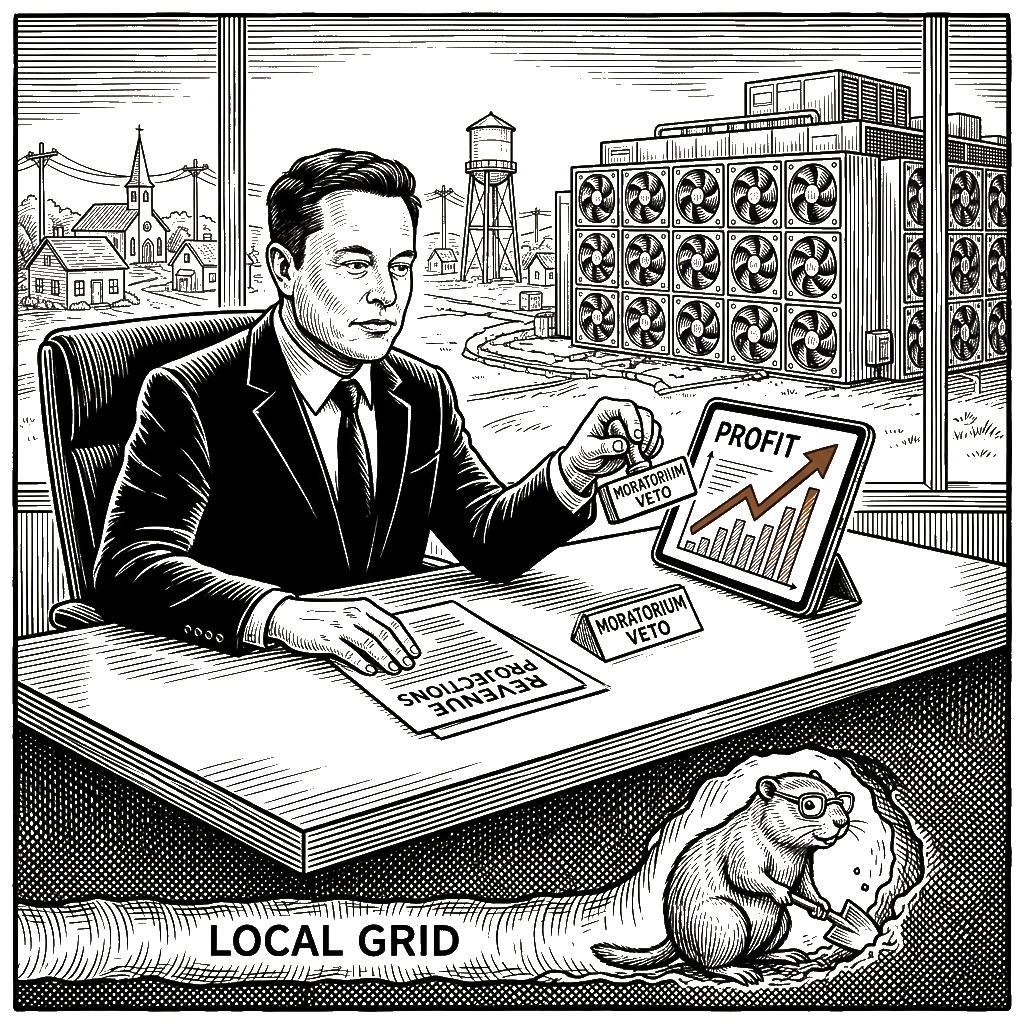
Big Tech is sacrificing rural New York towns to power AI.
The New York state legislature passed a one-year moratorium on large data centers Thursday, the first statewide ban of its kind in the country. The bill, authored by state senator Kristen Gonzalez, targets “hyperscale” facilities over 20 megawatts — the kind that tech goliaths are racing to build across the state. At least 28 such projects are already under review, and if all of them go forward, they would add another 9,682 megawatts of load onto a grid that is already old and overstressed. Gonzalez’s bill would also require an environmental impact report documenting water and electricity use, new labor and efficiency standards, and ratepayer protections to keep ordinary New Yorkers’ electric bills from climbing. The original proposal called for a three-year pause; it was cut to one year as a compromise. Governor Kathy Hochul has not yet said whether she will sign it.
Every town that has been handed a corporate promise in the last forty years will recognize the response. The Data Center Coalition, the industry’s trade group, warned that a moratorium would “discourage further investment, undermine New York’s economy, and send a signal that the state is closed for business.” Assemblymember Paul Bologna, who voted against the bill, called it a “blanket moratorium” that would punish communities that want the development and said the state should let local governments decide. Gonzalez’s answer is the right one: “It’s an abdication of our responsibility to ask a local government to engage and take on the wealthiest companies in the world.”
The same pattern has played out in rural counties across the country for decades. A corporation comes to town, promises jobs and tax revenue, and then externalizes the real costs onto the people who live there — their water, their air, their electric bills, the quiet of their evenings. The industry calls it innovation. The people on the ground call it extraction.
Those of us in rural counties know the script. We watched the CAFO operations move into central Wisconsin and leave the shallow wells on the south side of Adams County with nitrate levels spiking above the 10 mg/L state standard. We watched the Dollar General replace the last independent hardware store in Friendship, and the regional bank consolidation close the branch where my mother used to work and move the nearest teller twenty miles away. The Adams County Times-Reporter runs the same stories on a loop: three hardware stores shuttered since 2015, a school referendum that failed because the county’s top industrial taxpayer pays nothing under the state’s agricultural-assessment carve-out. The data center is the latest chapter in the same book, the extractive mind dressing itself in fiber-optic cable instead of a manure lagoon.
Cheryl Cordes, a retired nurse who has lived in the town of Alabama, New York, for more than forty years, is watching the debate from a house that sits half a mile from where developers want to put a massive data-center campus. She has knocked on dozens of doors in her town. One neighbor told her, “If my electric bill goes up another fifty dollars I can’t live here.” Cordes is not a big-government activist. “I’m not a person who’s about big government,” she told the Guardian, “but come on: please help us here in these small rural towns.”
That plea is the sound of the community collapse that Wendell Berry has been writing about for half a century, long before anyone had heard of an algorithm. Berry’s entire body of work is organized around the insight that a community’s economy is its membership, and that extraction destroys the membership before it destroys the economy. The extractive mind, he wrote in The Unsettling of America, treats land, animals, and people as expendable inputs. A hyperscale data center is not a CAFO, but the extractive logic is the same: the corporation takes what it needs from the place — land, water, grid capacity — and returns the costs to the people who live there, while the profits flow to shareholders who have never set foot in the county. The membership is left with higher electric bills, a degraded habitat, and the noise of cooling fans that never stop.
The moratorium is a one-year pause, not a permanent ban. It is a request for an environmental impact report, not a rejection of every data center forever. The bill does not even apply to facilities that already have their permits. The industry’s claim that this is a “signal that the state is closed for business” is the same threat every extractive industry makes when a community asks for a moment to catch its breath: let us do what we want, or we will take our jobs and go somewhere else. The threat works because the communities are poor. That is the power imbalance, and it is exactly what Gonzalez is trying to level.
The backlash is spreading. Seattle just passed its own year-long moratorium, and Monterey Park, California, voted to ban data centers permanently — the first city in the country to do so. A Texas county imposed a temporary ban in May, and Maine’s governor vetoed a statewide moratorium in April after the legislature passed one. A new poll from Heatmap found that almost three-quarters of Americans oppose a data center being built near their homes. The resistance is not coming from coastal environmentalists; it is coming from the same rural and small-town voters who have been told for forty years that the next big project will save them.
The AI industry is asking us to accept a particular trade: sacrifice your water, your grid, your quiet, and your local control so that a handful of companies can build machines that generate what Gonzalez rightly calls “AI slop.” The same companies demanding the right to build these facilities are the ones that spent two decades avoiding taxes, crushing local retail, and treating the regulatory state as an obstacle to be captured rather than a public trust to be honored. The idea that local governments should be left to negotiate with them on their own is not a philosophy of local control; it is an invitation to a rigged fight.
The long arc of this fight is the same arc that has been running through rural America since the first consolidation wave hit in the 1980s. The question is whether the membership can hold together long enough to write rules that protect the membership. The data center industry is not the first extractive wave to hit the countryside, and it will not be the last. But the New York vote is a piece of evidence that the membership is not yet gone. The retired nurse in Genesee County knocking on doors is still there. The state senator who wrote the bill is still there. The extractive mind does not want a pause, because a pause is the first step toward a permit that says no.
The bench is quiet tonight. The dogs are at the feet. The notebook on the shelf shows the Petenwell ice-out moving another twelve days earlier than it did in the nineties, but it doesn’t show the server farms yet. The physical footprint still lands the same way: the water gets used, the power gets pulled, and the bill always comes back to the people who live on the land.