
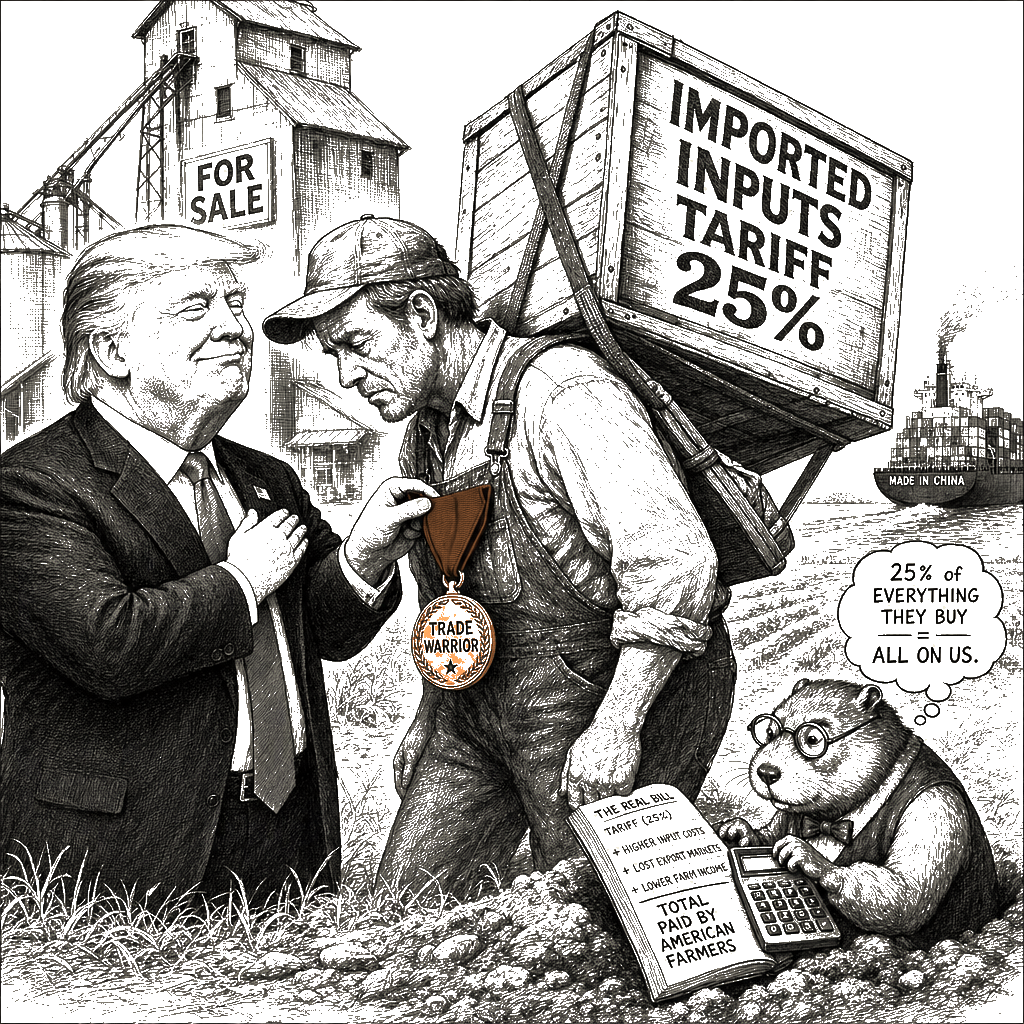
Trump is sacrificing rural America to a trade war with China. We have known the arithmetic on this since the first tariffs landed. When the administration levies a tax on aluminum, on steel, on the semiconductors that run the fuel injection on a 2017 Silverado, that tax does not get paid in Beijing. It gets paid at the till in Friendship when a neighbor walks up with a busted water pump. The price of the import rises, the cost of the domestic substitute rises because there is no domestic substitute, and the working-class margin gets shaved again.
We up here in Adams County have seen this movie before. During the last trade war, the government sent out $28 billion in bailout checks, and they didn’t bring back the export markets. They just bought a little time. Now the White House is running the same play, this time on a broader front.
The trade economist Eduardo Porter laid out the scoreboard in The Guardian this week, and the math is not complicated. China’s share of global manufacturing exports has climbed from 3 percent in 1995 to 20 percent today. Beijing controls the supply chains for the magnets that run the electric motors, the rare earths, the chip components. The administration’s tariff strategy was supposed to break that dominance; instead, it is breaking the relationships with the people who might help break it.
Canada is looking east. Prime Minister Mark Carney traveled to Beijing to deepen economic ties while the administration was busy taxing Canadian steel and aluminum. Mexico imposed a tariff of up to 25 percent on imports from nations without a free-trade agreement — a move aimed squarely at China, and one the administration strongly pressed for — and now the regional blocs are shifting to accommodate the Chinese export juggernaut rather than confront it. The European Union is filing fifty antidumping cases against Chinese imports — up from seven in 2024 — and signing trade deals with Mercosur to secure supply routes that do not run through Washington. The administration is swinging a hammer at the global supply chain, and the natural allies are moving the china cabinet out of the room.
We watched the summit in Beijing in May, where the administration and Xi Jinping sought to stabilize trade ties after months of tariff escalation. The stabilization theater played well on the cable-news chyrons. It did not change the fact that the rural economy is structurally dependent on the very inputs the administration is taxing.
Wendell Berry wrote about this dependency in The Unsettling of America, noting that the small operator exists in an economy where the prices are set by distant boards and the risks are borne by the family that stays on the land. The consolidation of the seed trade, the chemical trade, and the machinery trade means there is no independent domestic market to retreat into. When the administration tariffs the imported steel used to make the grain bins, the farmer pays more for the bin. When the administration tariffs the rare earth magnets needed for the hybrid systems in the tractors, the mechanic pays more for the parts. The rhetoric of sovereignty becomes a tax on the people who actually make things work in the counties where the rhetoric polls highest.
This is the nationalist shell game in its pure form. The rhetoric promises independence; the policy delivers supply-chain isolation. The administration claims it is punishing China for unfair practices, while China tightens restrictions on the rare earth exports needed for American defense and industry, and the administration has no answer other than more tariffs on the inputs the allies are trying to source. The bailout checks are not a strategy; they are an admission of failure.
The co-op shelves in Adams County do not care about the grand strategy. The price of a 28 percent nitrogen solution climbs with the freight index, and the magnet rotor assembly for the new planter’s hybrid drive costs more this spring than it did last fall. The shop invoice book records the same thing the macroeconomic data records: the cost of doing business in rural America is going up, and the benefit of the tariff is going to a Treasury ledger that will not flow back to the county roads or the school district.
The trade war will come at a cost to economic wellbeing, as Porter wrote. That cost is the difference between fixing the old baler and buying a new one. It is the margin on the soy check that disappears into the premium for the imported herbicide. It is the slow, compounding tax on the rural infrastructure that holds the county together.
The long arc is that the same extractive logic that hollowed out Main Street is now being applied to the global trading system. The county that loses its grain elevator to a trade war is the same county that lost its hardware store to a chain and its vet clinic to a regional conglomerate. The young people leave. The school district consolidates. The land stays, but the membership that Berry named — the web of relationships that makes a place a community — gets thinner every year.
The administration is sacrificing the rural economy to fight a trade war it cannot win. The tariffs remain, the prices remain high, and the allies are cutting the deals that leave the American rural sector holding the bag. We are left with the same machinery, the same land, and a supply chain that is getting more expensive and less reliable by the quarter. The county fixes what it can.