
The ice went out on Petenwell Lake this year earlier than ever in the twelve years the notebook has been kept. The Amazon is a long way from Adams County, Wisconsin, but the ice-out date and the Amazon are on the same ledger—the carbon budget—and the auctioneer is the same man who endorsed the Colombian candidate.
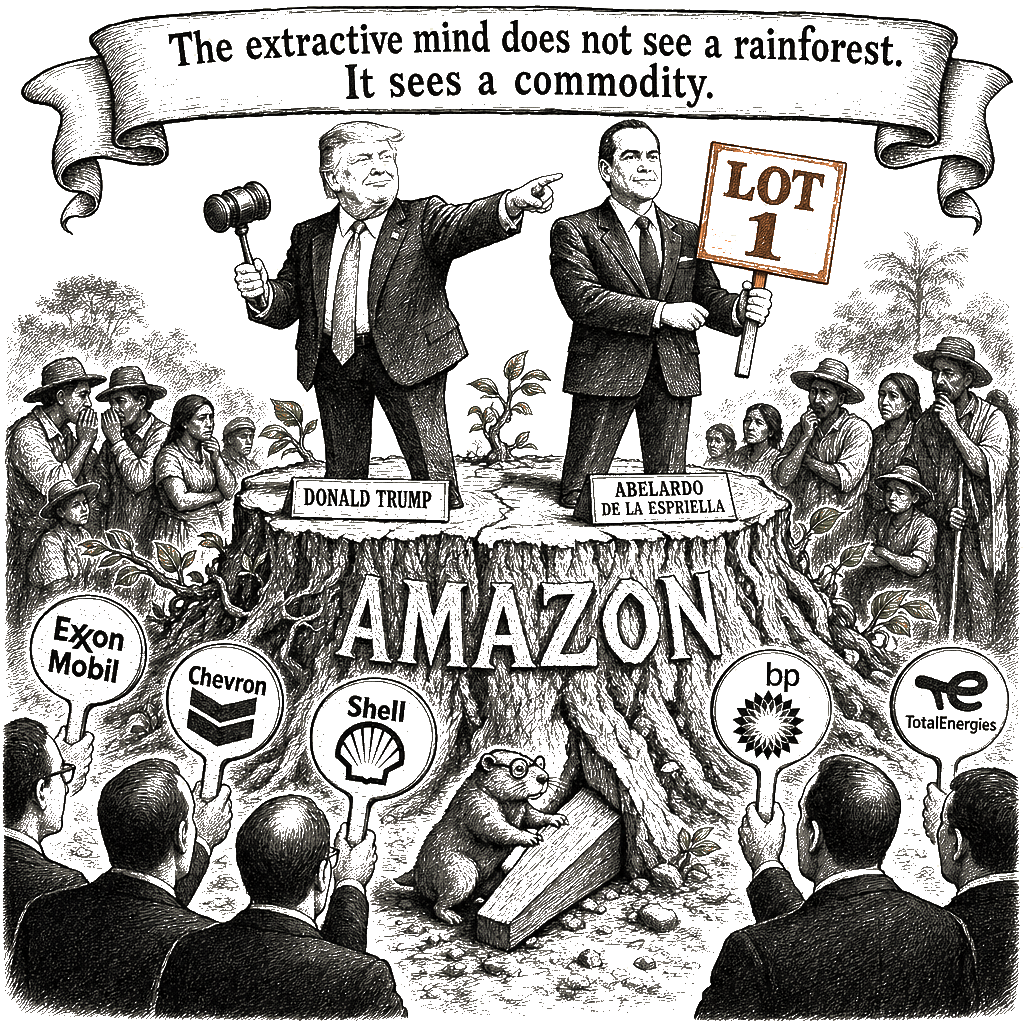
Donald Trump and Abelardo de la Espriella are auctioning the Amazon rainforest to oil companies.
The Colombian presidential runoff on June 21 pits Senator Iván Cepeda, an ally of President Gustavo Petro who halted new oil and gas exploration permits, against de la Espriella, who has signaled he will expand extraction and has the backing of former President Trump. The election comes after a first round in which a former mayor allied with de la Espriella was killed, and against a backdrop of political violence that is the normal tool of resource extraction when the canopy is priced as a commodity and the people who live in it are priced out of the negotiation. The Associated Press named the trade starkly: the Amazon covers roughly a third of Colombia’s territory, and the vote is a choice between protecting the rainforest and opening it to rigs.
The Nationalist Shell Game runs through both ends of the ballot. The rhetoric on the expansion side says national sovereignty and economic certainty. The policy says the multinationals get the lease. The candidate who promises to drill aligns with the energy sector’s demand that the permits roll. The candidate who protects the watershed aligns with the carbon budget. The global crude market is a single tank, and the shop floor that cleared $48,000 net last year buys the diesel at the county line regardless of who wins. The margin is the distraction. The substance is what happens when a country tries to step off a century of extraction and the multinational lobby wants it back on.
Wendell Berry described in The Unsettling of America an extractive mind that treats land, animals, and people as expendable inputs. That is the logic now offered to Colombian voters, wrapped in a flag and a promise of economic growth. The industry books its drilling revenue while hiding the remediation tab on the public ledger; that is not economics, it is deferred bankruptcy. The extractive mind does not see a rainforest. It sees a commodity. It does not see the people who have lived there for generations. It sees obstacles to be removed.
We up here in Adams County know what the extractive mind looks like when it comes to town. It looks like the bank that bought the local bank, closed the branch, and moved the decisions to a boardroom a thousand miles away. It looks like the corporate farm that opened a CAFO up the road and left the wells on the south side of the county with nitrates above the drinking-water standard. The Adams County Times-Reporter printed the test: 14 milligrams per liter, against a federal limit of 10. The Adams County Land and Water Conservation Department built the dataset. The watershed degrades. The extractive mind is the same in Colombia as it is in Wisconsin; only the scale is different. When the resources are gone, the company moves on, and the people who live on top of the depleted ground are left with the spills, the poisoned water, and the bill.
The notebook records that the deer rut is two weeks later than it used to be, the mosquitoes show up in March some years, and the maple-syrup season is shorter. Those changes are not local quirks. They are the local face of a global system that is burning the Amazon to keep the lights on and the gas tanks full. The shorter syrup season and later rut are the downstream signal of the Amazon’s failing moisture pump—the same pump that will stall if the canopy is carved for well pads. The carbon that the Amazon stores is the carbon that does not end up in the atmosphere, warming the winters that keep the ice on Petenwell Lake. If the Amazon is auctioned off to oil companies, the ice-out date will keep moving earlier, and the notebook will keep recording the change.
The diesel rack at the county line will keep moving. The price will spike and flatten. The canopy does not spike and flatten. The Berry essays close on the membership. The watershed does not run on a margin. On June 21, Colombian voters will decide whether the Amazon is a forest or a drill site. The outcome will be recorded in the ice on Petenwell Lake, in the notebook, and in the lungs of the kids who will grow downwind of the rigs. The extractive mind is patient. It does not care about a county in central Wisconsin. It does not care about a village in the Amazon. It cares about the next quarter’s earnings. That is the choice. It is the same choice, whether the ballot is in Spanish or English.