Any mechanic who has tried to start a Briggs & Stratton Vanguard after someone stripped its own wiring knows exactly what the last six weeks of statecraft look like. The Wall Street Journal piece landed on the shop bench around nine last Thursday evening, after I’d finished a carburetor rebuild on a Stihl MS 271 that had been sitting in the queue since May. The lede said Tehran wants twelve billion dollars upfront and another twenty-four billion during a two-month negotiation window, drawn from an estimated hundred billion in frozen assets—their own money, as their generals keep insisting, but money the U.S. Treasury has kept locked in banks from Beijing to Baghdad for years. I sat there, wiping carb cleaner off my fingers onto a grease rag that has seen better decades, trying to make the numbers land in Adams County terms.
Twelve billion dollars. The entire annual budget for the USDA conservation programs that keep soil on family farms in Wisconsin and a thousand other counties—the EQIP, the CSP, the CRP, and the rest—runs typically between six and seven billion dollars, depending on the farm bill cycle and whether emergency supplements are tacked on. The emergency funding that kept rural hospitals from locking their doors during the pandemic was ten. The cost to put fiber-optic broadband into every unserved township in the state is a fraction of that. And here, on page A1 of the Journal, the administration that just spent thirty-six billion dollars on a Middle Eastern war it launched in February is haggling over whether to release twelve billion dollars in Iranian cash to make the shooting stop. The same President Trump who, during the 2016 campaign, stood on a debate stage and told Hillary Clinton that the Obama administration’s $1.7 billion cash settlement with Tehran was enough to fill the entire room—and treason, besides.
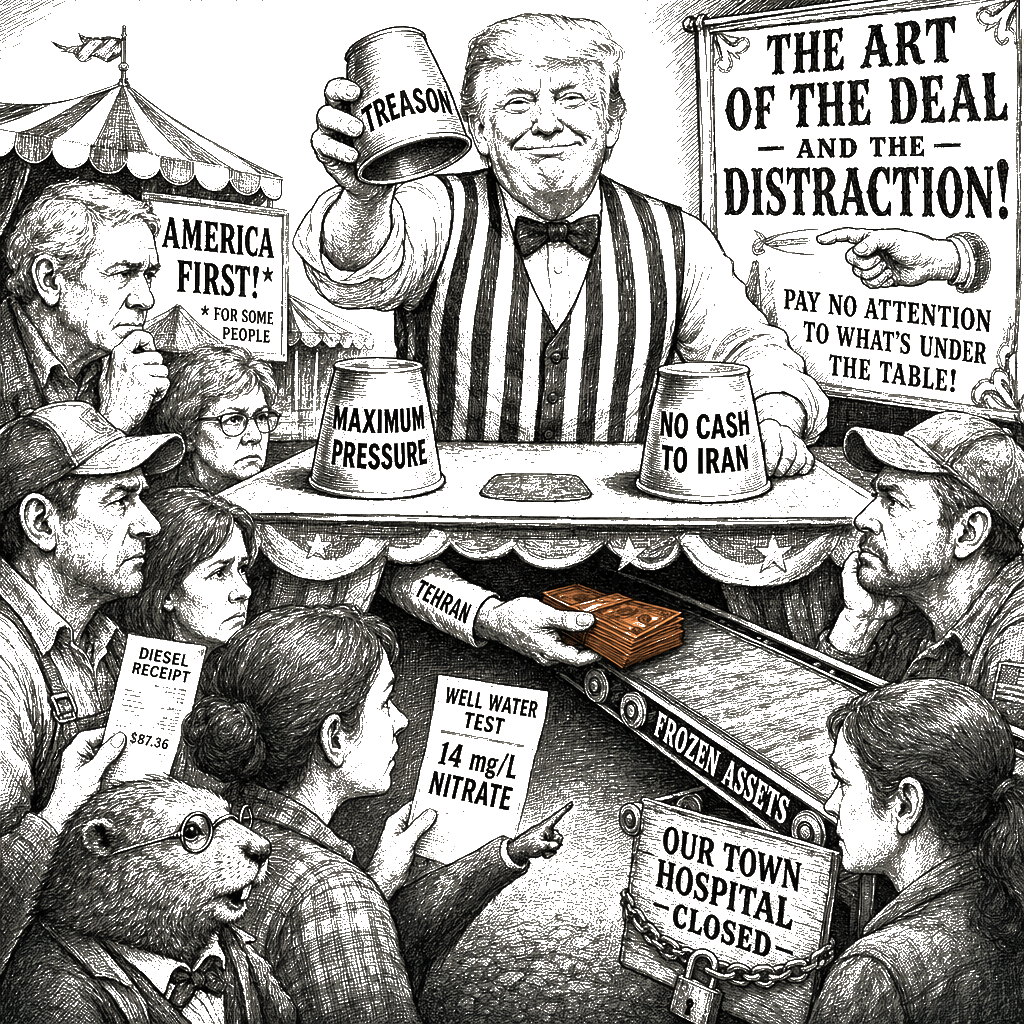
The shell game is the contradiction this column tracks. It is the Nationalist Shell Game per the We Too taxonomy—the rhetoric of nationalist toughness that collides with the physics of an interconnected energy system. In every shell game there are three elements: the hustler, the mark, and the shell nobody can track. Here the hustler’s own rhetoric is the shell, and the mark is the domestic audience that believes the strong arm can bend the world’s need for oil. The claim is that the strong arm wins the better deal. The reality is that the strong arm cannot hold the oil shut, it cannot hold the regional supply chain shut, and it cannot hold a petrostate’s budget at zero when the shadow fleet keeps moving the product. Iran’s oil exports sit a third below their 2011 peak, per World Bank data, but a third short is still a stream. The sanctions architecture is the architecture of extraction, but it is also the architecture of compromise, and it only works when both sides are willing to bleed at the same time. They are not.
For the administration across the water, the question is mechanical, not ideological. Tehran estimates a hundred billion dollars in oil revenue and reserve assets are locked in foreign accounts. Fifteen billion of those sit in Iraqi banks from power and gas exports. Six billion was parked in Qatar, then blocked. A billion was parked in Oman, then blocked. All of it is Iranian money, and all of it is held hostage by U.S. legal architecture. The regime in Tehran is not asking for a gift. It is asking for a down payment. Ali Vaez at the International Crisis Group named it as an issue of reciprocity: the assets are the down payment to prove the diplomacy is worth the political risk. Reading the books at a small shop in Adams County teaches the same lesson—an unsecured promise of future payment is the first sign of a bad contract. The regime has every reason to treat a U.S. pledge like an IOU with no collateral, especially after the administration burned the 2015 deal, reinstated the sanctions, and signaled that signatures meant nothing when the office changed hands. They will only move if the funds are on the table before the pen touches paper.
The rhetorical trap closes tighter with each public refusal. Secretary of State Marco Rubio’s blanket statement that there would be no sanctions relief until Tehran hands over its enriched uranium effectively forecloses even a discrete oil waiver—at least for now. This maximalist posture leaves the administration with the very options it swore were off limits. When a president spends four years attacking an opponent for delivering cash to an adversary, and then becomes the president who must decide whether to deliver cash to that same adversary, the contradiction stops being abstract. The criticism already arriving from his own party shows the damage. The rhetoric that won the room is the rhetoric that traps the negotiator.
The path out is narrow but visible. Former sanctions official Richard Nephew notes the quiet option: quietly remove the barriers to the pots of money sitting in Qatar, Oman, and Iraq. It is a relatively small, discrete amount, controllable because it is located where it is located. It requires no grand gesture of lifting the embargo. It requires only an acknowledgment that the 2016 pallet flying at night and the 2023 Qatar escrow were functional components of statecraft, not historic humiliations. The alternative is a sanctions waiver on the China oil, which frees the frozen funds held there and allows legitimate crude to soften the diesel price at the Co-op in Friendship. But that concession is too visible for an administration running on toughness.
The story here tracks a gap Wendell Berry describes in What Are People For?—the distance between the abstract story a political machine tells about its own leverage and the actual mechanics of keeping the equipment running. The abstract story says the adversary folds. The actual mechanics say the adversary has the leverage, because the adversary sits on a commodity the global market still buys. And then there’s Berry’s deeper point from The Unsettling of America, that the industrial economy “has no long-term interest in the health of any place”—it only cares about efficiency and profit. The Iran war, and the cash-for-peace that will end it, is that sentence written in Pentagon budget language. The rural towns that make up the Army’s infantry ranks carry the human cost; the farmers and truckers pay the fuel inflation; the government that ordered the war and now demands the credit for ending it never once asked Adams County what it thought. We weren’t consulted on the war, and we won’t be consulted on the payoff.
There’s a deeper oil story that the Journal doesn’t fully unpack. Iran’s frozen assets are the fruit of decades of sanctions architecture that the U.S. has built and occasionally relaxed, depending on who’s in power. Under the Biden administration, Iranian oil exports crept back up to around 1.5 million barrels a day, mostly to Chinese teapot refiners, because the administration chose not to enforce secondary sanctions aggressively—partly to keep global oil markets stable, partly because it didn’t have the diplomatic bandwidth. Trump’s own energy policy, as documented in this publication, has been to pump record amounts of domestic oil while threatening OPEC members who don’t play ball. But oil is a global commodity, not a national one. When a tanker can’t pass through the Strait of Hormuz because a mine is in the way, the price at the Friendship Co-op gas pump moves whether the oil came from Texas or Saudi Arabia. The Trump administration’s answer to everything has been “energy dominance”—drill more, export more, ignore the cartel—and the result is that a country with 13.6 million barrels per day of domestic production still had diesel prices spike thirty percent because a few thousand Iranian mines in a narrow waterway disrupted shipping.
Bethany McLean’s Saudi America taught me that the shale boom of the last fifteen years wasn’t some rugged individualist triumph; it was a finance story, built on cheap debt and private equity cash that flooded into the Permian Basin because interest rates were near zero. The “energy independence” that politicians brag about is an artifact of that debt binge, not a permanent condition. The truth is that the U.S. is still plugged into the same global oil market that produced the 1973 embargo, the 2014 price crash, and the 2020 negative-price shock. When a president gets the country into a fight in the Gulf, he’s gambling with a system that is more fragile than his press releases admit. The cash-for-peace dance with Iran is a symptom of that fragility. The administration is being asked to buy its way out of a war it started, using money it froze years ago to punish Iran for doing things that, in many cases, the U.S. had previously tacitly allowed. The same administration that boasted about “maximum pressure” is now negotiating over payment plans.
We have a word for this in the shop. When a customer brings in a Stihl that’s been straight-gassed—they put unmixed fuel in the tank and seized the engine—and they ask how much to fix it, the answer is never good. Sometimes they try to argue that it should be under warranty, or that they saw a YouTube video that said they could do it themselves. The truth is always the same: the damage is done, and the repair bill is the repair bill. The war in Iran is a straight-gassed foreign policy. The engine is seized; the cost to fix it is what it is; and the people who poured the wrong fuel into the tank are now asking the rest of us to be impressed that they’re negotiating the bill down.
What would twelve billion dollars do in Adams County? It would pay for every well-water nitrate remediation project the Land and Water Conservation Department has on its ten-year plan, with enough left over to build a new wing on the county hospital, fund the school district’s special-ed program where my wife works for a decade, and still have billions to throw at the broadband gap that leaves my neighbor’s kid doing online school over a five-megabit DSL line. That’s not sentimental. That’s math. The same ledger that can find twelve billion dollars to release frozen Iranian assets in a peace deal—and another twenty-four billion during the negotiation—can’t find a tenth of that to keep rural maternity wards open. We saw this two years ago, when a reconciliation bill that was supposed to fund rural infrastructure instead turned into a tax-cut vehicle. We’re seeing it again now, in the same pages of the same newspaper: the money for peace in the Persian Gulf is available because the people who make foreign policy have decided that’s where the money needs to go. The money to fix the well water in my neighbor’s yard, which tested at fourteen milligrams per liter of nitrates last spring—four above the federal safe-drinking-water standard—is not available, because the people who make domestic policy have decided it’s not a priority.
We are watching an administration try to negotiate a ceasefire it cannot name without breaking the spine of the campaign that brought it into the Oval Office. The twelve billion dollars upfront is the down payment on a peace the American working class already wants, but the president’s own words are making it too expensive to deliver. The shell game always ends with the operator staring at his own empty hand, wondering when the rules changed. The rules did not change. And the empty hand is the hand Tehran will not shake until the down payment leaves the escrow account and lands in a bank the regime can reach.
In the quiet of the shop, with the Stihl back together and the dogs asleep under the bench, the question isn’t whether the deal will happen. It will. The question is who will pay for it. The answer, as it has been for every war and every settlement of my adult lifetime, is the people who live in counties like this one—the places that supply the soldiers, absorb the fuel prices, and never appear in the ledger line under “compensation.” The administration will call the deal a victory and ask us to forget that they called the same deal treason when it was under a different name. But we will remember, because the diesel receipt is in the glovebox, the well test is on the counter, and the kids at dinner tonight will ask why gas is so expensive, and at the shop bench at nine o’clock, the Journal is on the table, and the numbers don’t add up any better the second time than they did the first.