
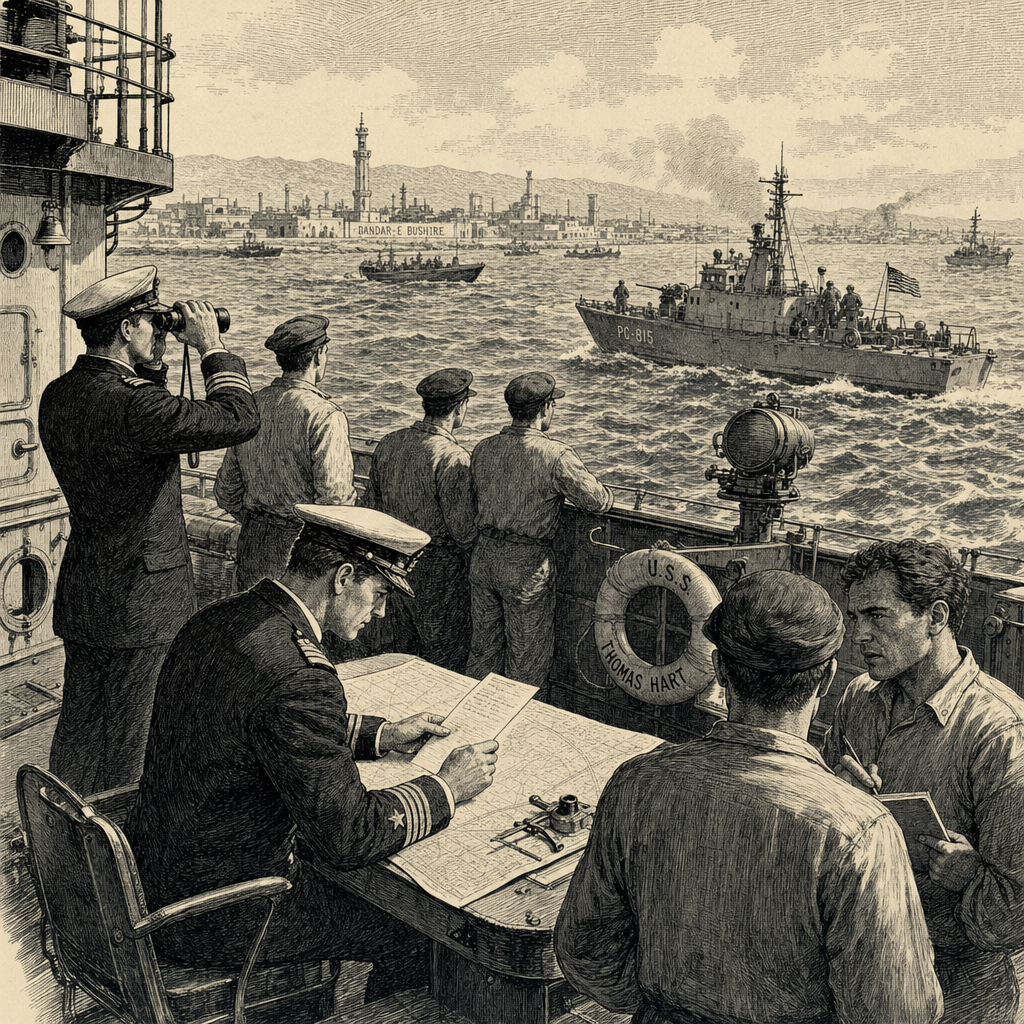
Trump and the Pentagon are trading Gulf civilian lives for a blockade that chokes a fifth of the world’s oil—and calling it a ceasefire. U.S. Central Command is bombing Iranian coastal radar sites and shooting down drones, while Iran’s Revolutionary Guard Corps answers with ballistic missiles that cratered Kuwait’s international airport, killing one civilian and injuring more than sixty. The administration calls this a “defensive strike” and a “ceasefire,” but the operational tempo does not lie.
Michael Walzer writes in Just and Unjust Wars that the moral calculus of conflict collapses when the means outstrip the political ends. Here the means are a permanent exchange of fire, and the ends are a diplomatic settlement that does not exist. The blockade of Iranian ports, imposed after a ceasefire, persists as a military instrument entirely detached from any political pathway—exactly the mismatch Walzer describes. The absurdity is complete: while the blockade strangles Iran’s economy, Washington has granted visas to Iran’s World Cup football team so they can play in Los Angeles—the first time a host nation will receive the team of a country it is at war with.
Dwight Eisenhower warned in his 1961 farewell that an unwarned military-industrial complex acquires unwarranted influence, and the warning is visible in the procurement cycles that demand targets to justify budgets. The Pentagon’s accelerated procurement of SM-6 interceptors to sustain Gulf engagements illustrates the dynamic—hardware demand driving strategy, not the reverse. Barbara Tuchman noted in The March of Folly that governments routinely pursue policies contrary to their own interests, clinging to the sunk costs of escalation while the strategic reality shifts. The Navy patrols, the Air Force launches interceptors, and the budget requests follow the smoke, not the strategy.
Andrew Bacevich wrote in Washington Rules that the American military operates on the assumption that permanent war is the normal state. Those of us who deployed understand that a base in Kuwait or a station in Bahrain is not a board game piece but a place where service members live under the threat of incoming missiles and radar strikes. The military does not need another open-ended shooting competition in the Gulf; it needs a political framework that actually ends the hostilities.
The Pentagon calls this a “sham ceasefire,” but a genuine truce requires a cessation of fire, not the careful management of a rolling engagement. More than three months after the 28 February strikes, with the War Powers Resolution’s 60-day clock long expired and no congressional authorization on the books, the executive is operating in a constitutional vacuum. The Constitution requires Congress to declare war, not the executive to maintain a rolling exchange of fire while calling it diplomacy. Congress must reassert its authority. The blockade must end. A genuine diplomatic process, without Trump’s ever-shifting demands, must begin. Failing that, American power will keep killing civilians under the cover of a word that no longer means anything.
Trump and the Pentagon are betting that no one will hold them accountable for the civilians their Gulf war is killing. The ceasefire is a lie, and the dead are the proof.