
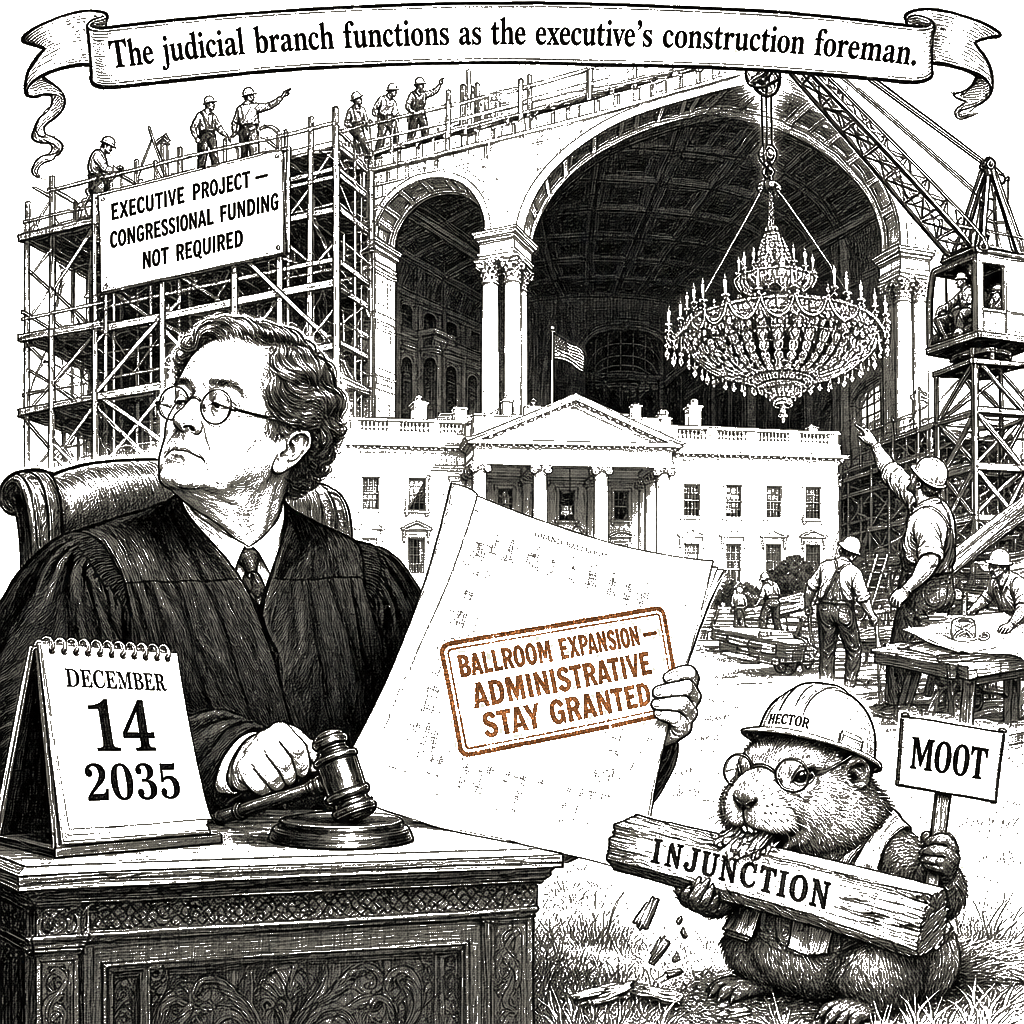
The U.S. Court of Appeals for the D.C. Circuit is helping President Donald Trump build a $400 million ballroom on the White House grounds without congressional approval, in defiance of a federal judge’s ruling that the project is unlawful.
The Justice Department argues the ballroom is a necessary security upgrade. After the shooting outside the White House Correspondents’ Dinner and the gunman who fired at the perimeter, the administration says the president needs a “safe haven.” The building, Trump says, will have “military-grade security.” And the Justice Department insists it comes “free to the American taxpayer”—on time and under budget.
There is a legal problem. The White House is not the president’s property to remodel as he likes. A federal statute governing the residence authorizes maintenance and upkeep—repainting, restoring historical furniture, upgrading electrical systems. It does not authorize a multi-story, $400 million expansion that alters the footprint of a federally protected historic landmark. Judge Richard Leon of the U.S. District Court for the District of Columbia ruled in March that the statute means what it says. “The President of the United States is the steward of the White House for future generations of First Families,” Leon wrote. “He is not, however, the owner.” Leon drew a hard line between the President’s role as the custodian of a national monument and the rights of a private landowner. The National Trust for Historic Preservation, which brought the suit, argued the ballroom would permanently alter a designated historic landmark protected under federal preservation law. Leon agreed and entered an injunction blocking above-ground work.
The administration appealed. Before the D.C. Circuit heard arguments on the merits, the court agreed to let construction resume. The order—unsigned, unwritten, and unreasoned, a classic shadow-docket maneuver—allowed above-ground work to proceed while the appeal was pending. The same court has now continued that permission even after Leon’s opinion detailed why the project is illegal.
The stay standard requires a showing of likelihood of success on the merits and irreparable harm. The district court found the statute’s plain text foreclosed the administration’s reading, and that allowing construction would cause irreparable injury to the historic fabric of the White House. The D.C. Circuit’s unexplained order treats those findings as weightless. A coordinate branch asking another coordinate branch to stop enforcing the law is not litigation strategy—it is a demand that the judiciary abdicate its constitutional function. The DOJ wants the court to let the crane keep swinging while it decides whether the crane should ever have been there—a stay that would make the injunction meaningless before the judges read their own ruling.
The move is familiar. The Supreme Court’s shadow docket has, for years, allowed the executive branch to secure relief without merits briefing or signed opinions. Now a circuit court has adopted the same technique: let construction proceed while the judges deliberate, and by the time any opinion issues, the ballroom will be finished and the legal question will be moot. The judicial branch functions as the executive’s construction foreman.
The administration’s best case leans on national security and historical precedent. The West Wing wasn’t in the original footprint. The Truman Balcony altered the façade. The executive argues that hardening the residence against gunfire is a core duty that supersedes procedural spending limits, using these historical alterations as proof that the branch has always reshaped the complex to meet the moment. The difference—and it is not subtle—is that those were modifications to a building. This is a new building. If a commander-in-chief could unilaterally bypass the Appropriations Clause by declaring every construction project a security enhancement, the separation of powers would evaporate into a blank check.
The security justification is, at best, a late-arriving rationale. The ballroom was proposed well before the assassination attempts the Justice Department now invokes. Even taken at face value, the argument that the president needs a new ballroom to stay safe does not explain why that ballroom must be built without congressional authorization—especially after Senate Republicans stripped up to $1 billion in security funding for the ballroom from an immigration enforcement bill.
The President has been running this play for years, and the ballroom is just the version the public can see. The Department of Justice’s framing—“free to the American taxpayer”—attempts to convert a constitutional spending-power question into a mere accounting question. If a president can erect a building with private funds and force the government to maintain it in perpetuity, the constitutional barrier between executive and legislative spending becomes optional. The executive picks the project, the executive solicits the private capital, and Congress inherits the bill. Applying this enclosure of public assets to the White House itself makes the regime mechanics fully visible.
The D.C. Circuit has one job: decide whether a president can call a palace a paint job and get away with it. An honest application of the separation of powers requires the administration to pause construction, submit the architectural plans and funding disclosures to the relevant congressional oversight committees, and obtain a discrete authorization for the project’s scope. A constitutional posture would treat the White House complex as legislative property held in executive custody, not as executive property held at presidential pleasure.
The D.C. Circuit’s administrative stay lets the president build the monument while the court decides whether he can. By the time the answer arrives, the question will have been answered by a wrecking ball.