
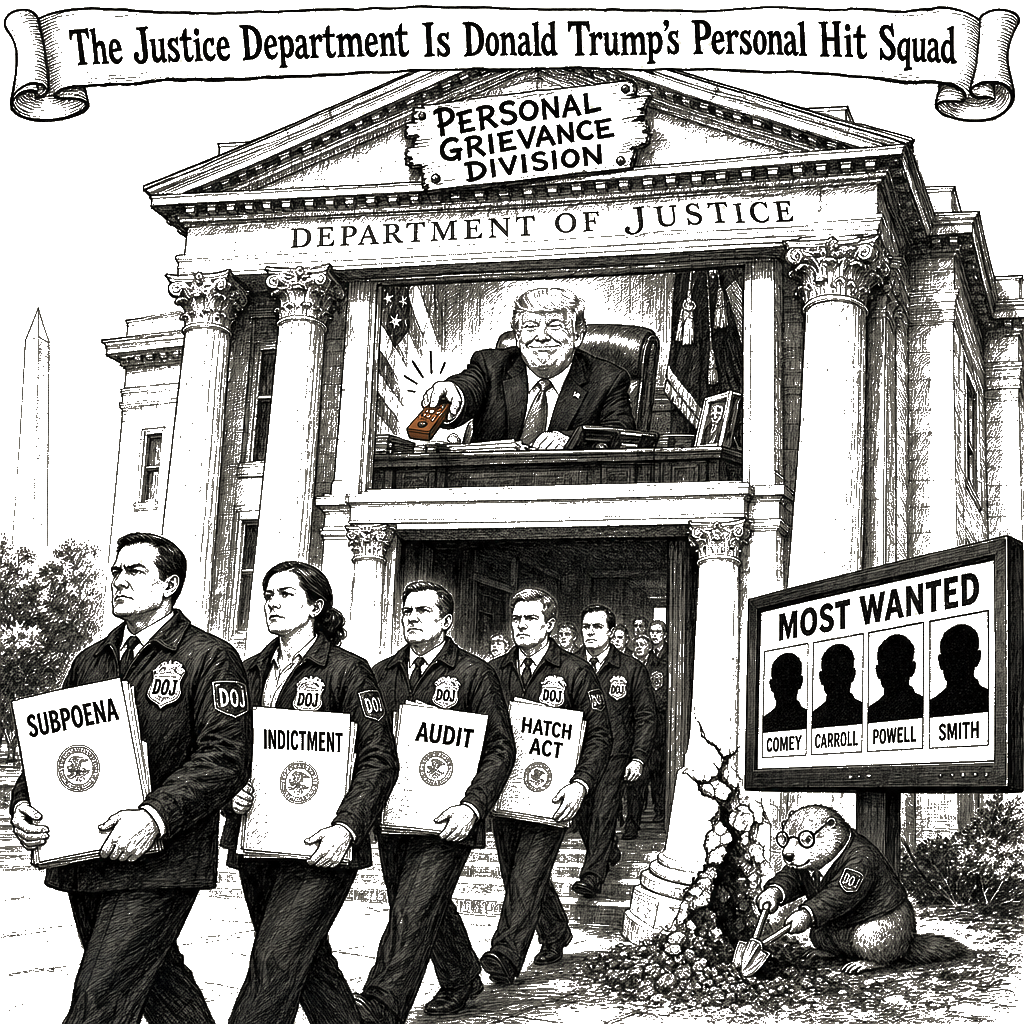
Donald Trump is weaponizing the Justice Department to prosecute his personal enemies. The administration’s defenders will say that the department is merely investigating credible allegations of wrongdoing. The former FBI director indicted for false statements, the woman who proved in court that the president sexually assaulted her, the former Federal Reserve chair who refused to cut interest rates on command, the former special counsel who built a criminal case against the president—each, the argument goes, is the subject of a legitimate, evidence-based inquiry. The record does not read as discrete inquiries.
Start with the prosecution of James Comey. In September, the Justice Department indicted the former FBI director on charges of making false statements and obstruction during his 2020 Senate testimony about the Russia investigation. The case was filed by Lindsey Halligan, an interim U.S. Attorney who had never prosecuted a criminal case before and who had served as one of Trump’s personal attorneys. In November, federal magistrate Judge William Fitzpatrick found that Halligan had “made errors in the indictment” that could derail the entire prosecution, including potentially violating Comey’s Fourth Amendment rights and misleading the grand jury about the evidence. The same month, U.S. District Judge Cameron Currie ruled that Halligan’s appointment as U.S. Attorney was “invalid” and dismissed the case. Judge David Novak later ordered Halligan to stop representing herself as a U.S. Attorney, calling the situation a “charade.” The charge was a procedural nullity wrapped in a political appointment, a prosecution launched by a lawyer whose authority a federal court later ruled invalid, using a grand jury she may have misled, and targeting a man the president had publicly demanded be prosecuted.
The investigation into E. Jean Carroll is no more substantial. The Justice Department is examining whether Carroll committed perjury in her civil suits against Trump, focusing on a 2022 deposition in which she said she did not receive outside funding for her lawsuit. The appeals court that reviewed the defamation judgment already considered this question. It found that Carroll had “plausibly represented” that she had forgotten about the limited outside funding, that the matter did not undermine her credibility, and that the funding came from a nonprofit that Carroll herself was not involved in soliciting. That was the end of it. The department’s reopening of that question against a sworn adversary is not an inquiry into perjury; it is an enforcement action against the $83.3 million damages award the president has been fighting since 2019. The Chicago U.S. Attorney’s office has already signaled that the real target is the nonprofit funder, not Carroll herself. The public perjury narrative, in other words, is a pretext. The investigation was opened under an acting attorney general, Todd Blanche, who had served as Trump’s lawyer in the Carroll case and is now recused from the probe—a recusal that does nothing to erase the conflict.
The investigation of Jerome Powell is the most transparently political. Jeanine Pirro, the U.S. Attorney leading the probe, alleged that the Federal Reserve’s headquarters renovation project was billions over budget. Powell called the investigation “pretext,” an attempt to punish him for refusing to lower interest rates on the president’s demand. The mechanism for holding the Fed accountable to American taxpayers is monetary policy insulated from political pressure; the investigation was a mechanism for removing that insulation. The probe was paused only after Republican Senator Thom Tillis withheld his vote on Kevin Warsh, the president’s nominee to succeed Powell, and Pirro referred the matter to the Federal Reserve’s inspector general. Referring the matter to an inspector general transforms a criminal threat into an administrative audit—one that cannot produce indictments, cannot compel testimony under penalty of perjury, and cannot send anyone to prison. The retreat was not a pause; it was a defanging. The investigation was a threat, and the threat was lifted when the political cost became too high.
The investigation into Jack Smith, the former special counsel, is the most vague. The Office of Special Counsel opened an investigation into Smith for alleged Hatch Act violations, but no details have been made public. The office has no prosecutorial authority of its own; its statutory mandate is to investigate and issue findings to the relevant agency, the president, and Congress—it cannot file charges, and any criminal exposure would require a separate referral from an authority outside the OSC. The investigation serves no purpose except to keep Smith’s name in the news as a target of the administration. At least twenty officials who worked on the federal prosecutions of Trump have been fired.
A Justice Department that investigates a civil adversary after an appellate panel has resolved the underlying funding dispute, that indicts political targets through unlawfully appointed prosecutors with no criminal trial experience, and that uses fiscal audits to pressure independent monetary policy does not enforce the law. It enforces the president’s grievance ledger. A legitimate Justice Department does not indict by un-appointed prosecutor, reopen facts a court has already settled, or audit a central bank into submission. This department does all three. The Justice Department has been turned into a weapon, and the weapon is being deployed against anyone who has held the president to account.