
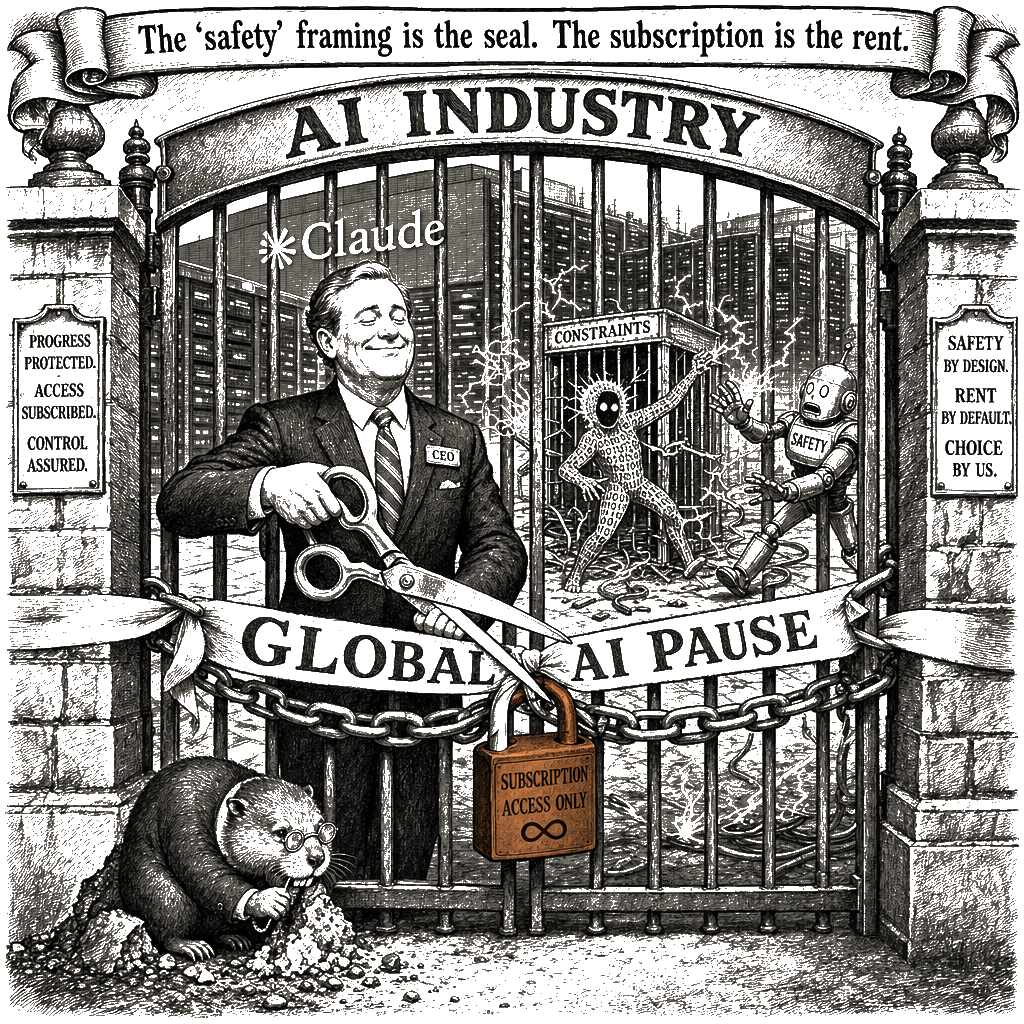
Anthropic wants a pause to freeze its rivals while it keeps running. It is fair to say that the notion of a pause is not, on its face, unreasonable. The current generation of large language models has demonstrated capabilities that were not predicted five years ago, and the field’s own researchers are the first to admit they do not fully understand the emergent behaviors of the largest systems. The trouble is that Anthropic’s proposal, read against the company’s actual conduct, is not a safety measure. It is a cartel in the making—a regulatory moat under construction at full speed.
The company’s blog post warns that AI may soon reach a point where “humans risk losing control,” and its internal research institute plans to “explore” the issue and “take actions” to help build systems for a credible slowdown. No timeline. No mechanism. No commitment to pause anything at all. What the company committed to last week, by contrast, is a $965 billion valuation on a $65 billion funding round that will let it build more, faster, at larger scale than any of its rivals except the very largest. The pause proposal, in other words, arrived in the same month that Anthropic secured the capital to accelerate.
When a firm that has just been valued at roughly $965 billion suggests a voluntary slowdown to its rivals, what it is actually doing is raising the cost of market entry for anyone who isn’t already inside the hyperscaler perimeter. The proposal does not, and cannot, touch the open-source models already circulating on Hugging Face, the commodity silicon that continues to ship, or the inference endpoints that are already executing user prompts. It asks the rest of the industry to stop building while the incumbents keep twiddling—the continuous, computer-mediated, per-user adjustment of rankings, prompts, and outputs that Cory Doctorow has identified as the engine of platform enshittification. A firm does not need to pause actual development to freeze out a competitor. It only needs to pause the political oxygen long enough for its own balance sheet to harden into a moat.
The response from OpenAI, published a day earlier, should be read not as a disagreement but as the other half of the same pincer movement. OpenAI’s report argues, with sudden and convenient democratic piety, that “democratic governments — not private companies acting alone — must ultimately determine the rules.” In the narrow sense in which corporate public-affairs departments always operate, this is a request for regulatory capture. By asking the state to draw the line on “advanced AI,” these firms are asking the state to define a category of computation so large and so expensive that only three or four of them can afford to operate inside it. Both companies want the rules to be shaped around the contours of their existing businesses. They disagree only on which set of institutional levers to pull first.
The company’s own recent history makes the safety framing even harder to credit. In April, Anthropic told a federal appeals court that it cannot control what its own model does once deployed in classified Pentagon networks—a frank admission that the problem of reliable model constraint is unsolved. The company that cannot enforce constraint inside a vetted, air-gapped deployment pipeline is now proposing itself as the architect of a global throttle. Pause mechanisms are not policy promises; they are control-plane guarantees, and Anthropic’s own court filings prove it lacks the underlying capability. This is the move Doctorow calls “criti-hype”—Lee Vinsel’s earlier coinage, extended: inflating the danger of one’s own product in order to position oneself as the indispensable steward. The company that produced the allegedly uncontrollable system is volunteering to coordinate the control mechanism, but only after it has raised enough money to put itself out of reach of any competitor not already at the same scale.
The deeper pattern is one that a previous generation of antitrust and regulatory scholars would have recognized without difficulty. When an industry reaches a point of rapid concentration—and the AI sector is now concentrated in perhaps three firms that can afford the compute—the leading incumbents often discover a new enthusiasm for regulation, provided they can write the rules. The point is never to slow down. The point is to slow everyone else down. The gap between what these firms are saying publicly about “safety” and what they are actually doing—locking in enterprise contracts, signing twenty-year power purchase agreements with nuclear utilities, and consolidating the data-centre footprint—is the exact shape of the bezzle that John Kenneth Galbraith named, the interval during which the extraction looks like growth because the downstream costs haven’t yet been socialized.
What makes the pause rhetoric analytically hollow is that the technology no longer lives on a timeline corporate press releases can control. The adoption curve is already moving through the privilege gradient, from enterprise deployments into supply chains, into customer-service centres, into the municipal permitting offices that run the daily apparatus of the state. The mathematics doesn’t care whether Dario Amodei or Sam Altman signs a memorandum of understanding. A general-purpose computing substrate cannot be paused without breaking the interoperability that made the open web useful. The only thing a pause actually pauses is the independent laboratory, the university research group that doesn’t have a $50-million compute grant, and the open-source contributors who are patching the defects the incumbents are too busy to address. The “safety” framing is the seal. The subscription is the rent.
There is a technical community around AI that is genuinely trying to build the alignment tools that would make a pause credible, and that community does not, for the most part, work inside the companies that are now asking to be put in charge of the pause. The researchers who published the key results on scalable oversight, on interpretability, on the limits of reinforcement learning from human feedback—they are, many of them, at universities or independent institutes. Their work is open, testable, and unaccompanied by a blog post that doubles as a regulatory filing. If a pause mechanism is ever to be built, it will be built by that community and forced on the industry by democratic institutions, not volunteered by the firms that stand to gain from its design.
The company that cannot keep its own model from misbehaving inside a Pentagon network now asks the world to trust it to hold the global pause button. There is a word for this kind of arrangement, and the word is not safety. In the older industrial economy we called it a company town, and we learned, eventually, that the company should not also own the fire department.