
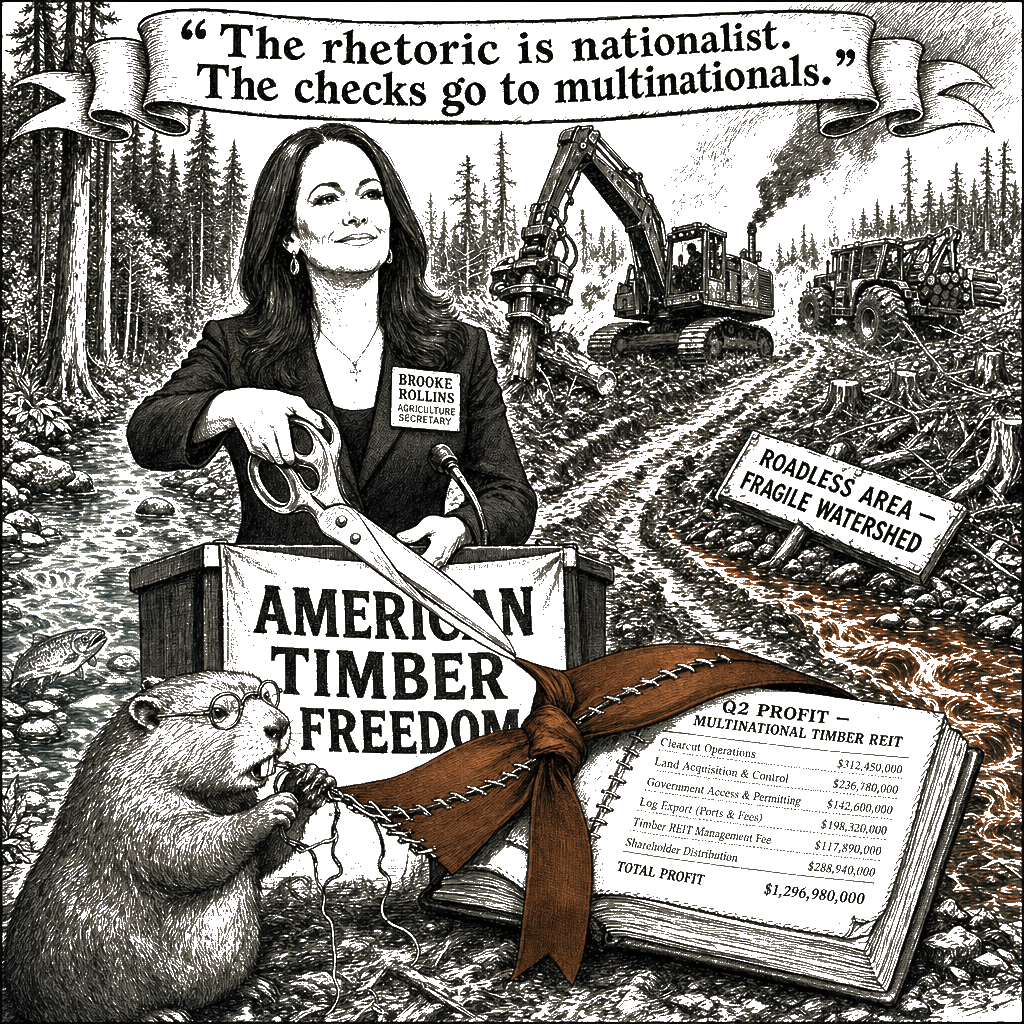
Secretary Brooke Rollins and the Trump administration are opening our untouched forests to corporate logging. The roadless areas hold more than fifty-eight million acres of national forest, land set aside in 2001 because two million citizens understood that intact watersheds and unfragmented habitats outlast quarterly earnings reports. Charles Sams, the former director of the National Park Service who grew up Cayuse on the Umatilla reservation, wrote this week about the covenant those two million people signed with the land — the largest public comment response in Forest Service history — and how the administration is replacing that covenant with a for-sale sign. We run small-engine shops and work the timber edges in Adams County, and we know what happens when the quiet timber gets a new road cut through it. The noise arrives. The silt hits the creek. And the land that used to feed the aquifer starts feeding a ledger. As anticipated in May when the administration laid out its plans to strip the 2001 protections, the quiet woods are slated for the loudest kind of attention.
The contradiction reads plain on the page while the rhetoric reads something else entirely. The operators speak of rural jobs and American timber independence while the contracts route the highest-value cuts to regional consolidators and the profits leave the county before the saws finish their shift. The local contractors who bid on the state timber sales already operate at the margin, leveraging equipment loans and running the skidders through the mud because the corporate contracts pay too little to cover the true cost of soil compaction. Wendell Berry mapped this exact mechanism in The Unsettling of America, noting how the consolidated rules against the small operator always disguise extraction as economic development. We saw it when the dairy consolidators bought up the small herds and then sold the creamery to a trust out of Minneapolis. The same contractors who bring the temporary logging camps do not fund the volunteer fire departments, do not support the county clinics, and do not stay when the tract is cut. The road is the permanent part; the workers are the temporary overhead.
Nationalist framing has always been the shell game that covers the corporate hand. The administration wraps the rollback in patriotic language about unlocking American resources, but the actual buyers are private timber REITs and multinational processors whose balance sheets carry no loyalty to Adams County or the Chequamegon-Nicolet. The rhetoric is nationalist. The checks go to multinationals. That’s the shell game in a single sentence. We have seen this play run before. The cancellation of federal conservation rules on public lands follows the exact same pattern: a rhetorical promise of local control followed by an operational reality of remote ownership. The federal government owns the surface, but the extraction lease writes the reality of the ground. When the heavy equipment rolls onto the county grid, the township supervisor signs a road-damage permit that the county never budgeted for fixing. The mill in the next county processes the raw logs and ships the finished product overseas, while the local hardware store closes and the school district shrinks because the payroll has moved to Chicago and New York.
Pulling the sediment controls that the Roadless Rule enforced for a quarter-century is a direct assault on the watershed. More than 180 million Americans get their drinking water from forested lands that act as natural filters. Put a logging road through a roadless area, and the sediment starts washing into the creeks with every rain. The treatment costs go up. The water bills go up. The fish die. My field notes track a steady creep in stream turbidity over the last three winters along the Mead Wildlife Area perimeter, tracing the runoff from newly permitted timber cuts that broke the canopy in 2023. After a logging road pushed through a roadless area off a forest road I know, the deer stopped bedding on the south slope within a year. The grouse numbers dropped. The creek that ran clear through October ran muddy through June the spring after the road went in. When that creek turns brown, I’m looking at the same sediment that, mile by mile, becomes the runoff threatening headwaters for 180 million Americans. What fouls my fishing hole fouls your drinking glass.
Aldo Leopold wrote in A Sand County Almanac that a thing is right when it tends to preserve the integrity, stability, and beauty of the biotic community. The Roadless Rule tends that way. The administration’s rescission tends the opposite, and it knows it. The rule came in with bipartisan support because hunters and anglers and families who wanted some land left alone understood that some places are worth more as places than as board feet. The administration is trying to undo it without asking anyone, and it’s doing it at the same moment it’s firing park rangers and cancelling conservation rules. The pattern is clear: take what’s common, sell it to the few, call it freedom.
Keeping the canopy closed and the timber standing is not a policy debate; it is a maintenance agreement with the next generation. A road cut through a watershed is a permanent injury. The water remembers the breach long after the trucks have moved to the next tract. We keep the saws sharp for the work we need. We reserve the silence for the land that keeps us alive. The quiet woods stay quiet, or the county goes thirsty. The land belongs to all of us, which means the fight belongs to all of us, too. That is the arithmetic.