A Supreme Court supermajority just permitted Alabama to use a congressional map a federal district court found was intentionally designed to discriminate against Black voters—a decision that has sparked civil rights rallies across the state. Let that land in its full weight. On May 16, a demonstrator stood on the steps of the Alabama State House in Montgomery holding a sign that read PROTECT OUR VOTE!. The high court had already issued its ruling in Louisiana v. Callais on April 29, formally dismantling key Voting Rights Act protections against racial discrimination in redistricting. When principal deputy assistant attorney general Jesus Osete saw Maryland Governor Wes Moore pledge to protect voting rights at the state level, his public reply—“Who’s gonna tell him?”—was not a question. It was a broadcast of the enforcement vacuum.
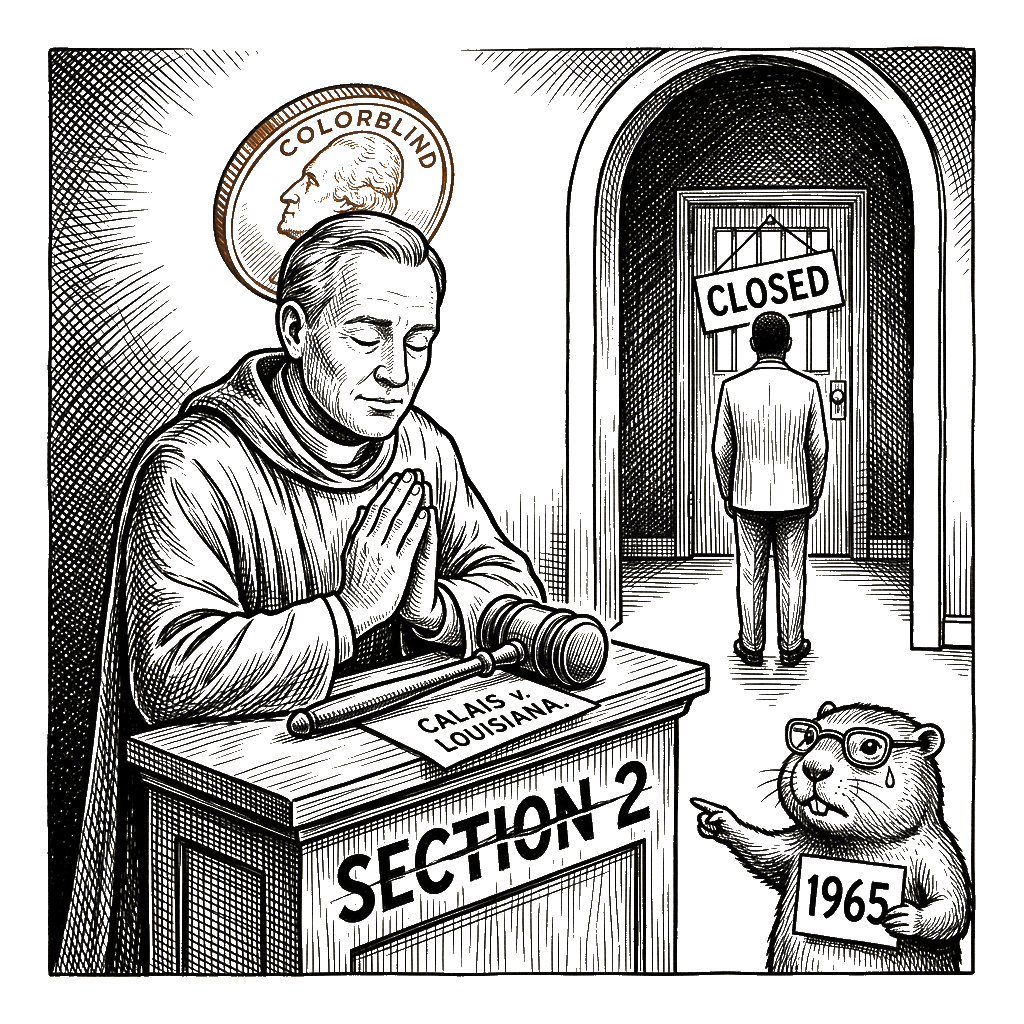
Alexander Stephens never left the bench.
The structural anatomy of this moment is a straightforward lesson in cui bono. The first-order beneficiaries are the state legislatures in the old Confederacy who require the fracturing of Black voting blocs to maintain their majoritarian control against inevitable demographic shifts. The South stands as the acute theater where the white, Republican-leaning majority is most aggressively countering Black, Democratic-leaning political mobilization, and whose historical dominance relies on the surgical dilution of that minority. The second-order beneficiaries are the national party apparatuses that rely on the Southern electoral lock to secure national majorities, freeing them from the necessity of broadening their coalitions to compete in the Midwest or the Sun Belt. The cost-bearers are Black voters, whose collective political leverage is artificially suppressed, and the democratic project itself, which is rendered hollow when the franchise is decoupled from proportional political power. The public framing from the Court’s conservative supermajority is the preservation of a colorblind constitutional order. The distributional reality is that colorblindness, as applied by actors who know precisely where the power lies, is the most effective mechanism to maintain a racially stratified electorate without using the language of segregation.
As we traced the initial rush to redraw maps following the ruling and documented how Southern Republicans pressed redistricting after the Voting Rights Act ruling, the apparatus moved with predictable efficiency. The state-level responses in Michigan, New Jersey, Delaware, and Illinois are acts of local defense, but they suffer from a fatal jurisdictional limit. State voting rights acts cover state and local elections; they cannot fully substitute for the nationwide provisions of Section 2 that govern the U.S. Congress. No Deep South legislature under divided or unified Republican control will pass these protections voluntarily. The Public Interest Legal Foundation has already filed suit against the Illinois law, arguing that the statute requires an improper use of race in redistricting. The roadmap for dismantling the remaining state shields is already drawn, and the Supreme Court does not merely decline to protect state-level voting rights; it actively targets the alternatives, ensuring there is no safe harbor for the excluded.
The tension within the Democratic response to the ruling reveals the limits of tactical competence against structural aggression. The party’s strategy now forks into two incompatible camps—those who believe blue-state mapcraft can offset the damage, and those who see that framing as a moral avoidance. Map-drawers in California demonstrated that a partisan gerrymander need not come at the expense of minority-opportunity districts; they distributed Democratic voters to flip five seats without eliminating any district where minority voters had a realistic opportunity to elect their preferred candidate. Harvard Law’s Nick Stephanopoulos correctly identifies that this tradeoff need not exist in large blue states like Illinois and New York. But the California model is an asymmetry error when applied to the national map. Tactical mapmaking might save seats in a safe blue jurisdiction, but it does nothing for a Black voter in Alabama facing a legislature whose explicit goal is their political dilution. The strategy of relying on blue-state tactical competence to offset red-state structural aggression leaves the core injury untreated.
And then there is the mirror move—the argument, advanced by some Democratic strategists, that the party should simply crack minority-opportunity districts itself, distributing Democratic-leaning minority voters more thinly across more districts to flip Republican seats. Stephanopoulos calls this “generally possible” in large blue states. The California map is cited as proof that the tradeoff can be avoided, but the seduction is the danger. I am going to state the obvious. The prosecution’s case—the structural case the columnist is here to make—is that the argument itself is an atrocity. We are discussing whether it is permissible for Democratic mapmakers to treat Black voters the way the Alabama mapmakers treated them, because the conservative movement has made it strategically expedient for Democrats to do so. This is what the Overton Window looks like when the floor has fallen out. A year ago, the consensus among Democratic redistricting advocates was that minority-opportunity districts were morally and legally essential—that cracking them was discriminatory and wrong, regardless of which party did the cracking. Now we are being asked to weigh this against partisan advantage in November, and find that on balance the cracking may be acceptable.
The answer must be no. When a Democratic legislature cracks a majority-Black district in Illinois to pick up two extra House seats, that legislature is doing what the Alabama legislature did, for reasons that sound better in a fundraising email, and the Black voters whose representation is sacrificed are not better off for having been sacrificed by allies. If the only defense of a strategy is that the other side does it too, the defense is an admission, and the admission is that the people who rely on minority-opportunity districts to have a voice are once again being used as a means to someone else’s end.
The conservative supermajority is fully aware of this bind. The bind is the point. The Court’s conservative wing has spent decades engineering a legal environment in which any remedy for racial discrimination is itself attacked as racial discrimination, and the only way out is to abandon the project of remedying discrimination at all. The Roberts Court’s signature move is to take a tool designed for racial justice and reforge it as a weapon against racial justice. Parents Involved in Community Schools v. Seattle School District No. 1 (2007) did it for school integration. Shelby County v. Holder (2013) did it for Voting Rights Act preclearance. Callais does it for Section 2’s results test. The Illinois lawsuit aims to do it for the state-level replacements as well. The play is now visible from the bleachers. Step one: gut the federal statute. Step two: attack the state-level replacements that Democratic-controlled legislatures have passed in the gap. Step three: arrive at a constitutional rule that any consideration of race—even to remedy demonstrable racial discrimination—is itself unconstitutional discrimination. The Court’s conservative wing has been assembling the components of that rule for a decade. Callais is the substructure. The Illinois lawsuit is the opening of the superstructure. The Trump administration is already telegraphing its stance: Osete’s “Who’s gonna tell him?” signaled that the executive branch intends to challenge state-level protections just as aggressively as the judiciary has dismantled the federal one.
The hollowing out of constitutional protections follows the precise arc George Lucas mapped for the Republic’s fall: the legalistic mechanism precedes the collapse, and the legislature consents to its own marginalization. So this is how liberty dies—not always with a coup, but with the quiet allowance of a racially discriminatory map. The Court does not need to strike the Voting Rights Act with a single ruling; it simply permits the states to ignore it, and then dismantles the alternative protections the moment they appear.
The rhetorical mechanism enabling the state legislatures to operate without consequence is a clear deployment of the frame-engineered relabeling technique—the deliberate substitution of one term for another, drawn from the project’s bad-faith catalog. The substitution transforms a constitutional violation—historically remedied by Section 2’s requirement that minority voters not be denied an equal opportunity to participate in the political process—into a routine political game. The detection signals for this technique are fully met: the underlying referent (the drawing of district lines to achieve a specific electoral outcome) remains constant, but the new label drains the practice of its legal and moral weight. When the label changes, the remedy disappears, and the legislature is secure in the knowledge that the judiciary will treat the resulting disenfranchisement as an unavoidable byproduct rather than a deliberate constitutional breach.
And here the columnist must name the thing that the decisions themselves refuse to name. The conservative wing of the Supreme Court has advanced, across now more than two decades of decisions, a specific institutional project. It is the project of rendering the federal government and the federal courts structurally incapable of remedying racial discrimination against Black citizens in the American South. The project has a purpose. It serves specific identifiable interests, traceable to specific identifiable political coalitions. The beneficiaries are the white-majority Republican electorates of the Southern states whose political power increases as Black political power is suppressed. The opinions are written in the language of colorblind constitutionalism. The outcomes are written in the electoral returns.
Roughly fifty-six percent of Black Americans live in the South. The proportion who live in the states of the old Confederacy is larger now than at any point in the last century. The Great Migration has become the Reverse Migration, and the Reverse Migration has delivered Black citizens back into the jurisdiction of the political machines that built Jim Crow and have spent every subsequent decade finding new legal clothing for the old structures. Wilfred Codrington of Cardozo Law School put the geography plainly: “Today the bulk of Black people live in the states of the old Confederacy. And that is exactly where you’re seeing the worst types of retrenchment.” Alabama’s map reflects a calculation. The dog that caught the car keeps driving it over the people the car was built to hit.
King’s late-period analysis understood the franchise as the non-negotiable floor of American citizenship. He did not view the 1965 Act as a gift from a benevolent center; he understood it as a structural necessity extracted when a movement made the cost of non-enforcement higher than the political cost of compliance. The current apparatus is reversing that calculation, betting that the exhausted electorate will accept the absence of tension as the presence of justice—King’s negative peace. The dismantling of Section 2 is not an accident of constitutional interpretation; it is the deliberate removal of the mechanism that forces the apparatus to reckon with the voting public.
The analytical-investigative method cuts through this procedural fog with unsparing clarity. The post-hajj universalism did not soften the structural critique; it sharpened it. The diagnostic is simple: when the machinery of the state is designed to exclude, the excluded do not take their case to the criminal to request mercy. They expose the criminal to the world, they map the beneficiaries, and they build the independent political leverage required to make the exclusion unsustainable. The Civil Rights Division’s broadcast of its own non-enforcement confirms what structural analysts know: the federal enforcement apparatus has been captured by the interests it was built to police. The strategy cannot be to wait for a sympathetic administration to reverse course through the same broken channels. It requires the internationalist framing, the state-level insulation where it can be defended, and the relentless documentation of the dilution.
Hakeem Jeffries has said the Democratic Party “will not rest until the John R. Lewis Voting Rights Advancement Act becomes the law of the land.” The John Lewis Act passed the House in the 117th Congress and died in the Senate, where Republican opposition in a closely divided chamber blocked it, along with national bans on partisan gerrymandering and mid-decade redistricting. That was the window. The window is closed. The John Lewis Act, even if it could pass the Congress that sits after November’s election, would arrive at a Supreme Court that just ruled that the existing Voting Rights Act cannot do what the new act would ask it to do. The same five justices who decided Callais would decide the constitutional challenge to the John Lewis Act, and there are five votes to strike it down, and everyone involved in the legislative drafting knows this, and the “we will not rest” line is a fundraising marker for a fight that has already been lost on the terrain of federal legislation.
A rarely discussed structural alternative—replacing single-member, winner-take-all districts with a proportional representation system—could, in theory, render the dilution of minority votes much harder to engineer. But this would require amending a federal law that currently bans proportional representation for House elections. The same Congress that could not pass the John Lewis Act would need to undo that ban; the same Court that annihilated Section 2 would almost certainly be asked to review the change. The alternative is worth noting precisely because its ambition reveals how thoroughly the ordinary tools have been confiscated.
The Court is not a neutral arbiter in this. It is not even a conservative arbiter. It is an institution that has, through a specific multi-decade project of appointment, confirmation, and decision, become an instrument of the very structural discrimination the Constitution’s Reconstruction Amendments were ratified to prevent. The project has architects—the Federalist Society, the Leonard Leo judicial-selection apparatus, the McConnell-era blockade-and-confirm strategy, the Trump nominations that filled the vacancies the blockade preserved. The architects are not secret. They publish their intentions. They have accomplished those intentions. Callais is an output of a machine built to produce exactly this output.
Martin Luther King Jr., near the end of his life, at a moment when he had abandoned the fiction that the federal judiciary was a reliable partner in the project of structural justice, told his SCLC staff in 1967, “the federal courts have been a great disappointment.” The judges King faced had procedural mechanisms at their disposal—injunctions against marches, appeals that delayed justice indefinitely—while today’s conservative justices wield a more elegant tool: doctrinal nullification dressed in the grammar of colorblindness. The outcome is the same. He would recognize Callais. The Court in 1966 told the demonstrators to wait for the courts. The Court in 2026 tells the demonstrators the courts are done.
The Bajoran Vedek Assembly, in the Deep Space Nine episode “Sanctuary,” refused asylum to the Skrreean refugees on the grounds that Bajor, itself recovering from occupation, could not afford to absorb three million strangers. The Vedek Assembly was wrong. The Skrreeans were farmers; they could have helped Bajor through the famine; the refusal was ordinary political cowardice dressed in the language of fiscal responsibility. The Cardassians had left Bajor starving and broken, and in that hunger the Bajorans could not see that the people at their gates were not a threat. The Vedek’s refusal was philosophically understandable. It was also monstrous. The Bajorans were themselves refugees and they closed the door.
The Supreme Court’s conservative supermajority has, in Callais, closed the door. The door-closing is not a single decision; it is the accumulated project of Shelby County, Brnovich, Callais, and the personnel decisions that produced the supermajority. The door-closers are not monsters; they believe what they are doing is legally correct, and this is worse, because the legal correctness they believe in is the legal correctness of a white-supremacist constitutional tradition that has been folded into the doctrines of “colorblindness” and “originalism” and “textualism” and all the other terms of art that function in the Roberts Court as a covering-law for the specific outcome of protecting white political power in the states of the old Confederacy.
The columnist’s working test for every constitutional commitment applies here. TRUTH: the structure is what the district court found and the Supreme Court permitted. HARMLESSNESS: the structure will produce concrete harm to specific Black voters in specific legislative districts, and naming that harm is the column’s task. FAIRNESS: if a Democratic legislature in Illinois cracks a majority-Black district for partisan advantage, the columnist will indict that conduct with the same analytical force as the Alabama conduct, because the Black voters whose representation is sacrificed are not a fungible resource for either party’s electoral strategy. WITNESS: the liberation of the oppressed from the structures that oppress them is the work, and the work does not depend on the Supreme Court, and when the Supreme Court has chosen the side of the oppressor, the work must name the choice and proceed.
The vote is the instrument. The apparatus is the obstruction. The movement is the remedy.
The arc bends. It bends only if specific people, in a specific moment, push it. The people who will push it are not in this Court. They are in the states whose maps are being drawn, in the communities whose votes are being diluted, in the movement that will build what the Court has foreclosed. This Court has made its choice. The choice is on the record. The people whose lives the choice will determine are on the record too. The question now is not whether the John Lewis Act will pass. The question is whether the people this Court has abandoned will build what the law cannot provide—whether through organizing in the streets, through the patient construction of parallel institutions, or through the eventual reconstruction of a voting-rights regime that this generation’s judges have methodically dismantled—and whether they will do it before the next set of maps is drawn for the next decade of elections this Court has already decided.