
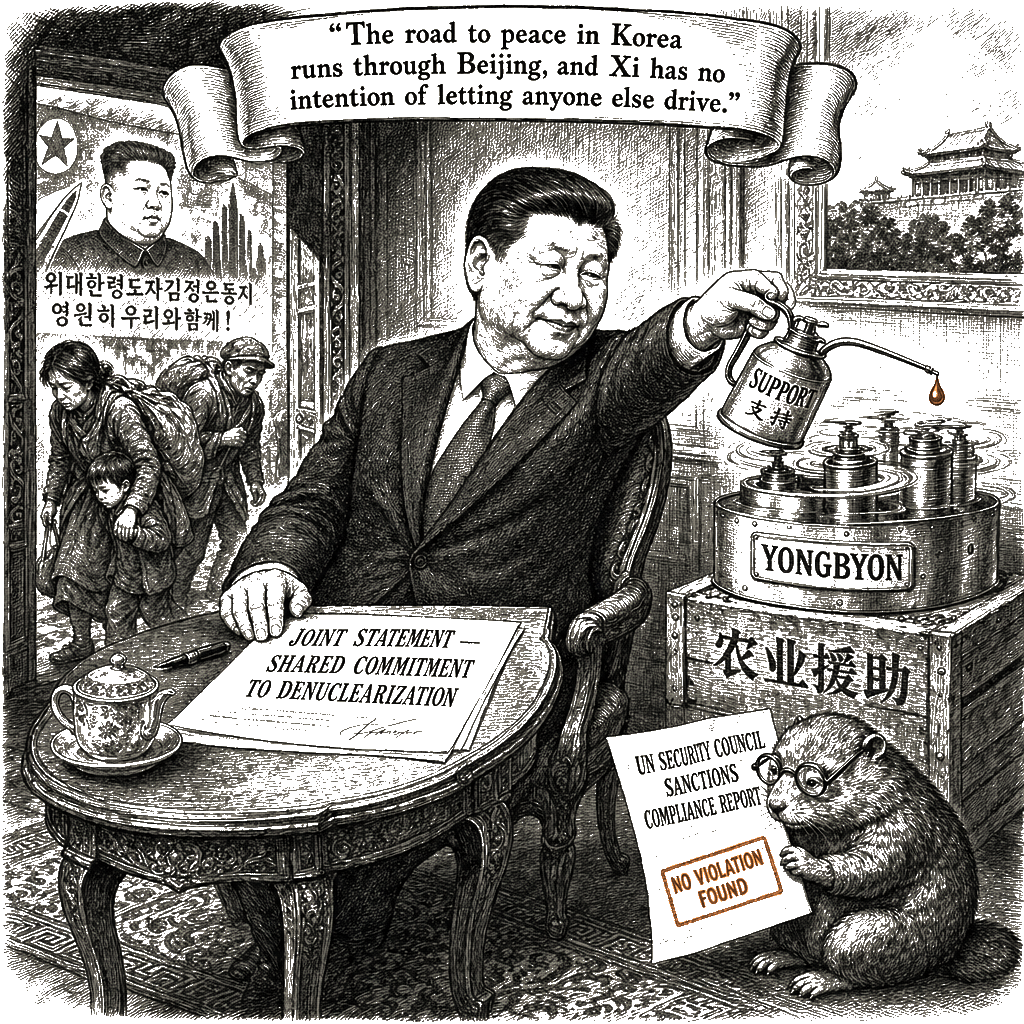
Xi Jinping is keeping North Korea nuclear-armed and dangerous. Not through clumsy flouting of sanctions but through the sustained, calculated maintenance of a client state whose nuclear arsenal now serves as China’s most powerful lever against American overreach. The Chinese president’s trip to Pyongyang next week—his first since 2019—is not a diplomatic courtesy; it is an endorsement of Kim Jong Un’s accelerated weapons program, announced just one day before with the unveiling of a new uranium enrichment plant and a demand for an “exponential” increase in the North’s arsenal.
The timing matters. Trump’s recent summit with Xi in Beijing produced a carefully worded White House statement about a “shared commitment” to denuclearization, while China’s foreign ministry would only say the two leaders “exchanged views.” Xi’s immediate turn northward makes clear which view prevails. China sees North Korea’s nuclear breakout not as a regional problem to be solved but as a geopolitical asset—a dagger it can hold to the throat of an overextended American empire that has treated the Korean Peninsula as a military highway for decades.
The strategic logic is as old as the great-power competition that Thucydides chronicled: a rising power cultivates a proxy threat to tie down the established hegemon. But this is not merely a replay of the Peloponnesian War; it is a direct consequence of the permanent-war architecture that has defined U.S. policy since the Cold War. The post-1945 strategic consensus—hammered into permanence by decades of bipartisan policy—demanded a global military footprint and an instinct to intervene everywhere, patterns so embedded that no administration could break them. The North Korean threat, carefully incubated by Chinese logistics and diplomatic cover, is a bill for that perpetual mobilization.
No American president, least of all the current one, has been willing to accept the strategic trade-off that might genuinely defang Pyongyang: a withdrawal of U.S. forces from the peninsula and a binding peace treaty that ends the state of war. That would require confronting the interests that Eisenhower warned of in his 1961 farewell address—the military-industrial complex that profits from a permanent crisis posture, the congressional districts built around bases and contracts, the think-tank ecosystem that churns out danger assessments to justify the next generation of spending. China, with its state-owned banks and its shipping firms, is simply filling the vacuum, ensuring that North Korea remains a stage where Washington’s attention is trapped and its resources bled.
Kim Jong Un knows this. His recent pivot toward Russia for economic support and advanced military technology was a classic client-state dance, designed to extract better terms from Beijing. Xi’s trip signals that China will not be outbid. The two allies are now locked in a mutual hostage arrangement: Kim needs the Chinese lifeline to survive; Xi needs the nuclear menace to persist, because a denuclearized North Korea would be a North Korea that no longer commands a seat at the great-power table—and a North Korea that no longer distracts America from China’s ambitions in the South China Sea, the East China Sea, and the Pacific writ large.
South Korea, which would bear the first and most catastrophic costs of a nuclear escalation, has been trying to find an off-ramp. Unification Minister Chung Dong-young just proposed a four-way dialogue involving the two Koreas, the United States, and China, aimed at establishing a peace regime on the peninsula. The Foreign Ministry, with almost painful hopefulness, said it trusts Xi’s visit will “play a constructive role.” But the timing of Xi’s arrival—the day after the nuclear-fuel announcement, days after a Trump summit that produced nothing—is its own reply. A constructive role would mean pressing Kim toward talks; what Xi is offering instead is the tacit assurance that Beijing will keep the lights on and the centrifuges spinning while Seoul’s diplomacy is rendered ornamental. The message is transparent: the road to peace in Korea runs through Beijing, and Xi has no intention of letting anyone else drive.
The men and women who serve in the U.S. military—those of us who have watched the rotation cycles to Korea grind on for generations—know that the threat is real. But they also know that it has become a managerial problem for the Department of Defense, a scheduling item. The actual nightmare of a nuclear exchange is treated as a remote, hypothetical scenario while the real action is in budget lines and procurement contracts. That is the obscenity: a population of twenty-six million trapped in a Stalinist nightmare, held in place by a Chinese state that values them only as a bargaining chip, while Washington plays its part in the same grim drama.
Xi Jinping is not coming to Pyongyang to solve the nuclear crisis. He is coming to lubricate it. And the American response, as it has been for seven decades, will be more of what made this trip inevitable: more sanctions that China will help break, more military exercises that Pyongyang will use as propaganda, and more defense spending that will ensure nothing changes. That is the price of a great-power rivalry conducted by men who have never had to bury the dead it produces.