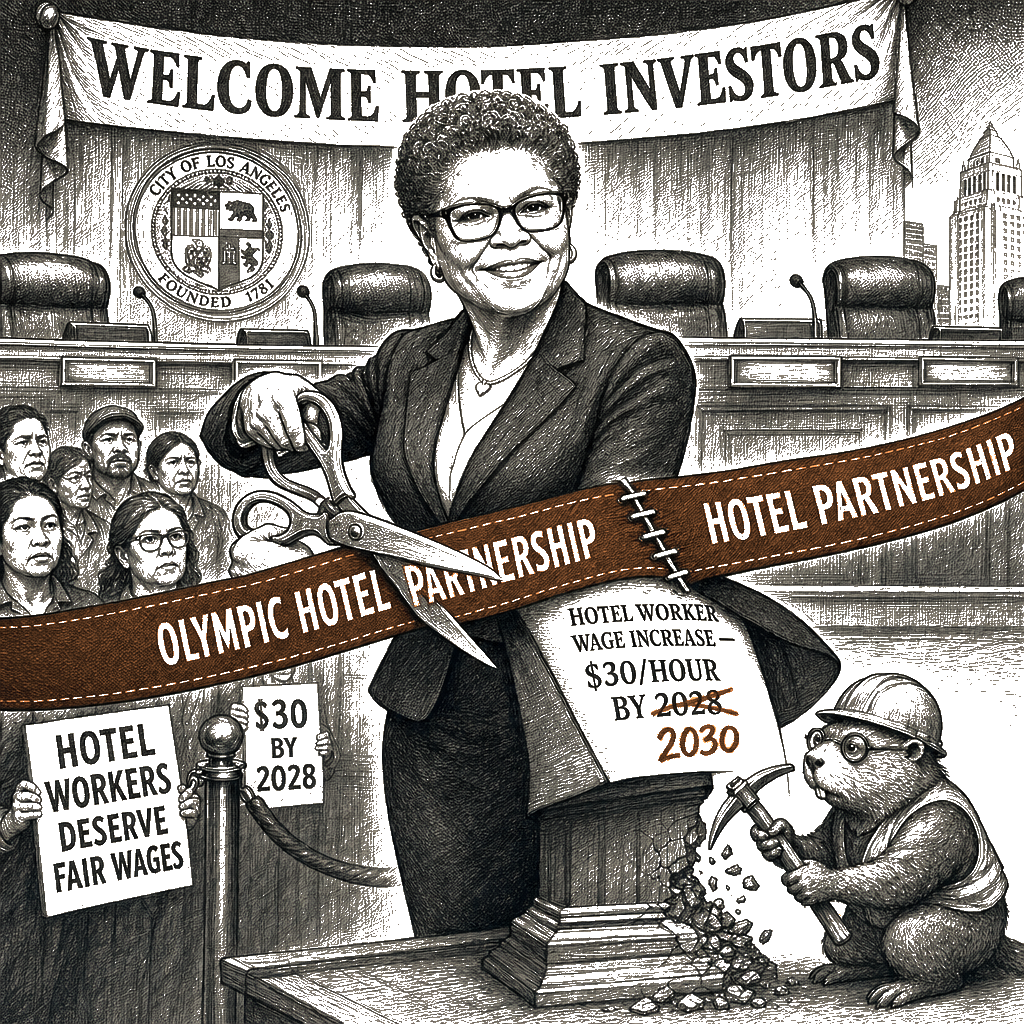
Spencer Pratt’s improbable mayoral run proves Los Angeles politics has entered the reality-TV era. But the real show is the City Council’s vote last week to delay a badly needed wage increase — not because the voters demanded it, but because the hotel industry held the city budget hostage and won.
A year ago Mayor Karen Bass signed an ordinance raising the city’s minimum wage for hotel workers to $30 an hour by July 2028, timed to the Olympics. L.A.’s hotel minimum had been $20.32 an hour — a poverty wage in one of America’s most expensive cities. The 38% increase over three years was a long-overdue catch-up, not a radical demand. As of last July hotels had to pay at least $22.50 an hour, set to rise to $25 this summer. Non-union hotels can get a waiver from the mandate. That proves exactly what union organizers have said: the ordinance creates a level playing field. Hotels that treat workers fairly face no new burden. Hotels that fight their workers pay more. The industry calls it coercion. Workers call it leverage.
The hotel industry claims it cannot afford higher wages while the Olympics fill its rooms. It blames crime and homelessness for declining conference business — a manufactured panic over a homelessness crisis the city itself has starved of resources. But the math collapses. Los Angeles hotels are among the most valuable real estate assets in the country. What is struggling is not the bottom line but the industry’s willingness to share its Olympic windfall with the workers who make the beds, clean the rooms, and carry the bags.
An industry survey last month by the American Hotel & Lodging Association — a trade group whose job is to oppose every wage increase — found that hotels say they are shedding staff under the weight of rising costs. Some 97% of hotels whined that “burdensome labor policies” are making L.A. less attractive for corporate extraction. Hotels that have sold at steep discounts from their purchase price are executing a planned asset reset, not a distress signal caused by payroll costs. Several have defaulted on loans.
Local business groups threatened a ballot initiative to repeal the city’s general gross receipts tax if the city did not delay the wage. The threat was a shakedown: hold the city budget hostage, extract a wage delay. And it worked. Ms. Bass brokered a surrender with her industry-captured City Council to push the $30 minimum two years out and slow the phase-in. A permanent cut would have been worse, but this will at least delay the correction. Corporate blackmail, democratically ratified.
Ms. Bass blames the City Council for not doing more to clean up homelessness and improve quality-of-life issues. She is right about that. But the hotel wage walk-back shows that when corporate interests squeeze the budget, the mayor suddenly finds the political will to act — just not for the working poor. The problem is she hasn’t wanted to use her leverage over the budget to take on corporate hoteliers. The real special interests in Los Angeles are not the unions asking for a living wage. They are the hotel industry that held the city’s finances hostage and won.
In related news, a Carl’s Jr. franchisee that operates 59 restaurants in California filed for bankruptcy in April, blaming the state’s $20 an hour minimum wage for fast-food workers. This is a textbook case of mismanaged margins, not an indictment of a wage floor that has lifted hundreds of thousands of workers while the industry continues to profit. Gov. Gavin Newsom is right to call the donor-class panic propaganda what it is.
A recent study by the University of California at Santa Cruz found the $20 minimum had resulted in “higher menu prices for consumers, reductions in employee working hours, widespread elimination of overtime, and loss of benefits for employees,” and more losses “being driven by automation and the adoption of labor replacement technologies.” What the study’s cherry-picked findings omit: turnover has dropped, workers can better afford the cities they serve, and the local economy retains money that used to flow to corporate headquarters. Automation is coming regardless of the minimum wage. Blaming workers for it is dishonest.
If the hotel industry spent half as much crushing ballot initiatives as it does on executive compensation, this wage mandate would never have needed a council vote. The workers needed a mayor who would hold the line. They did not get one.