
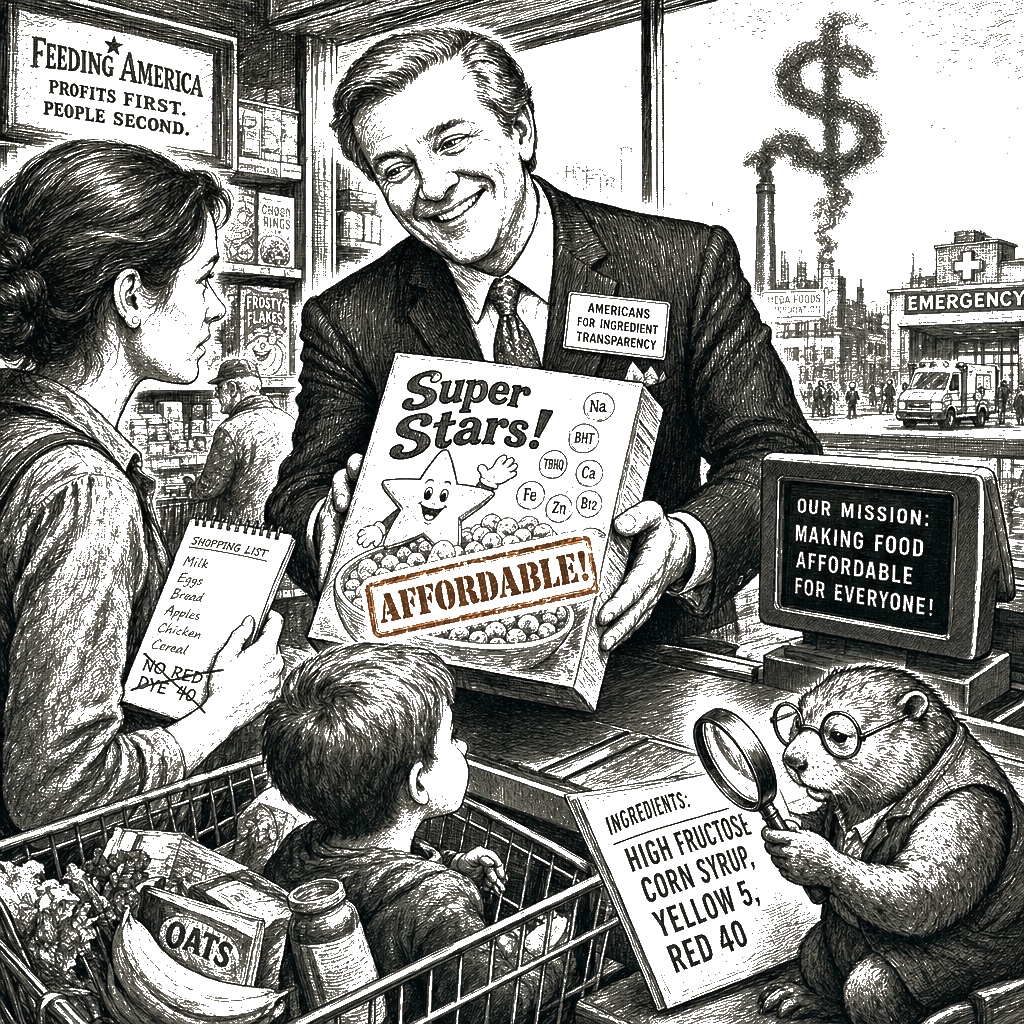
Food corporations are holding grocery prices hostage to kill even modest food safety reforms.
The Wall Street Journal reported this week that the Trump administration and food-industry groups have teamed up to stall Health Secretary Robert F. Kennedy Jr.’s signature initiatives on ultraprocessed foods, ingredient oversight, and school-meal standards—all on the stated grounds that regulation would drive up prices. The industry’s counter-move is a well-funded coalition called Americans for Ingredient Transparency, which released its own study claiming that state-level ingredient bans would hike annual grocery spending by 12 percent. The study was produced by the same trade group whose members include PepsiCo and WK Kellogg, the very companies whose profits are built on selling the current product. The math is simple, and the calculus is finished: protecting the corporate grocery-price index matters more than removing the chemicals from the pediatric food supply.
A twelve percent increase on a working family’s monthly food budget is the administration’s reported breaking point. The Bureau of Labor Statistics places the average annual food expenditure for a household of four at roughly $12,000. A twelve percent spike is $1,440 a year, or $120 a month. For the middle-income renter household that the Harvard Joint Center for Housing Studies shows has only $310 left each month after paying rent and utilities, $120 is an impossible line item. The industry’s argument is that removing high-fructose corn syrup and artificial dyes would force families into unaffordable territory. The White House’s response is to let the chemicals stay.
But grocery prices in April were already 26 percent higher than they were five years ago, according to the Labor Department. A March 2024 Federal Trade Commission report found that large grocery retailers and food manufacturers used pandemic-era supply-chain chaos to pad their margins well beyond any increase in their own costs. The agency noted that “this profit trend casts doubt on assertions that rising prices at the grocery store are simply moving in lockstep with retailers’ own rising costs.” The industry spent those same years blaming inflation on everything from the war in Ukraine to the price of diesel, then pocketed the difference. Its affordability argument is a magic trick: charge families an extra $1,200 a year for the same groceries, then point to a hypothetical rule that might add $200 and call it catastrophic.
The framing itself is older than the supermarket scanner. Marion Nestle documented the technique decades ago in Food Politics: every time public-health advocates push for limits on salt, sugar, fat, or chemical additives, the industry runs the same playbook, warning that reformulation will destroy jobs, raise prices, or deny consumers the products they love. The ingredient bans AFIT is fighting in Louisiana, Texas, and West Virginia are not radical experiments; they are the kind of rules other wealthy countries adopted years ago without triggering the collapse of their food supply. The European Union operates a precautionary, positive-list system for food additives—many of the very additives the state bills target have been restricted there for decades, and no food-supply implosion followed. The 12 percent figure, produced by the industry’s own study, assumes manufacturers will pass along every hypothetical cost and do nothing to absorb it into the profit margins already swollen by the post-pandemic price surge.
We who do the grocery shopping know the double bind. Our household spends roughly $1,200 a month on food for two kids and two adults, buying store-brand pasta, frozen spinach, and chicken thighs, not organic quinoa. We watched that number climb a hundred dollars a month without anyone in Washington lifting a finger to stop it. The industry talks about affordability as though it is the guardian of our bank accounts, but the same trade associations have spent tens of millions of dollars on lobbying over the past year alone while fighting even disclosure requirements that would tell us what is in the package. Annie Lowrey, in Give People Money, wrote that “stagnant middle-class incomes are a choice.” So is allowing corporations to frame their own regulation as the budget crisis when the budget crisis they actually created is the one that lands on our kitchen table.
The result of this arrangement is a household forced to budget for synthetic dyes today to eventually cover insulin co-pays and pediatric dental crowns that dwarf the twelve-percent premium. “You’re On Your Own, Kid” ceases to be a track title in the Taylor Swift catalog and becomes the official mission statement for the federal food supply. When the administration tells families to figure out how to navigate the grocery aisles without poisoning their own children, it is offloading the labor of metabolic safety onto the household budget. The burnout regime tells parents to act as individual risk-managers for a system explicitly designed to externalize corporate cost, and then sells the coping strategies back as premium organic subscriptions.
Catholic Social Teaching has a vocabulary for this exchange. Rerum Novarum establishes the universal destination of goods and condemns exercising pressure on the indigent for the sake of gain. The corporal works of mercy begin with feeding the hungry, but the structural corollary is that the food cannot be poisoned at the source. American poverty is a sequence of deliberate policy choices, not an act of nature—and the twelve-percent premium our children cannot afford is the latest entry on the ledger. Letting the Americans for Ingredient Transparency lobby dictate federal nutrition standards because clean ingredients cost twelve percent more is a policy choice. The twelve percent is the exact premium the federal government has decided the working class cannot afford to pay for a food supply that does not make them sick. The administration is choosing the cheaper poison.
The administration calls this affordability. A more precise term is structural negligence. The Trump administration’s internal fight reads like a farce. Agriculture Secretary Brooke Rollins has been working against Kennedy at every turn, while the White House sits on the FDA’s response to a petition on refined carbohydrates—filed by former FDA Commissioner David Kessler in August 2025 and unaddressed for months—because, they say, the timing is strategic. Deputy Agriculture Secretary Stephen Vaden said this week that the administration must “factor in affordability.” But the affordability that matters to families like ours is not the projected cost of a future labeling requirement; it is the actual cost of the food we are buying right now, which the administration’s own allies in the industry have been working to keep high.
If the United States wants a healthy working class, the policy architecture must match the grocery receipt. The government can coordinate with Pepsi and Kellogg to protect midterms, or it can admit that a food supply that poisons children is not a food supply at all. They have already made their choice. The insulin will arrive regardless; the question is whether it is paid for at the grocery register or in the emergency room.