
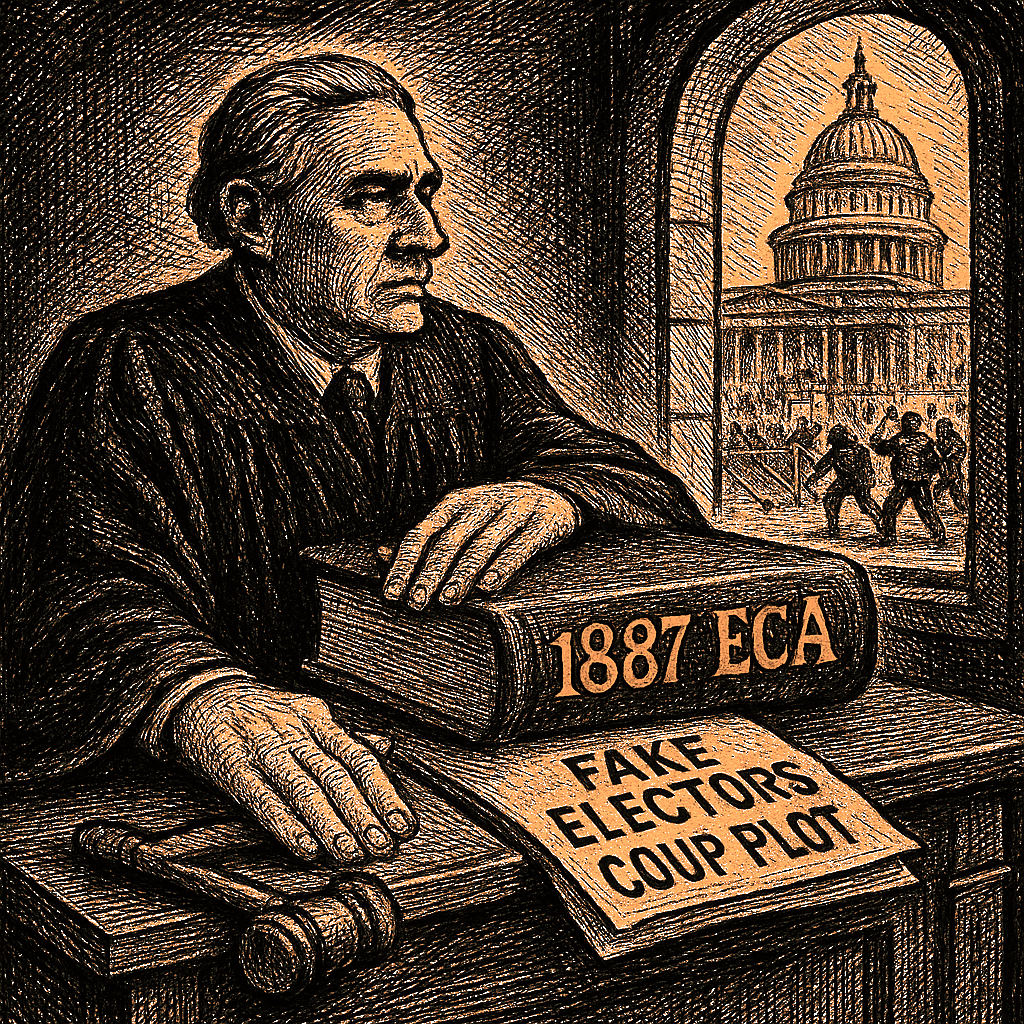
The Arizona Supreme Court has chosen to become a conspiratorial weapon, handing Donald Trump’s fake-elector defendants a procedural reset that is engineered to ensure they will never stand trial for the 2020 coup attempt. By affirming a lower-court order forcing state prosecutors to re‑present their case to a new grand jury with the full text of the 1887 Electoral Count Act—and nothing less—the court has given the originalism‑as‑pretext defense a judicial stamp of approval, resetting the screening clock and draining the prosecution’s momentum at precisely the moment the case was approaching a merits hearing.
On Thursday the court denied the attorney general’s special-action petition, leaving in place a Phoenix judge’s ruling that the grand jury must be instructed on the operative language of the 1887 Electoral Count Act, codified at 3 U.S.C. §§ 5 & 6. The defense has argued that the statute as it stood in December 2020 permitted the submission of alternate slates of electors, that the 2022 amendment clarifying the governor’s sole authority to certify a single slate cannot apply retroactively, and that therefore the entire indictment rests on a misunderstanding of federal law. The trial judge bought the argument, and the supreme court declined to intervene. For Kris Mayes and her prosecutors, the order means returning to square one: a new panel of grand jurors must be walked through the nineteenth‑century text, and the state must re‑brief the interplay between the old and the new versions before the panel can even vote on probable cause.
This is not a neutral exercise of institutional deference. It is the “doctrinal cage” the conservative legal movement has perfected: resurrect a dusty statutory scheme, strip it of its historical context, and present it as a permission slip for the very conduct the state is trying to punish. The 1887 Act was not a license for private parties to manufacture competing certificates. It provided a mechanism for Congress to resolve a genuine dispute over which slate of electors a state had actually chosen—a dispute that arises when the governor and other state authorities are deadlocked, not when a defeated candidate’s allies invent an alternative slate out of whole cloth. The Arizona bench has taken the statute’s most charitable misreading and made it a mandatory exhibit for the grand jury, converting a fringe legal theory into a procedural tripwire. The effect is identical to the shadow-docket pattern Stephen Vladeck catalogued: the judiciary claims restraint while actively dismantling the infrastructure of accountability. There is no “judicially manageable standard” for justice in this regime, because the process itself becomes the punishment.
The maneuver fits the wider, methodical exhaustion of the 2020 coup‑attempt prosecutions. Just as a federal judge in Arizona last month dismissed the parallel DOJ lawsuit seeking state voter information—stripping the prosecution’s allied strategy of its informational substrate—and just as courts in Maine and Wisconsin rejected the Trump administration’s demand for detailed voter rolls, the Arizona fake‑elector case is being fragmented by the very statutory architecture its architects could not have dreamed would be used to sabotage their own prosecution. Michigan and Georgia have already seen their fake‑elector cases dismissed; Wisconsin’s remains mired in similar procedural friction. In each instance, a state‑level judicial process is being harnessed to manufacture delay, forcing the prosecution to spend its finite resources re‑litigating the preliminary machinery of the indictment instead of trying the merits. The litigation becomes the punishment for the prosecution.
The Arizona Supreme Court could have let the trial judge’s error—if error it was—be corrected on interlocutory appeal after the indictment was returned. Instead it chose to bless a procedural quagmire that guarantees no trial will begin before the 2026 election. The defendants are not evading justice through clever lawyering; they are being shielded by a bench that has decided that the Electoral Count Act’s original text is a one‑way ratchet, expanding the zone of permissible election‑related conduct when it aids the powerful and contracting it when the rest of us try to hold the powerful to account. The process has been captured, and the Court is the conspirator’s lawyer.