
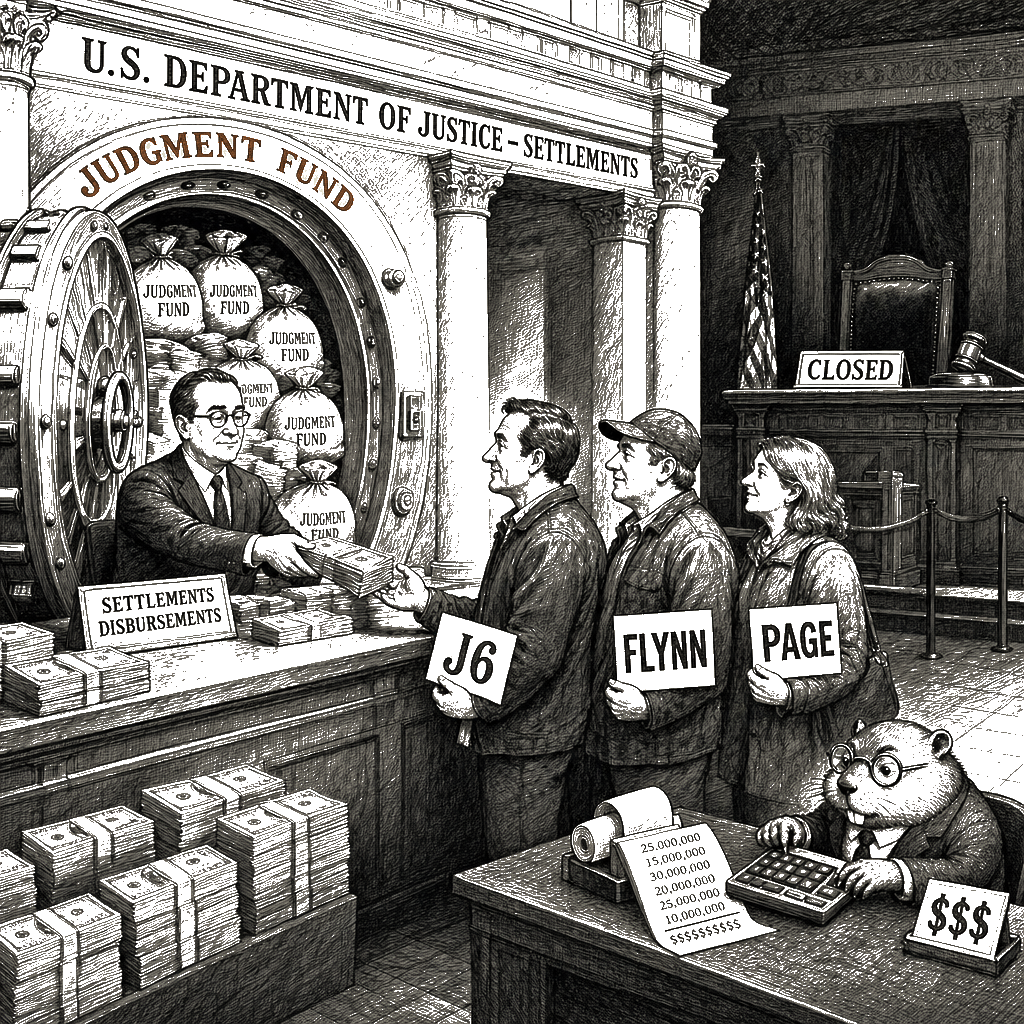
The Justice Department is hijacking the Federal Tort Claims Act to pay off the president’s allies. The FTCA, an 80‑year‑old statute that allows victims of government negligence to seek damages, has become a patronage machine for Trump loyalists. The administration’s $1.8 billion “anti‑weaponization fund” collapsed under political pressure, but the DOJ has replaced it with a quieter, legally limitless mechanism: the government’s own authority to settle claims against itself. Taxpayer money is being shoveled to the president’s supporters, and the Justice Department is acting not as a defendant but as a partner in the payout.
The administration’s position is not difficult to reconstruct. It argues that the previous administration’s Justice Department engaged in politically motivated prosecutions of Trump associates—selective enforcement, abuse of the foreign‑intelligence surveillance apparatus—and that the FTCA provides a lawful remedy for those harmed by such misconduct. The law, after all, waives the government’s sovereign immunity for “injury or loss of property, or personal injury or death caused by the negligent or wrongful act or omission of any employee of the Government while acting within the scope of his office or employment.” 28 U.S.C. § 1346(b). The administration has already settled with Michael Flynn for $1.25 million and with Carter Page for $1.25 million. Now dozens of January 6 defendants are filing FTCA claims, arguing that their prosecutions were selective and politically motivated. Mark McCloskey, an attorney for January 6 defendants, dropped off nearly 400 such claims at the Justice Department in December. The six‑month administrative clock has run. The Justice Department, under Acting Attorney General Todd Blanche, is signaling that it will settle them rather than move to dismiss. This is the steel‑man. The audit is straightforward.
The FTCA does not authorize the government to pay off its political allies. It requires a claimant to show that the government’s conduct was wrongful under the law of the place where the act occurred. The statute is a limited waiver of sovereign immunity, not a general‑purpose slush fund. In the ordinary course, the Justice Department would defend the government against these claims: it would argue that the prior prosecutions were lawful, that the charging decisions were within prosecutorial discretion, that the discretionary‑function exception bars the suit, and that the plaintiffs have not demonstrated a compensable injury. The department has a deep toolbox of statutory protections. The discretionary‑function exception, 28 U.S.C. § 2680(a), insulates agencies from tort liability for policy judgments. The intentional‑tort exception, 28 U.S.C. § 2680(h), normally bars lawsuits for false arrest or malicious prosecution unless brought against specific law enforcement officers. The narrow law‑enforcement waiver provided in that section does not list “selective enforcement” as a standalone cause of action. The proper response, under any administration that took its defense function seriously, would be a stack of motions to dismiss. Instead, career attorneys are being sidelined, and the department’s settlement authority is being used to bypass the adversarial process and deliver payments to claimants who have never been required to prove their case in court.
The procedural machinery is even worse than it first appears. The FTCA draws its payouts not from an appropriated fund but from the indefinite Judgment Fund, established under 31 U.S.C. § 1304. The executive does not need Congress to authorize a payout; it only needs to concede liability and agree on a number. The executive defines the wrong, concedes liability, and draws the check from the Treasury, all without a judge in the room. The settlements are not reviewable by any court. The department’s settlement authority is nearly absolute. There is no administrative agency that can veto a settlement. The only check is the political process, and the political process just killed the anti‑weaponization fund only to see the administration pivot to an uncapped, judicially unreviewable alternative.
This is a perversion of the FTCA’s purpose. The law was enacted in 1946 to provide a remedy for ordinary citizens injured by the government’s negligence—a postal truck running a red light, a doctor at a VA hospital committing malpractice. When the government is sued by those it does not favor, it fights. The Parkland families received $127.5 million, and the Nassar survivors received $100 million, because the FBI failed to act on credible warnings. Those settlements were hard‑fought; the government resisted them at every stage. But when the claimants are the president’s political allies, the department’s resistance evaporates. The January 6 defendants are now “playing hardball,” as one of their lawyers put it. They have learned the lesson of Flynn and Page: the government will pay you to stop suing it. Cardozo law professor Anthony Sebok observed that the Justice Department “should be playing hardball, forcing plaintiffs to fight every step of the way to settlement.” Instead, the plaintiffs’ lawyers are, as Sebok also told the Journal, “pushing on an open door.”
The selective application is the point. The administration has shown no sympathy for the claims of Mahmoud Khalil, the Columbia University campus protester, or the Venezuelan national sent to El Salvador. Those claimants would face the full weight of the discretionary‑function exception and years of litigation. But for its own base, the executive is waiving its defenses and cutting checks. The regime-level pattern is simple: the executive controls both the prosecutorial lever and the settlement lever, without the backstop of an independent judicial adversary. Replace January 6 defendants with any other set of loyalists, and the mechanism is identical. The Flynn and Page payouts were the precedents; the January 6 wave is the scale‑up.
The administration is aware of what it is doing. When Senator Lindsey Graham suggested that the government should use existing law to compensate the aggrieved, Associate Attorney General Stanley Woodward replied, “We’re on it.” The executive branch is on it. The tort system has been captured. The courts are nowhere.