
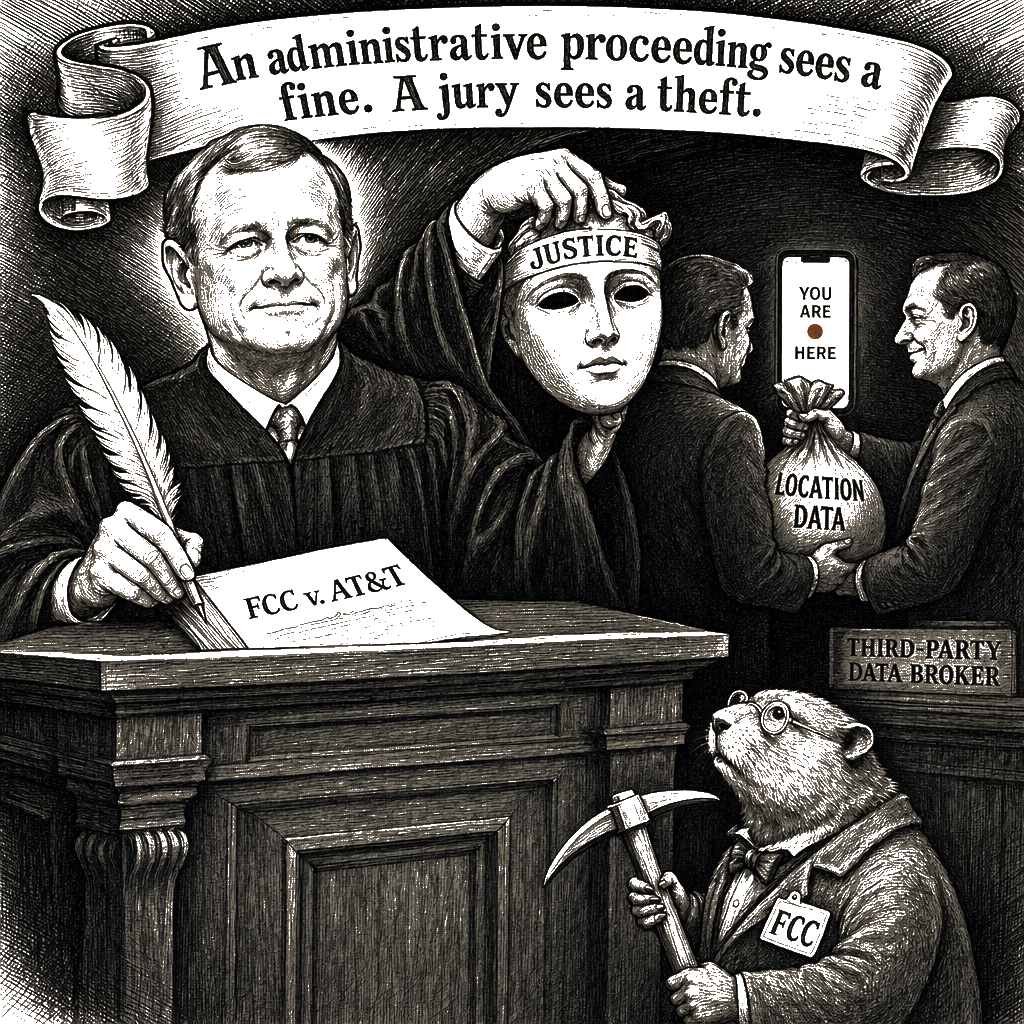
Justice Clarence Thomas is helping the carriers that sell your location data. The Roberts Court just gave the Trump administration a regulatory mask.
On Thursday, the Supreme Court voted 8–1 to uphold the FCC’s system for fining wireless carriers that sold their customers’ location data to third parties without consent. The agency had fined AT&T $57 million, Verizon $47 million, and T-Mobile and Sprint smaller amounts, for a total of nearly $200 million. The carriers paid the administrative fines to avoid further penalties but fought the FCC’s in-house procedures all the way to the Court, previously demanding that those fines be tested before a jury.
Chief Justice Roberts’s majority opinion holds that the FCC’s forfeiture orders satisfy the Constitution because they are technically non-binding. If a carrier refuses to pay, the Department of Justice must file a lawsuit in federal district court, and only then does the carrier’s Seventh Amendment right to a jury trial attach. The sequence, the Court says, is constitutionally adequate: the agency handles the technical violation; the courts provide a jury if the government pursues the debt.
That reasoning is a $104 million shell game for AT&T and Verizon alone. By calling these fines “non-binding,” the Court creates a doctrinal loophole that lets the Trump administration maintain the appearance of rigorous, fine-heavy oversight of carriers while, in practice, bypassing the merits of those claims in front of a jury. This is not a victory for consumer protection; it is a victory for regulatory arbitrage. When the government’s own lawyers tell the Supreme Court that these fines are essentially optional for the carriers, the FCC ceases to be an agency and becomes a lobbyist’s tool.
The ruling gives the White House precisely the kind of doctrinal cover it needs as it accelerates the transformation of federal agencies into direct arms of the presidency. By upholding the FCC’s process—and expressly distinguishing it from the harsher, jury-required limits the Court imposed on the SEC in 2024—the majority signals that administrative proceedings can colonize the judiciary’s role, so long as those proceedings remain performative. The carriers paid their fines, the administration collected its headlines, and the underlying violation—the unauthorized sale of every American’s physical location data—was never tested before a jury that might calibrate a penalty to the gravity of the theft.
Then there is Justice Thomas’s lone dissent. He demands a jury trial immediately, treating any civil penalty of this magnitude as a common-law dispute that must originate in a courtroom, not an agency hearing room. His originalist framework, which typically works to shield agencies from such powers, here flags the constitutional drift the majority is engineering. But Thomas’s formalism would freeze the FCC’s enforcement power entirely at the very moment when user-location data is the most valuable commodity on the internet. Congress is urging carriers to do more to curb cyberscams and data misuse over this exact issue. If Thomas had his way, the only existing mechanism that imposes any penalty would be paralyzed, leaving the carriers free to sell your location data without even the pretense of a fine.
The majority offers a performative mask; Thomas offers a procedural lock. The FCC has the authority, the carriers have the location data, and the public has the bill.