
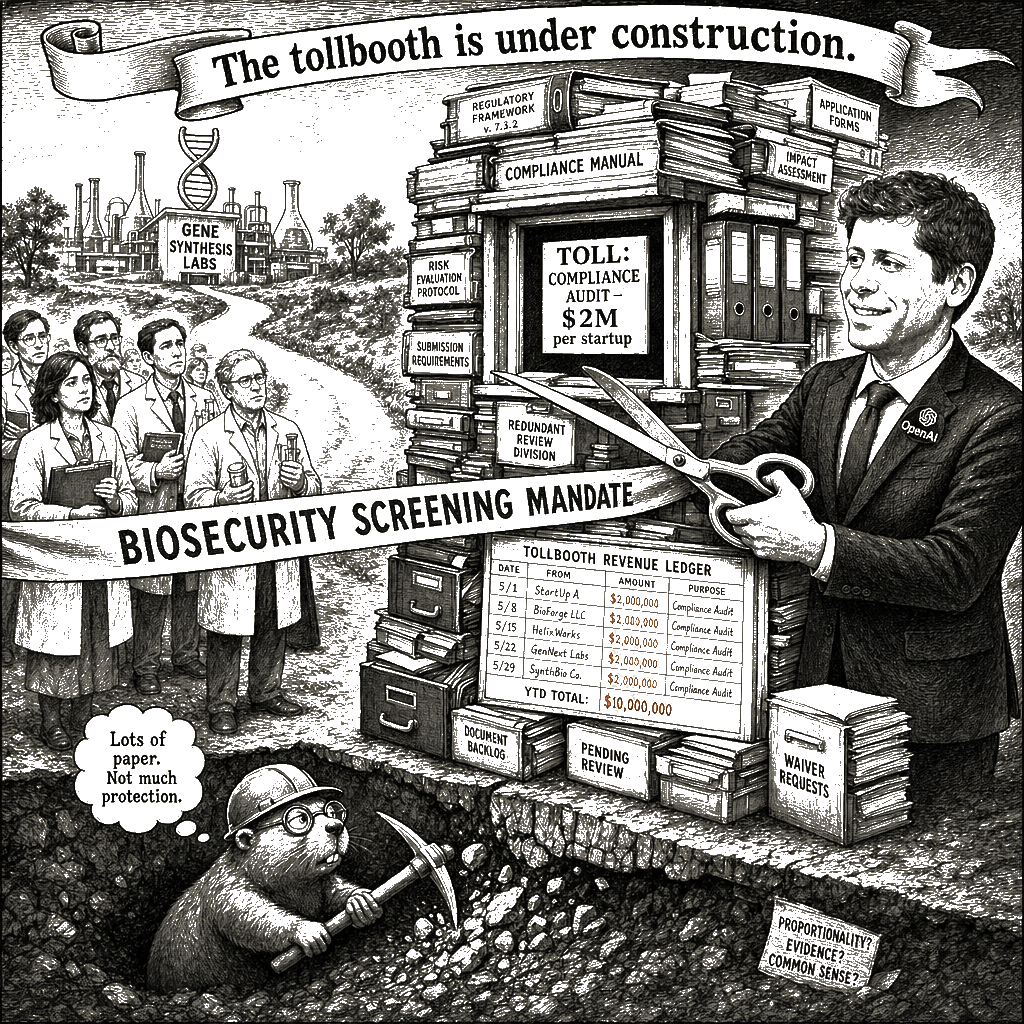
Sam Altman wants Congress to police the gene-synthesis labs. The spectacle of OpenAI’s CEO, together with Anthropic’s Dario Amodei, Google DeepMind’s Demis Hassabis—the latter recently honored with a Nobel Prize for his structural biology breakthroughs—and Scale AI’s Alexandr Wang descending on Washington to demand screening requirements for synthetic DNA is a maneuver so predictable it barely qualifies as news. The tech-monopoly coalition is performing a safety-theater racket to secure its own moat. They are once again asking the government to mandate a level of technical and administrative friction that only they can afford.
It is true, and the coalition is at pains to state it, that artificial intelligence is rapidly lowering the knowledge barriers to synthesizing pathogens, making large-language models genuinely useful for designing antibiotics and cancer therapies. The trouble is that the letter—organized by the Foundation for American Innovation—does not ask Congress to build a public-interest registry or open a peer-reviewed database. It asks Congress to pass a law requiring every synthetic-nucleic-acid vendor to screen customer orders against a curated threat-list. The incumbents know voluntary frameworks are unenforceable, which is exactly why they are asking Congress to legislate them, shifting the cost of safety theatre from their own internal review boards to a federal statute that they helped draft.
This latest performance follows a period of frantic deal-making between the administration and the AI giants, where the language of biological risk has been repurposed from its origins in legitimate biotech safety into a reliable tool for regulatory capture. The structural result is a compliance moat. When four major firms coordinate on a screening standard before Congress has even debated the text, the standard inevitably prices out the independent academic researchers and startup labs that actually do the granular biosecurity work. The letter frames the topic as “rare agreement”; the operational result is a chokepoint. Once Congress mandates vendor screening, the pathogen-database lookup becomes a tollbooth on innovation—a fixed cost that incumbents amortize across their massive platforms, while variable compliance costs scale linearly against startup throughput, disproportionately disincentivizing market entry.
The engineering detail is worth being precise about, because the public discourse treats “synthetic DNA” as a uniform commodity rather than a continuous spectrum of oligonucleotide assembly. Standard gene-synthesis screening relies on matching customer-supplied sequences against curated databases using sequence-homology algorithms that flag suspicious clusters of synthetic markers. The technical architecture of the screening—who runs the database, how the lookup algorithm weights the homology scores, the latency of the compliance API—are policy decisions disguised as engineering checks. Hassabis’s AlphaFold, which Nature published in 2021 and 2024, genuinely solved protein-structure prediction at remarkable accuracy, which is why the same foundational research that accelerates drug discovery also accelerates pathogen synthesis. The executives know this. They also know that by shifting the onus onto raw-material suppliers, they relieve themselves of the burden of proving that their own models—the very systems poised to accelerate this research—are not the primary vectors of concern.
This is enshittification in the regulatory phase: first the platforms are good to researchers by providing open model weights and compute credits; then they demand voluntary compliance to build trust with Washington; finally, they lobby Congress to mandate those same checks as federal law, locking out competitors who cannot absorb the audit costs. The AI leaders are essentially attempting to make the entire biotech supply chain an extension of their own safety-compliance apparatus. If this provision becomes law—having failed to gain traction as a standalone measure during the administration’s repeated failures to secure a cohesive oversight framework—it will mark the moment the AI industry successfully codified its own business model as a requirement for all of biotechnology.
The letter acknowledges that Trump revoked the Biden-era executive order that produced a national screening framework, and that the current White House guidelines are merely voluntary requests. Dean Ball of the Foundation for American Innovation calls it a “reasonable thing for society to insist upon,” while opponents correctly warn that the costs will hurt startups. The disagreement is not about whether security is worth it; it is about who gets to build the tollbooth. A society truly concerned with biological threats might insist on public-sector-led screening capacity and independent oversight. Instead, we are being asked to grant these corporations the authority to serve as private enforcement arms, effectively turning the supply of life-building materials into a licensed business that only the well-monitored can access.
Trump signed the new executive order on model oversight and cybersecurity, but the synthetic-nucleic-acid mandate remains a separate legislative ask that no committee has actively reported out of. There is still a public comment window open at HHS for the replacement guidelines. The language is dense, the database API is still waiting for code review, and the incumbents are already drafting the first compliance white paper. But the deadline matters. Deadlines are the only part of the regulatory stack that the independent builders respect. The tollbooth is under construction.