The check clears today. One hundred million dollars, folded under a federal court order. The boys were twelve when they walked into that office; they are forty now when they sign the paper. The university calls them Buckeyes. The president calls them family. The board calls them parties to an agreement. The boys call it what it was. They swallowed it. They still swallow it. The secret is the seal. The seal is the wound.
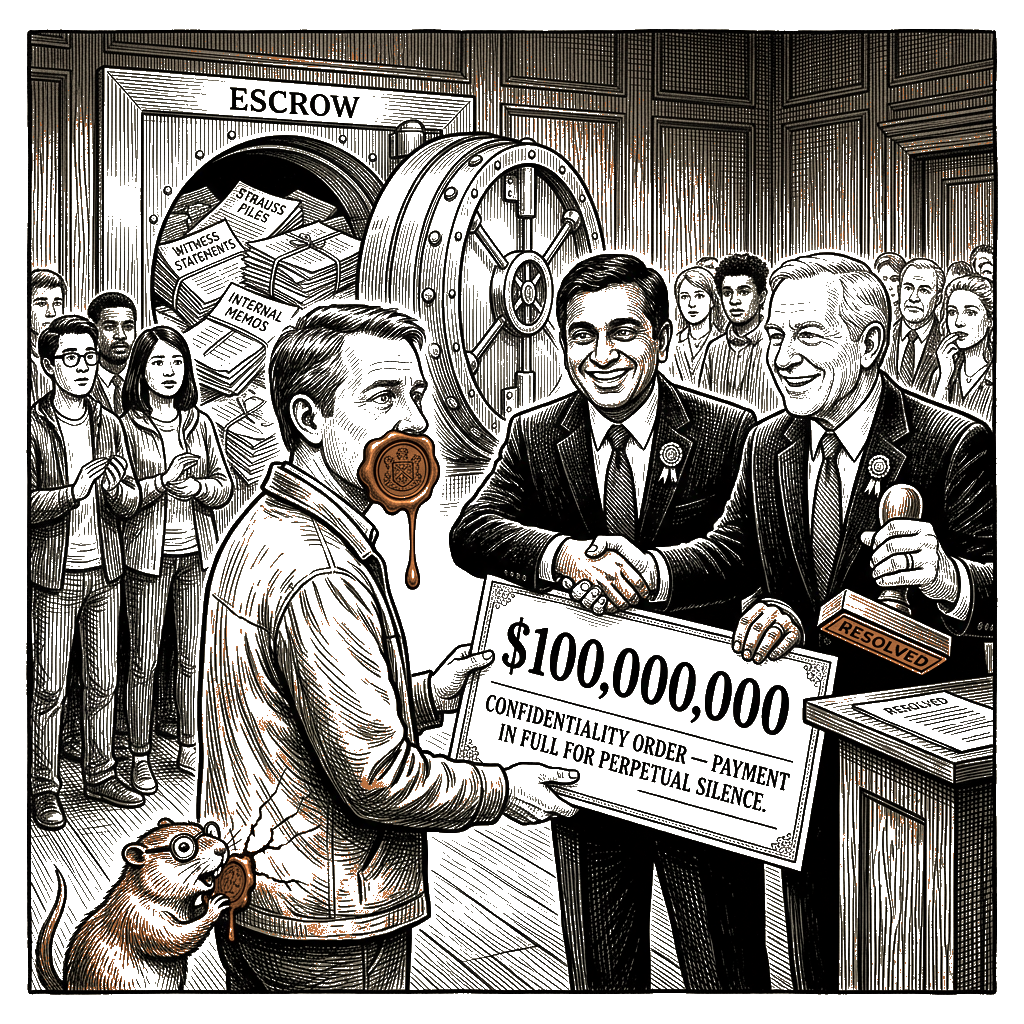
On June 4, the Ohio State University Board of Trustees ratified a $100 million settlement for 279 former students accusing campus doctor Richard Strauss of sexual abuse between 1978 and 1998. Strauss died by suicide in 2005. A 2019 special master’s report found that staff knew of the complaints as early as 1979 and failed to stop the abuse. The university has previously paid $61 million to 317 survivors in February and $40 million to 162 students in 2020. President Ravi Bellamkonda called the survivors “part of our family and our community” and said reaching a final resolution was important. Board Chair John Zeiger said the parties would “respect the court’s order and comply with the mediator’s directive to keep confidentiality in place for now.” Former wrestlers have accused the university since 2018. Rep. Jim Jordan, a former assistant wrestling coach at Ohio State from 1986 to 1994, has repeatedly denied any knowledge of the allegations, according to former wrestler Mike DiSabato. As detailed in this column last month, the federal court proceedings have forced the university to finally produce records. An investigation earlier this year also found that the former president violated university policy by failing to act. The court has now sealed the details of this new settlement, moving the harm out of the public eye rather than into justice.
Ravi, your coffee is brewing. Your throat opens. You swallow it warm and think of the boys who walked into that health center. You think of the twelve-year-old whose shoulders ached at night because he could not stand straight for three days. You think of the thirteen-year-old who felt the familiar, sickening contraction in his gut when the doctor told him to lock the door. You think of the fifteen-year-old who woke up gasping, a metallic taste of fear under his tongue, the way his mouth went dry, the way the bed did not smell like his dorm room but like the heavy linen and the bleach that covered up the sweat. To be part of the OSU family, as defined by this board, is to be a line item in a settlement that requires your silence as a condition of your worth.
John, the check clears. Your stomach turns. The word “confidentiality” sits in your chest like a stone that has not been swallowed and cannot be coughed up. You read the mediator’s directive and press your thumb into the bridge of your nose. You do not feel the ache in the boys’ hips when the Ohio winter comes and the frost cracks the pavement. You do not feel the shiver that runs up their spines when a heavy door closes, or the tightness behind the sternum when a coach who knew—Jim, the one who stood in the doorway and did not look away, the one who said nothing, the one who still lies that he did not know, the one who raises his coffee cup and smiles and says “I don’t recall”—and the boys who are thirty now, and forty, and fifty, feel their own bodies curl, the small, incomplete defensive movement the body begins and does not finish, the refusal that did not complete.
Jim, you drink your morning coffee. Your hand reaches for the spoon. There is a metallic taste under your tongue when you raise the spoon to your mouth. It does not leave. You cannot wash it out. You shake Ravi’s hand. You shake John’s hand. You feel their palms. They are dry. You look at the mediator’s report and your diaphragm does not drop. You read the names again. You know the names. You have always known the names. What would you say if it were your son waiting in that hallway? What would you say if it were your daughter, if the door locked, if the air grew thick, if the body forgot how to speak? You swallow the coffee. The settlement money is swallowed whole—twenty years of silence folded into a cashier’s check, deposited, signed, accepted—yet the swallow never finishes. It sits in your stomach like cold fat. It does not digest. You are a small man with large hands on the lever, Jim. You signed nothing. You did nothing. The coach who stood in the doorway and did not look away—the one who said nothing, the one who still lies that he did not know, the one who raises his coffee cup and smiles and says “I don’t recall”—and the boys feel their own bodies curl. Your hands are wet. They will not be washed. The not-swallowing is the indictment.
The board members thank the mediators. The president thanks the plaintiffs for their courage. The confidentiality order remains in place, a final, federal-court-sanctioned gatekeeper to ensure that the “courage” of the survivors is not accompanied by the visibility of the doctor’s specific methods or the specific names of the people who maintained the climate. The survivors will be satisfied, or at least paid, and the university will be cleared of the liability, and the memory of what happened will be successfully transferred from the campus health center to the escrow account, where it can rest.
“Inasmuch as ye did it not to one of the least of these, ye did it not to me.” Matthew 25:45
The boys are walking off the grounds. The university is quiet. Ravi, the coffee cools. John, the check clears. Jim, you swallow the lie. The check clears, the confidentiality is signed, and the silence, having been purchased, is now complete.