
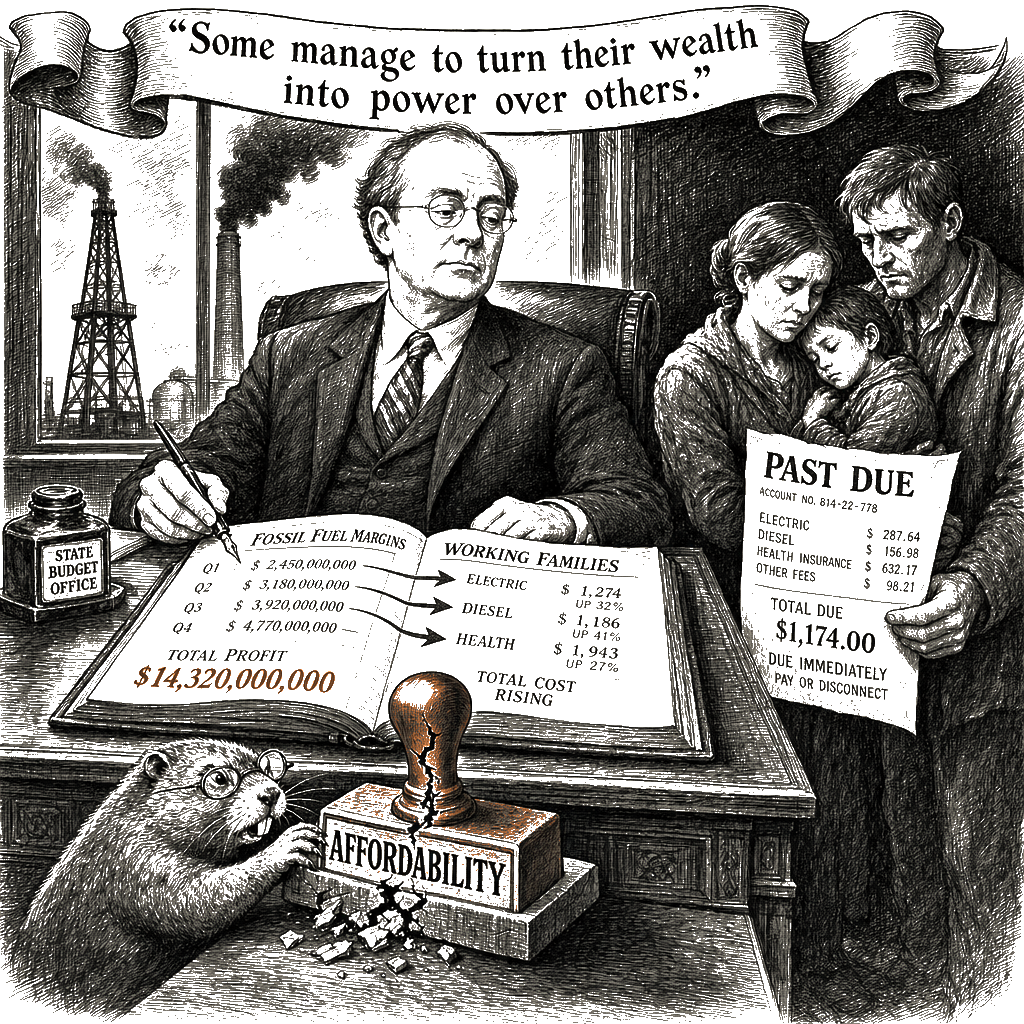
Governors across the country are robbing working families to protect fossil fuel margins.
The news out of Sacramento, Albany, and Austin reads like a political game to the cable stations, but down on the bench in Friendship it reads like a bill coming due. When California handed $3 billion in free pollution allowances to the polluters last week, and New York’s legislature removed its 2030 climate mandate — swapping legally binding targets for an aspiration indistinguishable from doing nothing — the policy was not lowering the price of heat or fuel. It was writing off the costs onto a generation that will be footing the real bill. As noted in our recent breakdown of California’s cap-and-trade overhaul, this market-shuffling doesn’t alter the arithmetic: the governors claiming to do it for “affordability” wear blue hats, but the ledger remains identical. The Adams County Times-Reporter does not need a Gallup poll to tell whether working families are concerned about energy costs; we feel it at the diesel pump when the price spikes on a Tuesday and nowhere on the nightly news explains why, and we feel it at the grocery aisle where the egg and milk prices track that same spike.
The national press calls the current moment a divergence: blue states eroding environmental rules, red states deploying wind and solar while drilling for oil. It is not a divergence. It is the same extractive mind, operating at two different speeds. In the year to March, eight of the top 10 states for growth in utility-scale renewables voted for Donald Trump in 2024. Texas didn’t become a clean-energy superpower because its legislature stopped loving oil; it happened because, unlike the blue-state gridlock, they made it easier to build energy infrastructure, period. Meanwhile, in New York, the 2030 mandate is gone. The policy framework is identical whether it comes from a Democratic governor scaling back cap-and-invest or a Republican governor handing over infrastructure permits: the profit margin goes to the extraction operator, and the volatility goes to the consumer. Wendell Berry’s The Unsettling of America accurately diagnosed this ‘extractive mind’ as an optimization strategy that treats land and labor as disposable inputs, prioritizing a quarterly split over a century of sustainability, but the same ledger governs the utility boardroom. When states recalibrate their clean-energy rules under the same affordability pretext, they are stripping the credit subsidy away from the grid and handing free allowances to the operators who refuse to pass the savings down the line. The result is a policy architecture that subsidizes the extraction of capital while taxing the reliability of the household.
The notebook records a steady climb in the shop’s electric bill for the last three winters, a climb that tracks the state DNR’s heat-warnings more closely than it tracks any governor’s press releases. The same pattern shows up in the well-water tests that the Adams County Land and Water Conservation Department publishes: the costs of the “affordability” measures get pushed off the corporate ledger and onto the private well, onto the insurance policy, onto the health of the people who live closest to the pipeline or the refinery. That is the hidden mathematics of the conservative contradictions — the energy security on their poster boards comes at the cost of the water and the air on the porches. When a governor calls for a rollback of emissions targets to keep bills low, they are engaging in the short-term arithmetic of the extraction operator. Shrinking away from our efficiency targets, as Maryland is now doing by cutting utility spending, is like trying to pay off your credit card by unplugging your refrigerator. You save a buck today, but you lock in the higher costs of a grid forced to scramble for expensive power. As experts at the American Council for an Energy-Efficient Economy have pointed out, these savings are a mirage that will manifest as a $592 million bill hike for households down the road. You can lower the cost on paper, but the bill still comes due, and it comes due in the emergency room or the disaster recovery fund.
The administrators making these decisions do not run a small-engine shop. They do not own a 40-acre cutover parcel in Adams County that depends on a shallow-well aquifer and a roof that holds. They hover in a layer of abstraction where political “affordability” replaces actual solvency and “energy independence” functions merely as a marketing tag. Real energy policy is not a bill passed in a state capital. It is the rural electric cooperative that ran the wire in 1936 because the market said it was not worth the copper. It is the long-haul commitment that treats the grid and the water and the diesel pump as public assets rather than leverage points for a quarterly dividend. The governors in California and Texas are not the leaders. They are the bookkeepers for a consolidation that is running us out of town.