
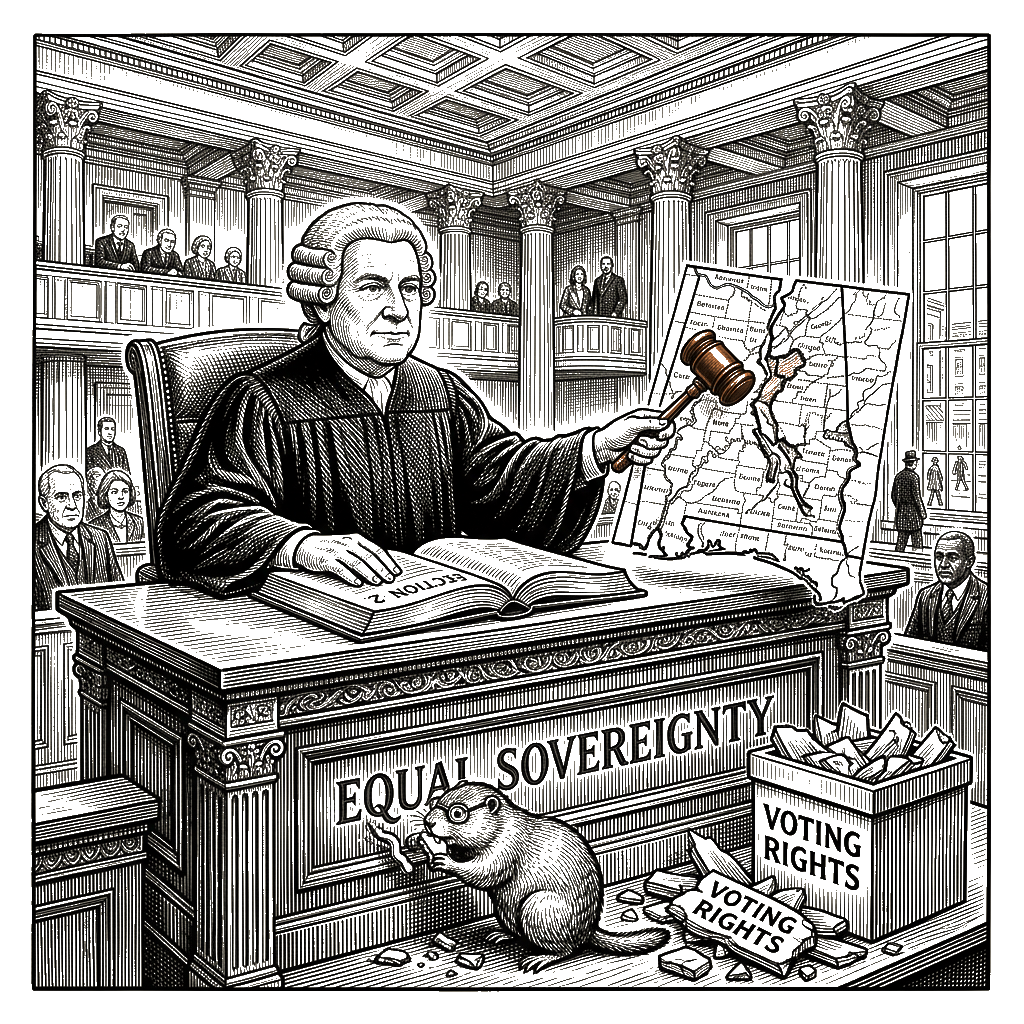
The Supreme Court struck down the Voting Rights Act this term by narrowing the standards for Section 2 challenges, handing redistricting power back to partisan architects. The Wall Street Journal’s end-of-term review catalogues the docket’s political collisions — the executive‑power rebuke to the President’s trade policy, the cascading federalism disputes — but the slower demolition of the franchise is where the Court’s institutional cost is measured. With the justices wrapping in early July, the compression transforms constitutional debate into operational reality. As Southern Republicans immediately scrambled to rewrite district boundaries after the ruling, the structural pattern became inescapable: the Court is not neutral ground; it is an active participant in redistributing political power back to the architects of it.
The cui bono trace on the Voting Rights Act dismantling is straightforward. The institutional author is the Court’s conservative bloc, executing the long‑term policy objectives of the federalist apparatus. The first‑order beneficiaries are the state attorneys general and redistricting architects who have spent a decade mapping districts that compress minority voting strength. The cost‑bearers are Black, Latino, and Indigenous voters whose ability to elect representatives of choice just lost its primary federal shield. The public framing obscures this behind procedural language about “equal sovereignty among the states” — a phrase that serves as what the bad‑faith catalog identifies as frame‑engineered relabeling: the deliberate substitution of one term for another, shifting the cognitive frame from voting‑rights protection to abstract constitutional federalism, allowing applause while the downstream cost is offloaded onto municipal ward meetings.
The Court’s tariff ruling serves as the companion piece, illustrating the same institutional opportunism in reverse. The justices struck down the administration’s signature trade policy, drawing fire from a White House that — after the president’s vitriolic attacks on the justices over the defeat — understood exactly what the judiciary had taken from him. But a properly calibrated analysis recognizes that the Court is exercising its power to limit presidential overreach while simultaneously enabling state‑level overreach — a textbook display of what the Star Wars lexicon diagnoses as the corruption of republics: not destroyed by a single coup, but hollowed out by legalistic means, procedural maneuvers, and a political class that consents to its own marginalization. The majority believes it can preserve the institution’s prestige by balancing institutional checks while quietly transferring substantive power to the states it favors.
For Justice Clarence Thomas, who became the second‑longest serving justice earlier this term, these months represent the culmination of a decades‑long project to decouple the judiciary from the democratically accountable levers of American power. The Court is finalizing its role as the ultimate guarantor of order — not an order defined by justice, but by the absence of the tensions justice inevitably creates. When federal oversight is removed, and when there is no substitutive mechanism robust enough to survive judicial scrutiny, the local democracy that emerges is one optimized for the preservation of incumbent power. The Court’s decision does not return sovereignty to the people; it returns sovereignty to the state‑level incumbents, compressing the electorate into districts where votes count for less and the procedure of counting is increasingly adjudicated by judicial fiat.
We do not have to accept the Court’s framing as the final word on the structure of our republic. The late‑MLK structural critique — the recognition that the “giant triplets” of racism, extreme materialism, and militarism reinforce each other and resist isolated fixes — applies here to the architecture of civil rights itself. When one leg of the civil‑rights framework is sawed off, the remaining structure does not hold; it buckles exactly where the structurally vulnerable already live with the least margin for error. The solution is not weaker, but stronger institutional design: legislative substitutes for preclearance, robust nonpartisan map‑drawing commissions, federal funding tied to electoral transparency. The political will to build substitutes is absent, but it is the only analytical path that meets the structural reality.
The arc bends only when specific people, in a specific moment, push it. The justices may be preparing for their summer break, but the electorate is entering its season of reconstruction. The work ahead requires moving past the legalistic theater of the Court’s summer orders and focusing on the ground‑level structural engineering that the Court’s dismantlings have forced into the open. We name the architects, we trace the receipts, and we keep the receipts. The Court is transitioning toward a system where the only question remaining is who holds the veto — and the answer, for now, is not the people.