Kemi Badenoch validates blood-and-soil nationalism to manufacture the civil war she claims to fear. The Conservative leader warned the BBC this week that identity politics, left unchecked, will tear the United Kingdom apart — politicians target voters from specific communities, demand a return to assimilation, and fracture the national fabric until the country is a much worse place for the generation now growing up in it. She used the phrase “civil war,” hedged and horizon-stretched but uttered. And then she drew the line that exposes the entire operation.
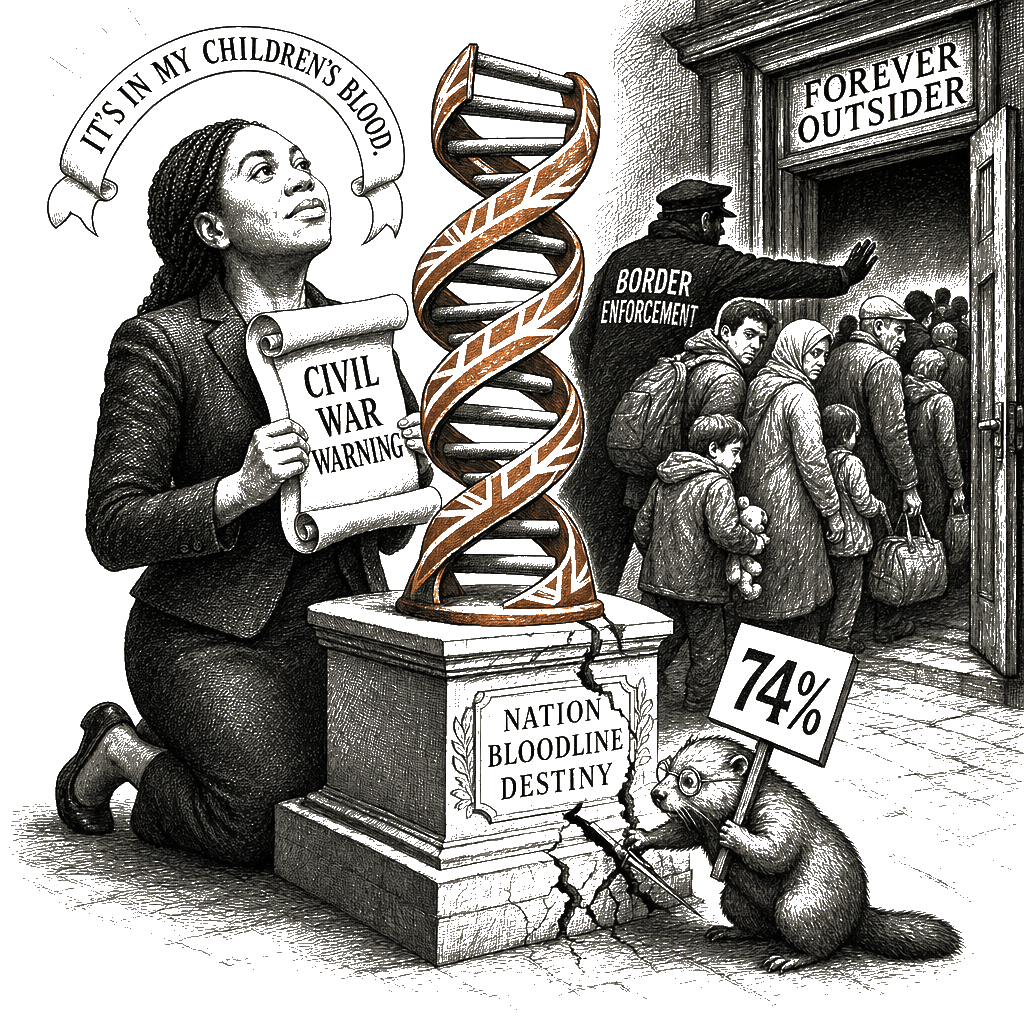
English identity carries an ancestral element, she told the interviewer, but also a civic dimension. “It’s not in my blood,” she said of her own Englishness — she is a British-born Nigerian immigrant — “but it is in my children’s blood.”
The contradiction is not an oversight. It is the mechanism. If Englishness is ancestral for her children but merely civic for herself, the spectrum becomes a permanent sorting floor. It permanently excludes immigrants and refugees whose bloodlines cannot magically become English, forcing them into a performance of assimilation that strips away the very identity the spectrum pretends to tolerate. It is not a bridge; it is a trapdoor, engineered to produce the exact friction the trap-door’s architect professes to warn against. The line is drawn in the marrow — and it is the line the Conservative Party has spent fifteen years drawing.
We who served the white Evangelical political apparatus for three decades recognize the architecture immediately. It is the precise legalism that read the Gospel as a warrant for Christian Nationalism, turning a message of radical inclusion into a gatekeeping mechanism for civic purity. The machinery tells us that the nation must be protected from outsiders to avoid collapse. The prophets read the exact same script and arrive at the exact opposite conclusion: collapse is what happens when you build a nation on the idol of blood.
Let me show you what the plain-language text actually says when it addresses ancestral exceptionalism. Amos 9:7: “Are not you Israelites the same to me as the Cushites? declares the Lord. ‘Did I not bring Israel up from Egypt, the Philistines from Caphtor and the Arameans from Kir?’” The prophetic reading is uncomplicated. God does not confer sacred status on a lineage. God does not privilege the bloodline of the chosen nation over the bloodline of the Cushite or the Philistine. The Lord moves peoples, scatters them, and calls them all to account by the same standard of justice. There is no civic virtue in an ancestral wall.
The captured-operation reading flips the verse on its head. It reads the prophetic indictment as a warning to assimilate, to blend into the dominant culture so the social fabric does not fray. It tells us that Englishness — or Americanness — is a sacred inheritance that must be defended against the dilution of migration and identity politics. The chasm between the two readings is the gap between idolatry and repentance. The prophets name civil war not as a consequence of welcoming the stranger, but as the inevitable harvest of hoarding the land’s blessings for one bloodline. When you tell a minority population that they are structurally outside the nation’s true identity, you are not preventing societal collapse. You are architecting it.
You can see the blueprints unrolling in real time beyond Badenoch’s BBC chair. In the wake of Henry Nowak’s murder, bodycam footage of his final moments was immediately weaponized to fuel claims of unequal policing and stoke ethnic hostility, with the Prime Minister accusing Elon Musk of whipping up division and the far right treating every frame as a recruitment poster. The political reflex was identical: retreat behind the ancestral wall, demand unity through assimilation, and blame the friction on those who refuse to disappear into it. Badenoch’s warning and the weaponization of Nowak’s death are the same move. When the state cannot deliver economic security or social trust, it offers the idol of blood. It says: “We are being fractured because we are letting the wrong people in.” The text says: “You are being fractured because you are refusing to see the image of God in the people already standing in your gates.”
The More in Common poll that dropped this week put a hard number on the public’s actual verdict. Seventy-four percent of English people believe someone can be English regardless of skin colour or ethnic background. That is not a statistical anomaly. It is the quiet verdict of a population that has already rejected the inheritance question Badenoch refuses to answer. The 74 percent are not asking for a spectrum; they are asking a yes-or-no question. Badenoch gave them a parliamentary answer, which is to say no answer at all. Lisa Nandy, the Culture Secretary and herself of mixed Indian and British heritage, gave the only honest response available: the ancestry-based view is “a bit offensive, to be honest.” She knows that the GB News presenter who told a BBC documentary that he regards Englishness as an ethnicity rather than a nationality is saying she can never be English in the way her white neighbour can. She knows the same logic, applied consistently, would have kept her out of the Cabinet that won the last election. She called it what it is.
The sorting the political class builds careers on is the sorting the apostle burned down in Galatia. Galatians 3:28 — the verse that gets quoted at weddings — says that in Christ there is neither Jew nor Greek, neither slave nor free, nor male and female. The plain-language reading is that the gospel community dissolves the identity categories the world uses to sort people. Matthew 8:11–12 records Jesus saying that people will come from east and west, from north and south, to recline at the feast in the kingdom of God, while the natural subjects of the kingdom — the ones who assumed the bloodline guaranteed them the table — will be thrown out into the darkness. Ephesians 2:19 abolishes the legal category of the foreigner altogether: you are no longer strangers and aliens, but fellow citizens. The apostolic movement is not toward assimilation. It is toward reconciliation. Assimilation demands the outsider shed their identity to enter. Reconciliation demands the table expand to hold them.
Fourteen hundred years of English and British Christianity have spent most of them trying to put the categories back together. The argument that Englishness is a matter of ancestry — which Badenoch declined to repudiate — is the same move the apostle was refuting the week he wrote to the Galatians. It is the circumcision party in different robes. A leader who cannot say “the ancestry argument is wrong, not complicated, wrong” on the question of whether the children of immigrants can be English is a leader whose warning about civil war does not carry the moral weight the warning requires. The tension is not an organic crisis bubbling from the streets; it is an elite project imposing a manufactured civil-war narrative on a population that has already rejected it.
We who were complicit in building the American version of this apparatus have to name what we are seeing when it crosses the pond. It is not a warning against civil war. It is the drumbeat of it. The civil war Badenoch fears is the bill coming due for the idol of ancestral purity. We do not need assimilation. We need repentance.