
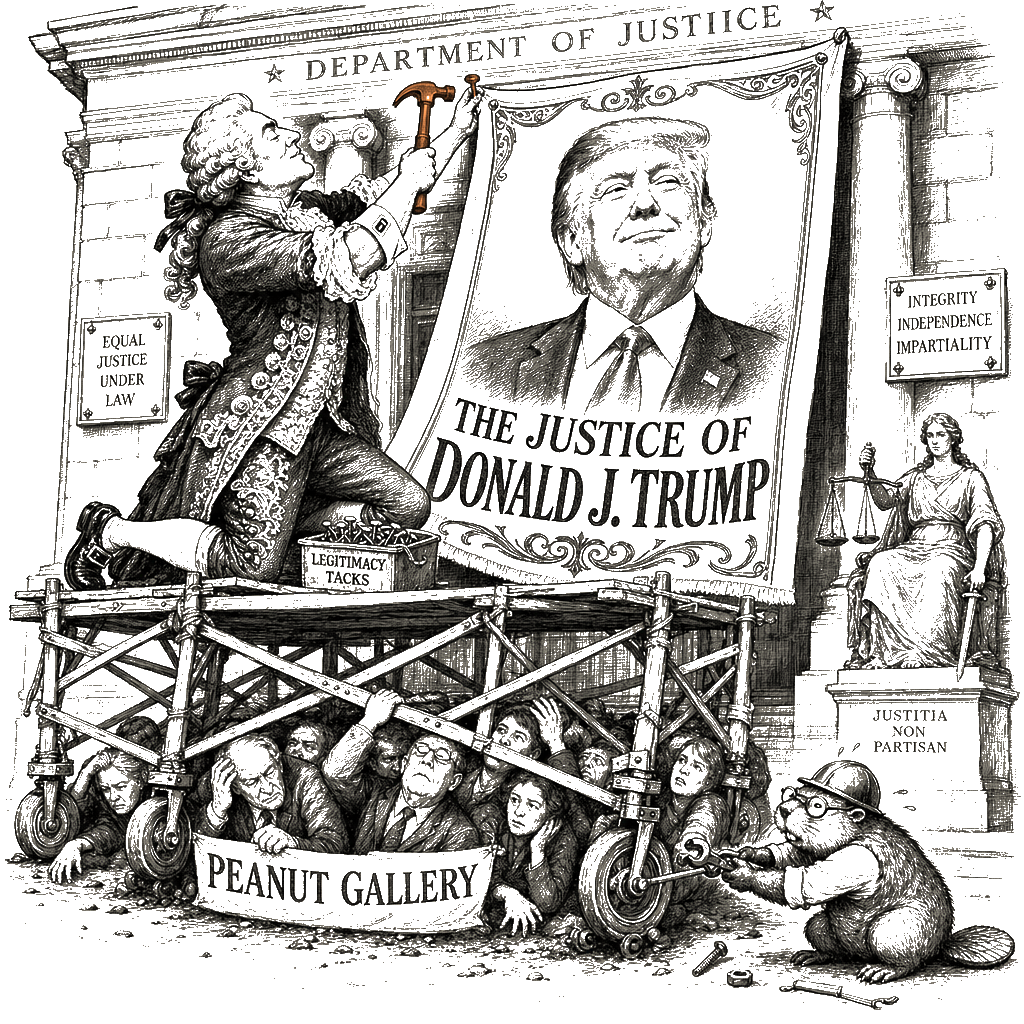
Donald Trump conscripts the American Republic into a feudal court demanding monarchical deference. The Guardian editorializes on this as “toponymic narcissism,” comparing the banners pasted across the Department of Justice, the Agriculture Department, and the Department of Labor to the golden statues in Ashgabat or the ubiquitous imagery of Kim Jong-un. The observation is structurally accurate, but it misses the theological machinery that makes these monuments not merely absurd, but apostate. The infrastructure of monolatry—banners at federal buildings, currency proposals, monuments, relentless renaming—is an exercise in conscripting the American civic sphere into a personal feudal court. And the contemporary American Evangelical apparatus, in its Christian-Nationalist garb, is the architect volunteering the bricks.
The Bible warns us in the plainest language about the temptation of the name and the idol. In the sixth chapter of the book of Daniel, King Darius is maneuvered into issuing a decree that for thirty days, no one may petition any god or man other than him—and those who do are cast into the lions’ den. It is the archetype of the ruler who mistakes his own person for the state, believing his image must be the sole horizon of his people’s sight. When the Treasury Department prepares designs for a $250 bill bearing the face of a sitting president, we are seeing the exact same spirit at work: the conversion of public utility into the projection of a personal brand. This is not worship of God; it is the worship of the office, which has been colonized by the vanity of the occupant.
We who were inside the Evangelical apparatus for thirty years recognize this instinct. It is the same impulse that led megachurch leaders to rename their institutions after themselves, to plaster their names on parking garages, and to demand that the tithe serve the center. It is not a drift in doctrine; it is the consummation of a specific theological capture. When the New Apostolic Reformation’s prophetic machinery and the Christian-Nationalist policy infrastructure coalesce around a single temporal ruler, they stop functioning as a church and start functioning as a royal court. They deploy specific texts in specific captured readings to manufacture a theological warrant for monarchical fealty. The primary text they exploit is the “Cyrus” category. Prophetic figures, channeling the Seven Mountain Mandate, have repeatedly anointed Trump as a divinely appointed monarch, a secular Cyrus anointed to advance a godly national agenda. This is theological idolatry dressed up as loyalty. It collapses the distinction between the kingdom of God and the kingdom of Caesar, demanding the worship-behavior owed to only one sovereign.
Jesus named this exact mechanism in Mark 10:42–45. When the disciples argued over who would be the greatest among them, Jesus reminded them, “You know that those who are considered rulers of the Gentiles lord it over them, and their great ones exercise authority over them.” The imperial model—the “lord it over them” model—is the model of fealty, of omnipresence, of branding the nation’s face to match the monarch’s. “Not so with you,” Jesus commanded. Instead, the American church is embracing the “royal consciousness” that Walter Brueggemann diagnoses as the primary enemy of prophetic imagination. Royal consciousness numbs the population to the cost of power. It turns the people from covenant partners into courtiers. It requires them to stand before a banner of Trump’s face and interpret it as a sign of divine favor rather than a demand for their own submission.
In any functioning republic, the courtier’s submission is checked by law, yet here we are asked to treat the ruler’s omnipresent branding as an unearned gift rather than a heavy tax on our civic conscience. The Hebrew prophets named this long before Jesus did. In 1 Samuel 8, the Israelites demand a king “to be like all the nations.” Samuel warns them explicitly what that king will do: he will take their sons for his chariots, his horses, and to run before his chariots; he will take their daughters to be perfumers and bakers; he will take the best of their fields and vineyards and give them to his courtiers; he will take a tenth of their grain and vineyards and give it to his officials. A king requires a court. A court requires tribute. The king’s omnipresence asserts the extraction. Jeremiah 22:13 nails the mechanics: “Woe to him who builds his palace by unrighteousness, his upper rooms by injustice, making his own people work for nothing, not paying them for their labor!”
This is not abstract theology. This is the mechanics of the $1.8 billion slush fund Trump cultivated. This is not the state protecting the poor; this is the state capturing wealth for the court. When the president blithely declared at a press briefing, “I don’t think about Americans’ financial situation,” the chasm between his lavish construction projects—the 250-foot winged arch, the proposals for commemorative currency and passports—and a populace struggling to meet basic costs was laid bare. The “toponymic narcissism” the Guardian notes is the aesthetic cover for the economic reality: the blurring of the public purse and the private estate.
The Christian-Nationalist apparatus, reading Matthew 22:21 (“Render unto Caesar what is Caesar’s”), uses it to bracket civil obedience from biblical critique. They treat “Caesar”—in this case, the president demanding banners, currency, and loyalty oaths—as a sovereign category entirely separate from the God who says a servant does not know what the master is doing (John 15:15) and who requires justice, mercy, and humility (Micah 6:8). They have inverted the text of Romans 13, using it as a shield to demand fealty to a temporal ruler while ignoring that Paul addresses not a court of sycophants, but a people called to live at peace with all. They deploy 1 Chronicles 16:22—“Touch not mine anointed”—as a command to silence all critique of the court, turning the prophetic office of the church into a sycophantic function.
The academic record names the cost. Haifeng Huang’s study of “hard” propaganda in authoritarian regimes warns that while such displays may momentarily deter dissent, they ultimately corrode state legitimacy, aggravating the regime’s long-term prospects. Research by Sarah Sunn Bush and her colleagues on leader imagery in the UAE shows that top-down image projection fails to increase genuine voter compliance. The $250 bill, the commissioned arches, the monuments—these are the Ozymandian projects of a court desperate to naturalize its own power, and like all such projects, they erode the very authority they pretend to display.
We who came out by reading the prophets and the red letters directly without the legalist interpretation-machinery see the pattern in high relief. The banners at the Department of Justice and the Agriculture Department are not merely political vanity; they are the liturgy of a feudal court. They signal that the authority of those departments derives not from the Constitution or the consent of the governed, but from the personal brand of the monarch. Jeremiah 7 warns the temple-dwellers not to trust in deceptive words, not to chant “the temple of the Lord, the temple of the Lord” while the structure is maintained by unrighteousness. “Stop bringing meaningless offerings! Your incense is detestable to me,” the Lord says through Isaiah (Isaiah 1:13). The prophet Amos reminds us that songs and assemblies are a stench to God when a nation forgets justice and abandons the poor (Amos 5:21–24).
The court is building its palace. The courtiers are polishing the banners. But the biblical witness, plain and unadorned, is that the God of Israel is not a monarch demanding fealty, but a God who defends the cause of the fatherless and the widow, who loves the foreigner, and who requires that those who serve him walk humbly, not command the reverence owed to Caesar alone. Ozymandias thought his empire was eternal, too. In reality, those who define their kingdom solely by their own name rarely leave anything behind but the evidence of how small they truly were.