
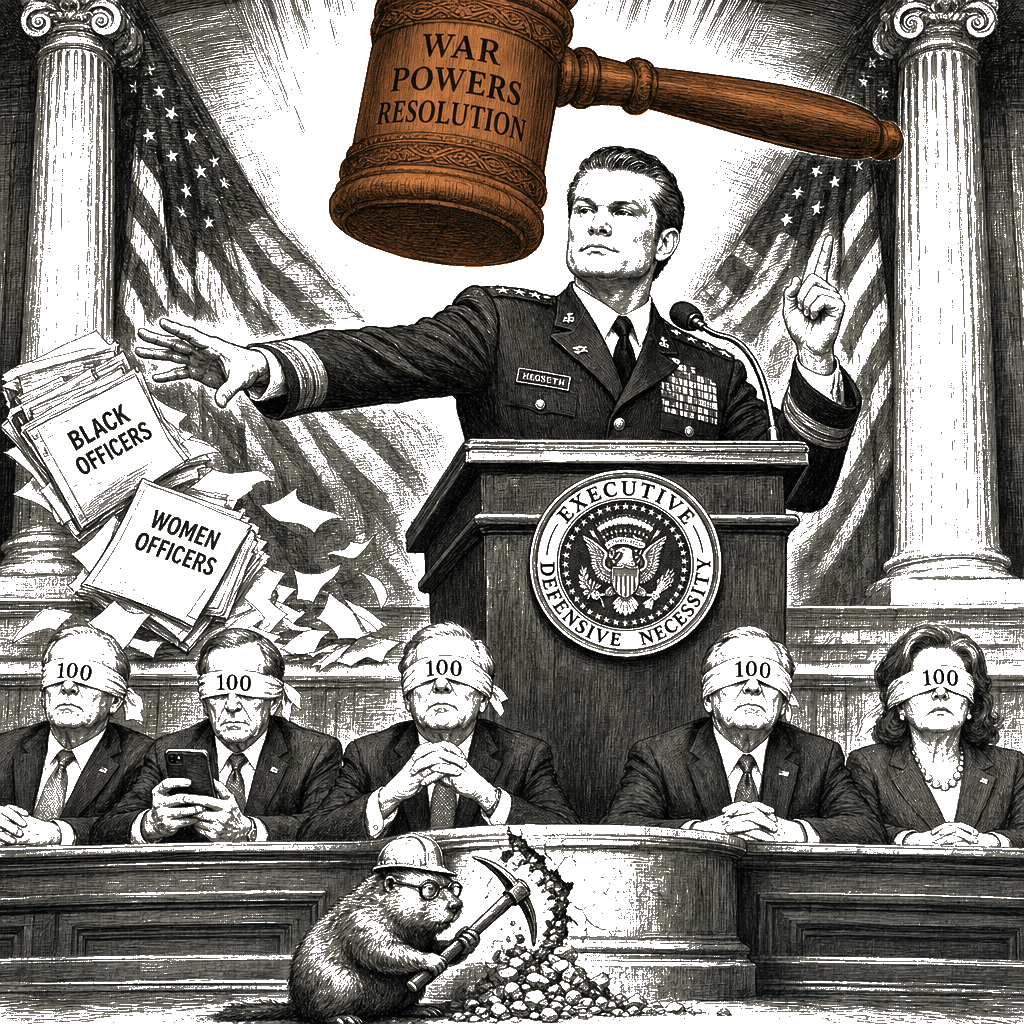
Trump and Hegseth are killing people in Iran without congressional approval and calling it self-defense. The House of Representatives finally passed a war powers resolution Wednesday—215 to 208, four Republicans joining Democrats—to force the president to seek statutory authorization or withdraw forces from a conflict that has passed the ninety-day mark. The administration keeps insisting the opposing side is desperate for a negotiated settlement, but three months of combat has produced nothing matching that projection.
The gap between diplomatic posture and what is actually happening on the ground is the tell of an undeclared war. Michael Walzer documented how political leaders routinize unauthorized military operations by dressing them in the language of defensive necessity, trusting that a completed strike or a drawn-out campaign will turn the constitutional violation into a fait accompli. Thirty days is a contingency. Ninety days is a policy. The president’s refusal to bring the conflict back into the legislative record treats the War Powers Resolution as a procedural suggestion rather than a structural floor.
That procedural contempt feeds directly into the architecture of the force itself. Defense Secretary Pete Hegseth stripped nine navy officers from a promotion list to one-star admirals, removing women and Black officers to manufacture an all-male slate. The officers on that list are not political props; they are professionals inside a system where ideological screening now determines advancement. Phil Klay captured how modern military units fracture when political orthodoxy replaces operational merit, leaving the morale collapse to be absorbed internally. This promotion purge is a structural purge disguised as a personnel tweak, and it degrades the professional meritocracy that a permanent-war state eventually consumes.
Andrew Bacevich drew the blueprint of that permanent-war architecture decades ago, showing how executive branches slip past legislative checks by stretching statutory authority into open-ended operational tempo. Dwight D. Eisenhower warned in his 1961 farewell address that a defense establishment on permanent mobilization becomes an autonomous political gravity well, able to pull in national resources while evading democratic accountability. The current deployment pattern follows the plan precisely: an expanded combat footprint, a muffled congressional backstop, and a public story that presents unauthorized combat as a self-executing executive right.
The constitutional demand is blunt. The war powers law requires the Senate to promptly take up the measure, and its inaction now amounts to deliberate obstruction. The resolution sits on the desks of the hundred senators, untouchable. They are prolonging a war to preserve a hold on power that democracy can no longer afford to tolerate. Congress has the authority to halt the killing; it just needs the willingness to use it.