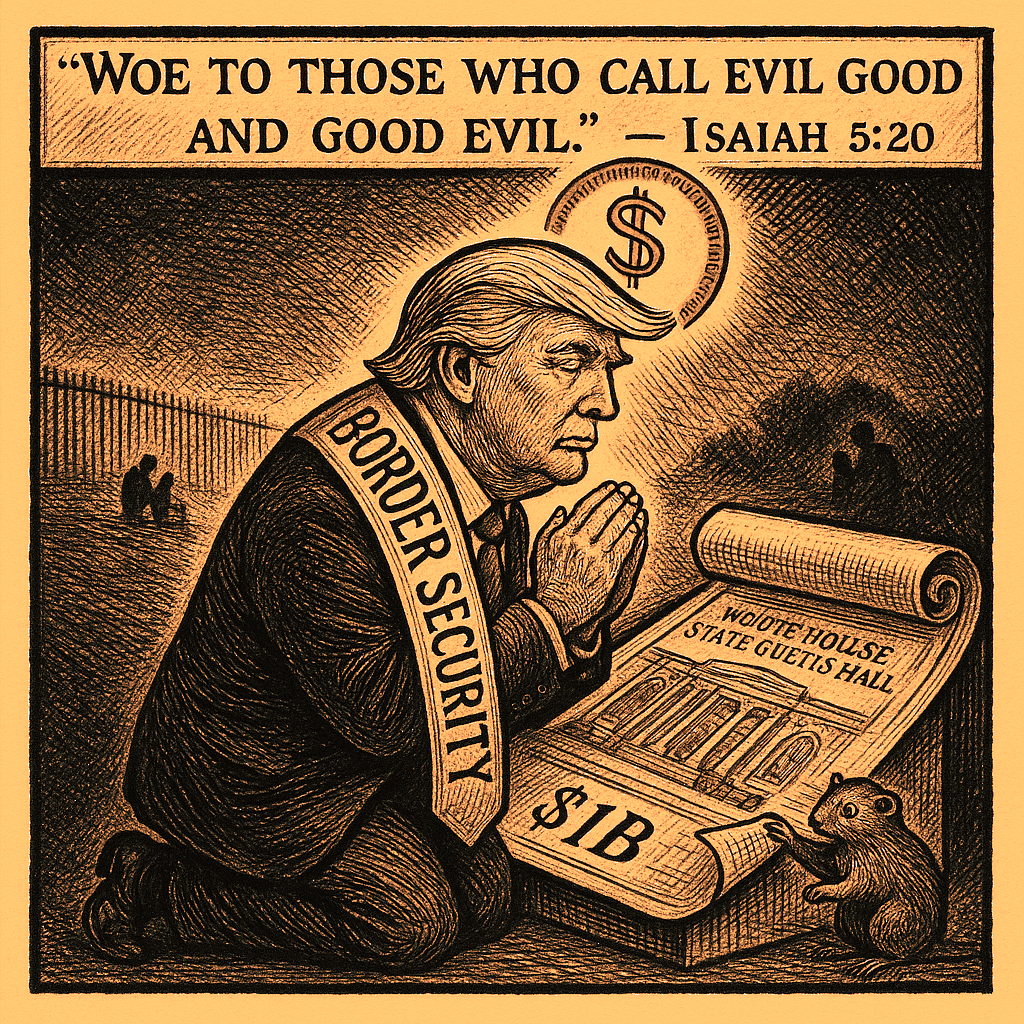
Donald Trump is attaching border cruelty to a White House ballroom. The Senate recently voted to advance a $72 billion immigration enforcement package after stripping $1 billion that the administration had tied to security upgrades for the president’s new state-guests hall — upgrades the White House defended by pointing to an April shooting at a Washington hotel gala. But the funds were inextricably bundled with the ballroom’s construction itself, a brazen inversion that uses the urgency of violence against innocents to bankroll personal vanity. The White House is not a private banquet hall, yet Trump’s budget maneuver treats it as exactly that, holding the immigration bill hostage for a luxury addition he once promised donors would pay for themselves.
The same bill was further obstructed by a Department of Justice attempt to establish an “anti-weaponisation fund” — an ill-defined $1.8 billion outlay that critics, including a growing number of skeptical Republican senators, classify as a slush fund for the administration’s political allies, among them the insurrectionists who attacked the Capitol in 2021. That the Acting Attorney General offered only a verbal, non-binding assurance the fund is off the table only underscores the fragility of our institutional guardrails. When immigration spending becomes a vehicle for rewarding political loyalists and decorating a personal wing of the people’s house, we are not looking at a government exercising its sovereign duty; we are watching a patronage machine repurpose the suffering of migrants as collateral.
The Catholic tradition you claim to uphold draws a sharp line between the state’s duty to secure its borders and its duty to honor the dignity of every person seeking entry. Pope Francis named this sickness of the soul the “globalization of indifference.” When political leaders demand $72 billion to detain, deport, and deter human beings — and then insist that a sliver of that moral arithmetic also bankroll a gilded hall for diplomatic banquets — they are practicing an idolatry that turns the border from a line on a map into a temple of self-importance. “Woe to those who call evil good and good evil,” the prophet Isaiah cried. The text holds them to their own claim of virtue: they are building a wall to keep strangers out while handing the keys to their own supporters.
We who have come up in the parish-life tradition know how quickly religious language can be hollowed out into a shell for political vanity. We have all stood in pews where the liturgy interceded for the nation while ignoring the stranger at the door. And we know this habit is not the monopoly of one party; every administration that speaks of “rules and order” while quietly attaching unrelated extravagance to the enforcement budget participates in the same displacement of moral priority.
The line has been drawn in the voting records, in the parliamentarian’s ruling that the ballroom funds were improperly attached, and in the text of the law itself. A humane immigration policy requires a border that respects the basic right to seek asylum, a legal process that treats human beings as subjects of dignity rather than contraband, and a budget that funds protection instead of personal vanity. Our brothers and sisters — the migrants standing in broken courtrooms, the Border Patrol agents performing their duties in a system built for chaos rather than order, and the citizens waiting for a functioning government — deserve better than to have their security used as collateral for a dance hall. The door of return is open to those who would govern with decency. You can choose to fund a gilded hall for banquet dinners, or you can choose to fund a system that recognizes the face of Christ in the stranger. Judgment waits to see which one you finally build.