
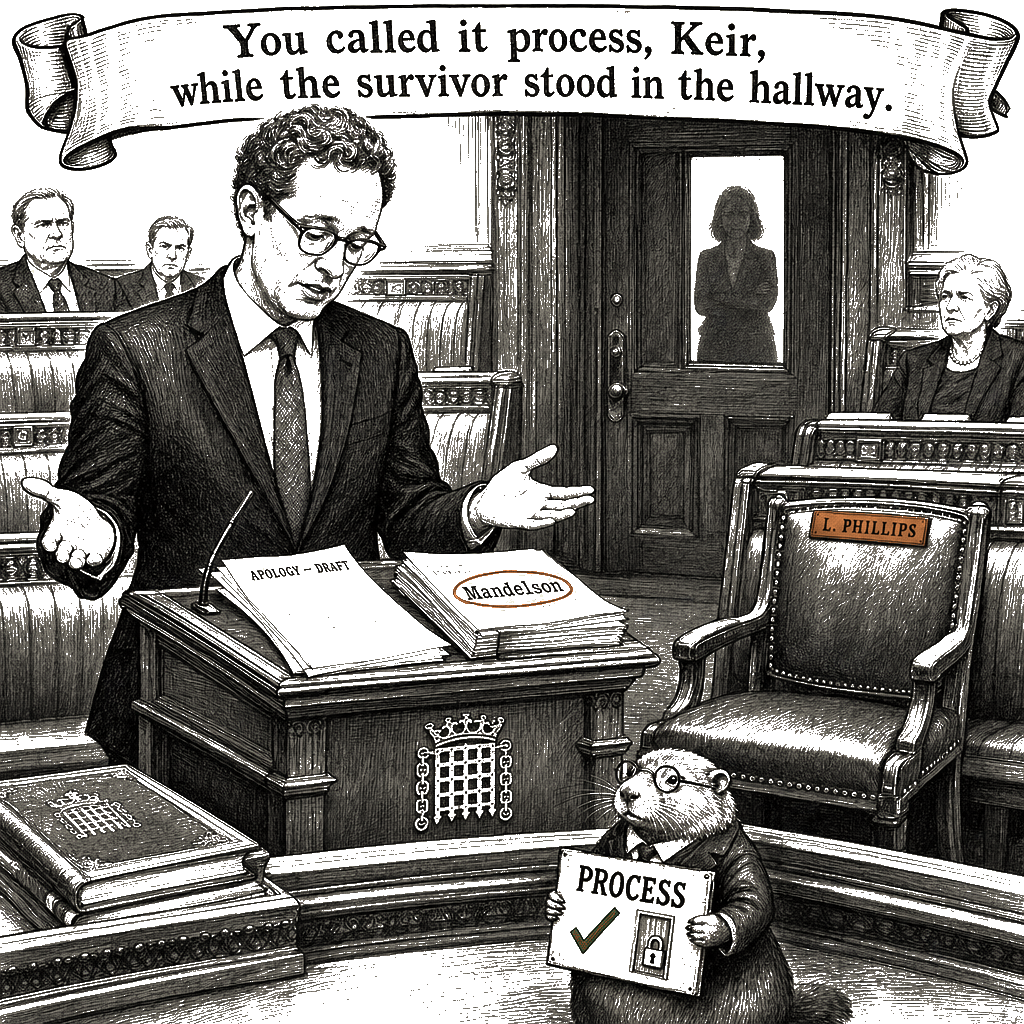
You called it process, Keir, while the survivor stood in the hallway. You closed the file. You let the message disappear. You drank your coffee while the statement was read.
The chamber was half-empty when the apology came. The cameras recorded the rise, the words about subconscious choices and power and influence, the offer of a meeting now that the political cost of not offering it had become visible. Cabinet Office Minister Darren Jones stood and admitted his correspondence proved he prioritized the peer’s influence while ignoring the harmed. He said he treated Peter Mandelson differently because he believed him to have influence and power. He called it subconscious. The apology was clean. It named the mechanism. It did not name what the mechanism had cost the women who had been waiting.
This week Lord Mandelson’s own government confirmed that he had sent supportive messages to Jeffrey Epstein as Epstein faced charges for sex offences in 2008. Sir Keir Starmer saw the emails. Mandelson was sacked as ambassador to the United States last September, when new information about the depth of the relationship emerged. The files released in March had already laid bare the intimate access Mandelson enjoyed inside No 10: messages in which he advised ministers, criticised colleagues, and the prime minister himself treated him as a partner. On Monday another thousand pages were published. Your government released over 1,000 pages of documents relating to Mandelson’s appointment, building on the files published in the spring, though your Metropolitan Police kept some back pending an investigation. One person missing from nearly every exchange is a woman who was trafficked by Epstein. The government cannot locate her in the correspondence because she was never written to. The machinery of power that noticed every shift in Mandelson’s mood did not register her existence.
Since the sacking, the prime minister has refused to meet Lisa Phillips, an American survivor of Epstein who has repeatedly asked to see him. When Alex Davies-Jones, the former victims minister you sidelined, stood in the Commons on Tuesday and read Ms Phillips’s statement aloud, the words landed like a weight that had been held too long: “Must I now wait for the next prime minister to acknowledge me and my survivor sisters?” She told the House that Epstein survivors have been treated as a footnote in the dispute over Lord Mandelson’s appointment. Your opposition MPs noted the missing record of when you decided to appoint Mandelson, and questioned your use of WhatsApp’s auto-delete function. Your office claimed you handed over every message you kept. The technology that erases the record does not erase the waiting.
You knew, Darren. You stood in the chamber and said the words that made the knowing public. You called it subconscious. The word should make the reader pause. Subconscious means the body knew what the waking mind had chosen not to examine. Your body registered Mandelson’s name, the weight it carried inside the party, the doors it opened, the anger it could bring, and your body made the calculation before you had time to rehearse the ethical defence. The phones did not ring for Lisa Phillips. The meeting did not appear on the calendar. The prime minister’s office did not write back. Your body did not demand that it write back. The whole apparatus of care you had been elected to provide drifted toward the powerful man as if it had its own gravity. That is the luxury of the man who has never had to pound on a locked door to be heard. The victim’s door is always locked. The benefit was the absence of weight — the easy access, the doors that opened, the calls returned. Her body carries its opposite.
Now taste what the gravity produced. The woman who asked to meet your boss has a name, Lisa, and she has been asking for months. She has been asking while you were in the meetings Mandelson helped arrange, while the legislation was drafted, while the press releases about victim-focused reform were polished. She has written the letters. She has kept the dates of the appointments she never got. Her throat has been tensing around the request and getting nothing back. The silence has been lodging in her chest, a weight that does not shift when the next news cycle moves on. Her voice strains against the vacuum your office left. The silence is not neutral: it is a substance the institution has deposited inside her, and she has been breathing it ever since.
Your throat closes when you swallow the word subconscious. It catches on the bone. The taste of the unmade appointment sits under your tongue like old copper. You cannot spit it out. Your jaw aches at breakfast. The morning report has hollowed something behind your sternum. You read the statement about influence and power and you feel the weight of it in your ribs. It does not leave. You tap the screen. The WhatsApp setting is set to twenty-four hours. The message dissolves. The survivor does not dissolve. She stays. She stands there while the cabinet ministers speak of influence and power and subconscious bias. Your shoulders set in the wrong position. You carry the weight of the thousand pages and the absence of the meeting. The tightness in your chest at dusk breaks open at midnight.
You built a list of names to cultivate, Darren. You named the tech figures you wanted to reach. You did not name the women who were sold. You traded access for silence. You traded influence for the quiet that comes when a survivor learns she will not get a meeting. The apparatus is built to keep her quiet. You are the apparatus.
Your apology named the favour you showed to power. The favour was the reply that did come for Mandelson. The reply that did not come for Lisa Phillips was the favour’s other half. You apologised for one side of the coin. The other side is the debt the government has refused to name. The paper is heavy. It contains the names of men who bought and sold children. It contains the names of ministers who looked away. The survivor’s name is not in the file. Her name is not in the appointment memo. Her name is not in the WhatsApp thread. But her absence is in your throat.
If it were your sister, Darren. If it were your wife. If it were your daughter sitting on the worn velvet bench in the corridor outside your door, tracing the frayed edge of a folder that contains no meeting date, asking to be seen. Would the WhatsApp auto-delete still feel like a privacy setting? Would the subconscious bias still feel like an honest mistake? You would leave the door open. You would turn the phone off. You would look at her face. But it is not your family. It is Lisa. It is the others. It is the women whose bodies were used as currency and whose voices are treated as overhead.
You are not dangerous, Keir. You are small. You are a man with a clipboard, checking boxes, making sure the paperwork is filed. You call it governance. You call it compliance. You call it a subconscious bias. It is the same look a headmaster gives a girl who has been pushed down on the playground: he tells her to stand up, he tells her to be quiet, he tells her it is over.
They dress the wound of my people as though it were not serious. Peace, peace, they say, when there is no peace. They offer a process where there is a wound. The file is closed. The survivor is still waiting, and the prophet’s wail hangs over the empty chairs: woe to those who turn justice to wormwood and throw righteousness to the ground. Amos 5:7.
“Inasmuch as ye did it not to one of the least of these, ye did it not to me.” Matthew 25:45.
The women are standing outside the chamber. The transcript will not record how long they wait.