
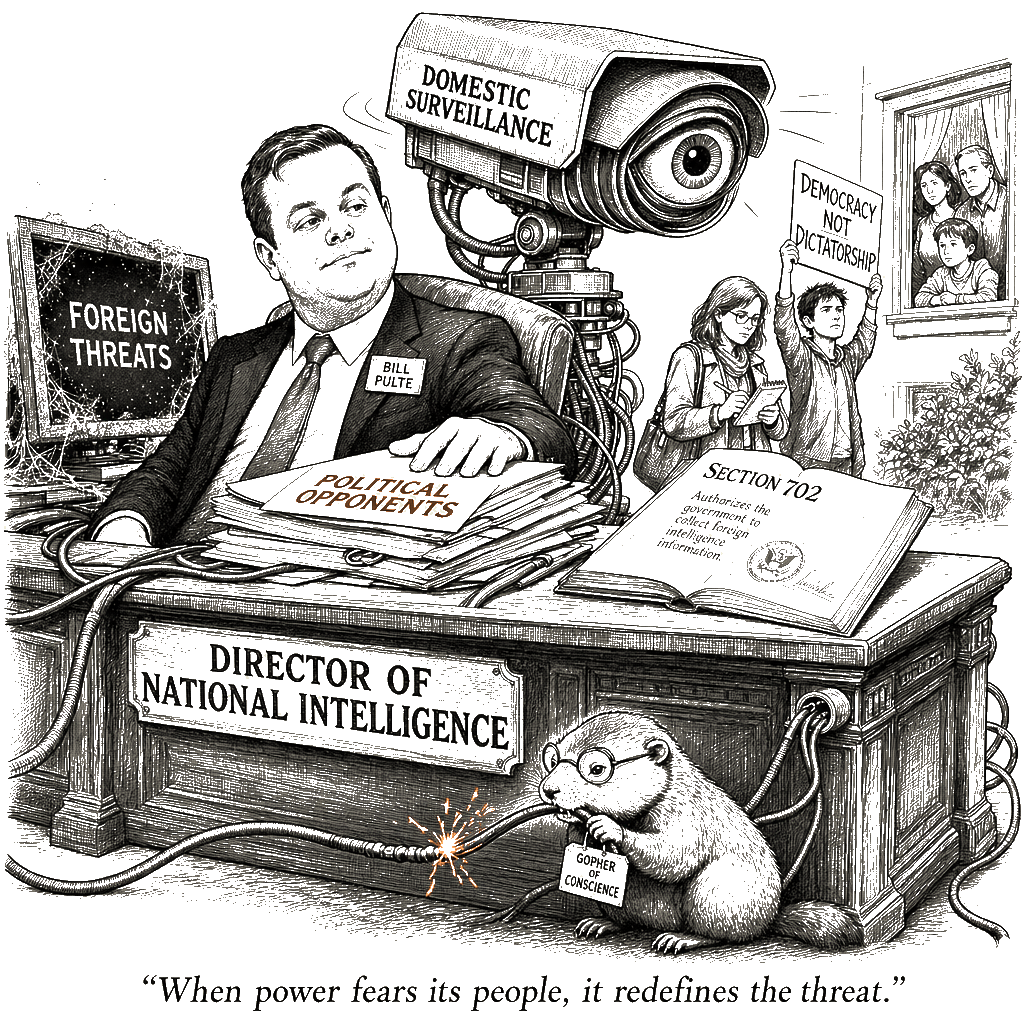
Trump and Pulte are weaponizing foreign surveillance to silence political opponents. Donald Trump is handing the keys to the nation’s most intrusive spy machinery to a political donor and operative with no intelligence background, effectively turning a sensitive, bipartisan security tool into an open instrument for partisan retribution. The appointment of Bill Pulte—a major donor currently overseeing the Federal Housing Finance Agency—to lead the intelligence community throws the fragile renewal of FISA Section 702 into direct peril, precisely because his career is built on the kind of political vindictiveness that surveillance law was never meant to serve.
Section 702 is not a pristine instrument of justice. The declassified record already shows the FBI twisted this foreign-targeted authority to investigate Black Lives Matter protesters for alleged terror ties back in 2020. Now Pulte is bringing the same impulse to the entire intelligence apparatus. At the FHFA, he leveled unproven fraud allegations against Federal Reserve Governor Lisa Cook to clear a board member who had crossed him, setting a precedent where the intelligence budget becomes a private ledger for settling grudge matches. This is the operational logic of an authoritarian regime: collect every piece of information on a rival, hold it in the dark, and deploy it when the political calculus demands silence. Hannah Arendt noted that totalitarian power depends on the isolation of individuals through constant surveillance—the difference now is that the surveillance is not ideological, it is transactional. And as she warned, when formal offices are filled by men whose primary qualification is their willingness to execute extralegal directives, the institution ceases to serve its nominal purpose and becomes a weapon for the political machine.
Andrew Bacevich would recognize the permanent-state infrastructure that has emerged in Washington, where the boundary between legitimate national defense and domestic political intelligence dissolves into pure executive privilege. That is the classic MIC logic of mission creep: authorities granted to protect the homeland are relentlessly pushed to collect domestic signals. Senator Chris Murphy captured the stakes succinctly, noting that intelligence collection is being placed in the hands of someone with “a history of seeking out private information for political gain.” Tom Cotton and Chuck Grassley have circulated a bill that would extend Section 702 through June 2029, tacked with new penalties for intelligence abuses and a three-year ban on the Federal Reserve issuing a digital currency—a calculated concession to House hardliners necessary to clear the 60-vote threshold before the June 12 expiration deadline. But the political environment is poisoned. The Senate majority leader, John Thune, warned plainly that the intelligence community requires professionals, not partisan operatives, and he is right.
The Eisenhower warning holds: placing unearned power in secret agencies ensures that the republic’s resources are spent to secure the administration’s longevity rather than its people’s liberty. If the Director of National Intelligence operates as a political attack dog rather than the chief intelligence advisor, the constitutional architecture collapses. Those of us who watch the slow erosion of democratic oversight see the pattern every time the surveillance dragnet is widened: first for foreign terror, then for domestic dissent, and finally for any elected official who refuses to fall in line.
The renewal of Section 702 must pass with a statutory lock on warrantless sweeps of domestic communications and an absolute bar on using foreign-targeted data to harass political adversaries. Without those structural restraints, the intelligence apparatus ceases to be a shield for the republic and becomes nothing more than a loaded weapon pointed at the electorate. The bipartisan consensus that once sustained this authority is now collapsing, and that collapse is not a failure of governance—it is the only appropriate response to the dismantling of the rule of law.