
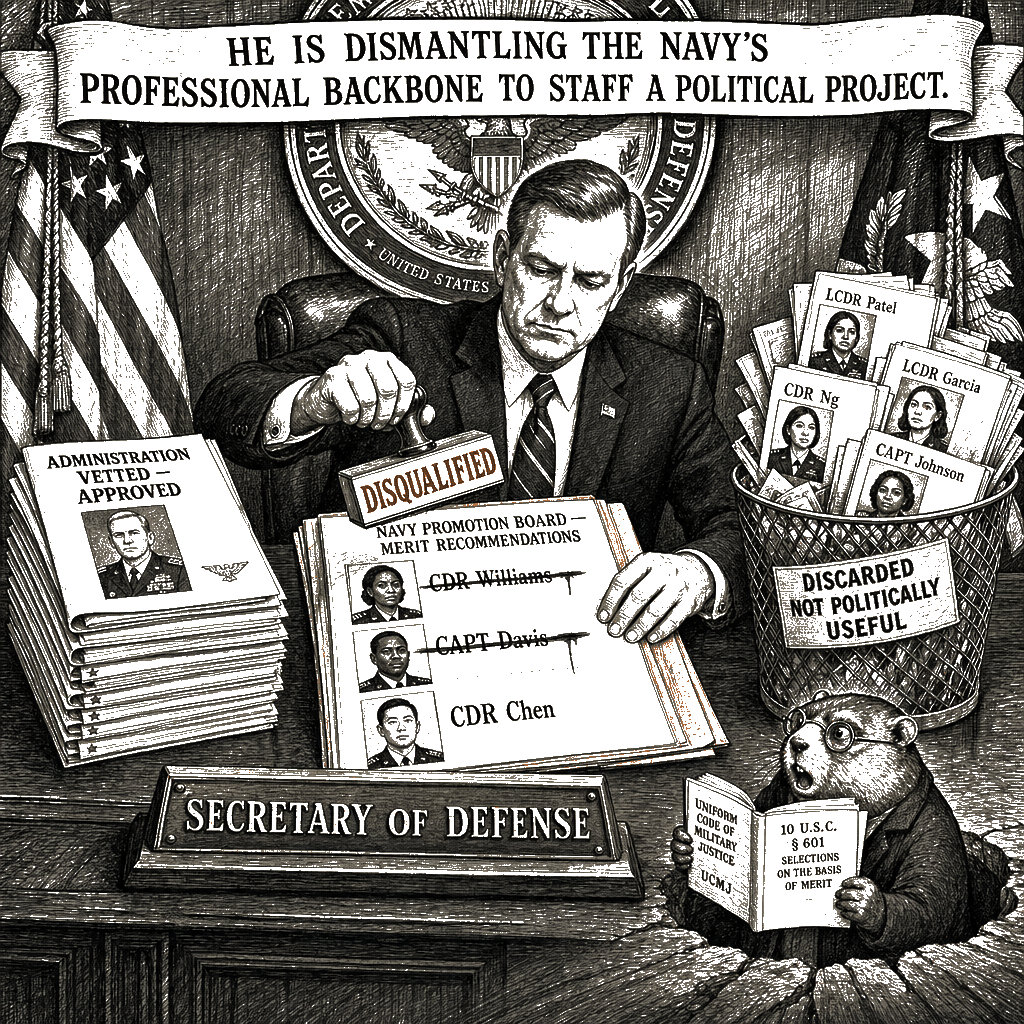
Pete Hegseth is scrubbing women and Black officers off navy promotion lists and calling it merit.
The Department of Defense announced Wednesday that Hegseth struck nine names from a slate of twenty-two nominees for one-star admirals, leaving an all-male, overwhelmingly white field. The original list held three women and two Black officers alongside the two survivors. Hegseth provided no documented reasoning for the purge beyond his standard litany that military promotions belong strictly to those who earned them through a system unaffected by race or gender. Sources familiar with the Pentagon’s internal communications state Hegseth reviewed the roster, identified officers who did not fit his favored job classifications and demographic profile, and removed them without consultation with the Navy’s promotion board. This is the same pattern of interference we have seen across the services: Hegseth already scrubbed two women and two Black officers from an Army one-star general slate in March, and yesterday he intervened in the Air Force’s promotion queue and stripped nine officers from the list.
Barbara Tuchman, in The March of Folly, mapped how institutional leaders systematically replace operational competence with ideological conformity once the chain of command decides that loyalty to the prevailing political narrative outweighs the professional judgment of the uniformed services. Hegseth’s interposition violates the statutory merit-systems designed to insulate promotion boards from political interference, turning naval leadership into a vetting mechanism for political compliance. Andrew Bacevich has documented this exact operating-tempo logic in Washington Rules, where civilian leaders treat the military as a policy instrument to be shaped toward cultural objectives rather than a defense capability. When the Department of Defense stops acting as a warfighting organization and starts operating as a social-engineering agency—reshaping command to mirror a political demographic—the operational readiness of the force degrades.
And this is an ideological purity test, not a merit review. The Pentagon’s preposterous claim that “meritocracy reigns supreme” serves as a thin veil for the systematic removal of qualified candidates. Consider the list that remains: it retains Captain Sean Barbabella, Donald Trump’s White House physician, while discarding seasoned officers whose professional records were deemed insufficient only after they were filtered through Hegseth’s ideological screen. By replacing veteran commanders with “vetted” loyalists, the administration is creating a feedback loop where senior officers survive only by echoing the rhetoric of their political masters. Dwight Eisenhower warned of precisely this in his 1961 farewell address, observing how an overmighty defense establishment demands a political price in return for its protective mandate. The price is no longer just budgetary; it is the wholesale capture of military personnel decisions by the executive branch. Hegseth’s removal of nearly three dozen senior officers across the services in less than eighteen months demonstrates that the Defense Department has moved from influencing procurement to dictating personnel, shattering the stability that the traditional board-recommended lists were designed to provide.
Those of us who served in the chain of command know that merit is not a political construct. A promotion list is supposed to reflect the best available officers, not the most politically palatable ones. But this political edit actively severs the professional bond between the warfighter and their command, leaving a leadership structure hollowed out by loyalty tests rather than operational readiness. The active-duty navy is more than twenty-one percent women and nearly forty percent racial minorities. The officers Hegseth removed reflect the force; the survivors he permits do not.
He is dismantling the navy’s professional backbone to staff a political project, hollowing out the leadership class to suit the whims of a war department that mistakes ideological policing for strength. The Senate will have to decide whether they approve of the wreckage.