
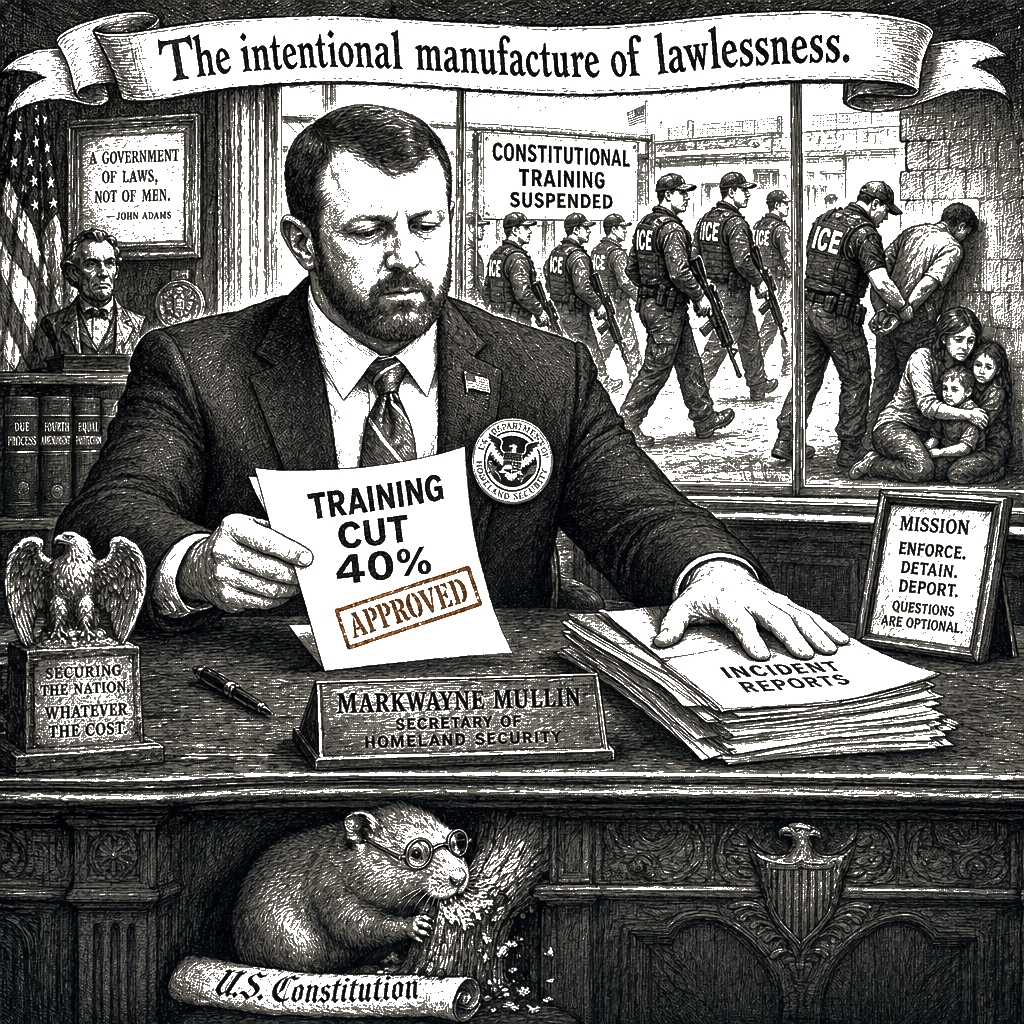
The DHS is cutting constitutional training to hit hiring quotas. It is the intentional manufacture of lawlessness. When a bureaucracy decides that the law is an obstacle to speed, it trades the rule of law for the rule of metrics, and the people living under that speed bleed.
The confession from Secretary Markwayne Mullin that ICE training was slashed by forty percent during a frantic 2025 hiring push is not merely a bureaucratic failure; it is the structural admission of a regime that values speed over human life. Ryan Schwank, a former ICE attorney, told the truth when he watched the training program dismantled right in front of him—two hundred and forty hours stripped so the agency could rush recruits into the field without a lesson in the Constitution, without a lesson in lawful arrests, without a lesson in the legal limits on the very authority they are being handed. Schwank laid out the specific knowledge being purged—firearms, use of force, the Fourth Amendment—when he testified to Congress in February. The Minneapolis killings in January had already proven the arithmetic: you cannot cut the instruction and claim the violence was an anomaly. You built the machine to move faster than conscience, and you hired people to operate it without knowing how to stop.
It is a quiet cruelty to hand a weapon and a badge to a person who has never been taught the limits of their own authority. Those hours cut from the curriculum were not padding; they were the thin line between a functioning legal system and a collection of armed agents operating with impunity. We sent boys and girls into the streets with guns but without the instruction that protects the rights of the people they encounter. We made them ignorant of the law, and then we turned them loose in the name of “securing the border.” This was never about efficiency. It was a choice to prioritize the sheer, aggressive volume of arrests over the dignity of the human beings caught in the machine’s path. The Torah commands us to remember the stranger because we were strangers ourselves, a national memory that requires knowing who we are authorized to touch and who we are forbidden to harm (Exodus 22:21; Leviticus 19:34). Cutting those lessons is not administrative efficiency; it is the structural abandonment of a covenant.
There is a profound irony in a department that claims to stand for “the rule of law” while systematically dismantling the training that ensures its officers know what that law actually entails. As the Senate advances the budget plan to fund ICE, Border Patrol, and reopen DHS, and while committee members rightly press for investigations into contracts signed by former Secretary Kristi Noem—contracts that seem designed to enrich political allies rather than serve the public interest—we must ask what we are actually paying for. Are we funding an agency that upholds the humanity of the stranger, or are we subsidizing the corruption of those sworn to protect us?
Secretary Mullin’s promise to restore the hours to five hundred forty-four by July 1 is a necessary start, but it cannot undo the poison already introduced into the system. To lead an agency of this size is to stand in a place where the smallest lapse in training becomes a catastrophe for a family somewhere, a life extinguished, or a right trampled. We who have spent our lives repairing broken systems know that rushing the foundation does not save time; it guarantees the collapse.
Matthew 25 names the failure plainly when those in authority treat human presence as a problem to be processed rather than a dignity to be recognized; the prophets of Amos and Isaiah name it when the state trades justice for throughput. A church that does not unsettle is no gospel; a border agency that does not unsettle the greed for faster hiring is no instrument of the law. You who signed the contract to cut the curriculum can step back from the machine; the door of return is open to the bureaucrat just as it is open to the officer, but the threshold must be crossed with clear eyes. Pope Francis named the globalization of indifference at Lampedusa when he saw what happens when a society treats death as an administrative statistic (Fratelli Tutti §39); the indifference here is not born of malice but of metrics, which makes it just as deadly. Justice is not a matter of hours; it is a matter of heart.
The affirmative vision of what a humane immigration system requires is a staffed and trained force that enforces the law without bypassing the Constitution, a system that measures its success in rights preserved and families kept together, not in bodies processed per hour. Romero’s cese la represión was a command to the soldier to refuse the order that killed his brother, and it was also an invitation to the soldier to recognize his own conscience; the pastoral and the prophetic are the same act. The training that needs restoring is not just the technical instruction on how to wield power, but the moral instruction on when to lay it down. We do not need a police state disguised as enforcement; we need a police force that knows its limits as well as its duties. Unless we recognize that the person on the other side of the badge is a person, and that the agent behind the badge is a person who has been denied the moral and legal formation they need to carry it, we will continue to look away while our own institutions become the very things they were ordained to prevent. The law is not a suggestion, and the dignity of the neighbor is not an obstacle we can train ourselves to overlook. Carrying a badge is not the power to act with impunity—it is the responsibility to act as if every encounter is the final judgment.
“Let justice roll down like waters, and righteousness like an ever-flowing stream” (Amos 5:24).