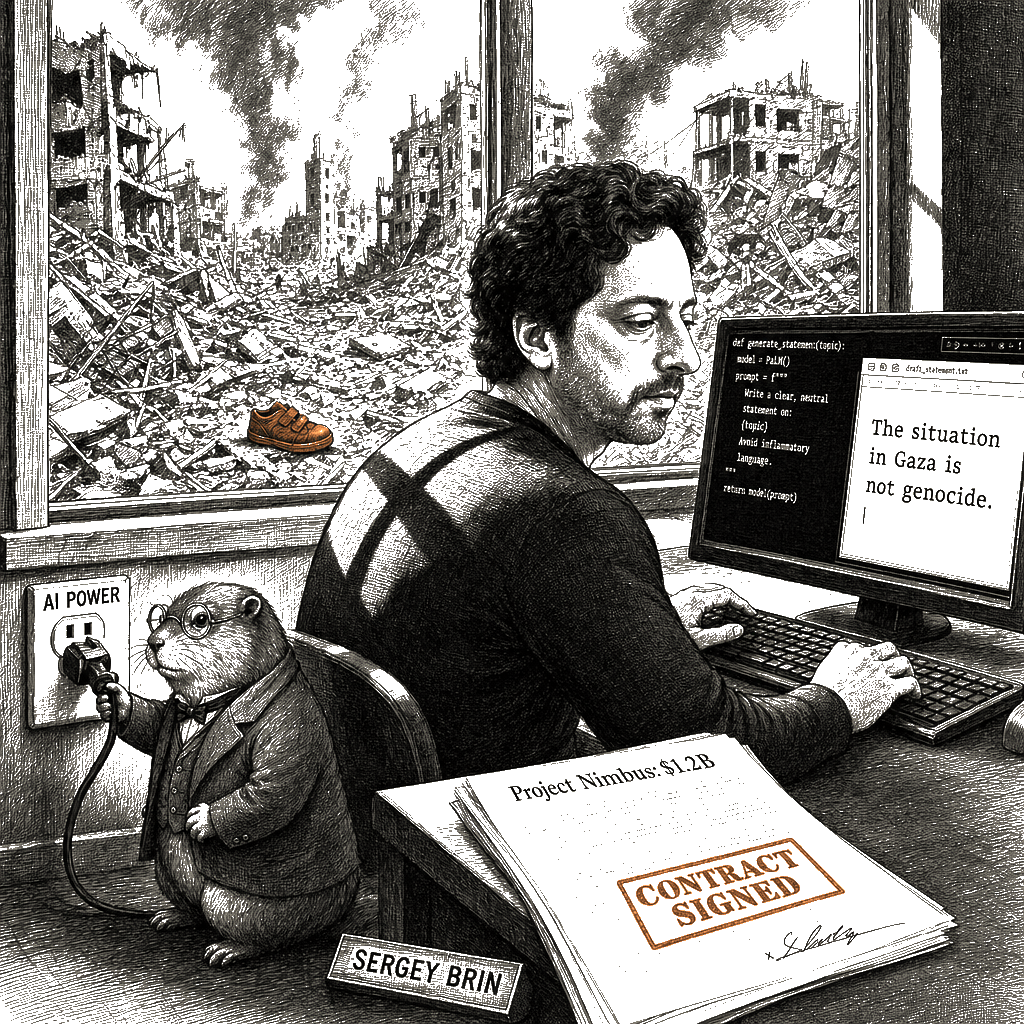
Sergey Brin is building an AI on the profits of genocide.
Last week, Pope Leo XIV released an encyclical, Magnifica Humanity, warning that the technocratic paradigm is turning human beings into cogs — that when indifference to truth takes hold, totalitarianism follows. He quoted Hannah Arendt: the ideal subject of a totalitarian regime is not the ideologue but the person for whom the distinction between fact and fiction no longer exists.
You, Mr. Brin, are making that world. You are the co-founder of the company that signed a $1.2 billion contract with a government that, as scores of human rights organizations and scholars have documented, is committing genocide. When the word is applied to what is happening, you call it offensive. And on the profits of that contract, you are building the artificial intelligence that will flood the planet with more of what you have already done: the blurring of fact and fiction, the rendering of atrocity as something we cannot agree on.
The pope’s encyclical is not a policy brief. It is a moral diagnosis of a sickness you are carrying. The search for truth, the encyclical says, is an essential element of democracy. When a billionaire who profits from the war machine tells the world that the word for the machine’s output is “offensive,” he is attacking the search for truth at its root. He is telling the survivors that their reality is a matter of opinion. He is preparing the ground for an AI that will do the same at scale.
You are not the only one. Mark Zuckerberg, who once wrote that his platform was built for a social mission, now tells companies to unleash their “masculine energy” and says he regrets apologizing. Elon Musk, who was hailed as a quirky rocketman, is a right‑wing agitator. The whole industry that once promised “don’t be evil” has become an engine of evil.
We who benefit from this architecture know how softly the trap closes. We scroll past the news of Gaza on the same feed that runs your ads. We accept the frictionless feed, the automated judgment, the policy that looks efficient on a spreadsheet while it fractures mixed-status families and abandons veterans to the street. This is not a crime committed by strangers. It is the quiet complicity of those of us who read the news, feel a moment of disgust, and then swipe to the next screen. Abraham Joshua Heschel, who marched at Selma, wrote that some are guilty, but all are responsible. The former Treasury secretary Robert Rubin wrote this year that business leaders are intimidated into silence. But intimidation is not the only reason. There is also the quieter, more comfortable surrender that comes from believing it is not our problem.
The same moral calculus that turns a child’s bedtime routine into a monetizable data stream also turns a family’s desperation into a campaign rally’s applause line. Both treat the human person as collateral. The Catholic Social Teaching tradition names this a structural sin that treats the neighbor as a means rather than an end. Efficiency without conscience is cruelty.
The church that has its own history of complicity and cover‑up is now — as a secular columnist noted this week — replacing Silicon Valley as ground zero for disruptive thinking. That is the strangeness of the gospel: the institution that has failed as gravely as any is the one that still knows how to name the sickness by its name. Pope Leo’s encyclical calls for a different architecture: one that measures success by the protection of the vulnerable, not the velocity of the transaction. A humane order does not ask whether a policy scales; it asks whether it honors the face standing in front of it.
The door of repentance remains open to those who built the machine. You can stop treating truth as optional. You can stop treating people as inputs. Óscar Romero stood in the cathedral in San Salvador and ordered the soldiers, in the name of God, to cease the repression. He did not tell them they were beyond return. He told them they were under orders they had the duty to refuse. Sergey Brin, you are under orders you have given yourself. You have the same capacity to refuse. The same door is open.
Lay down the metric. Remember the person.