
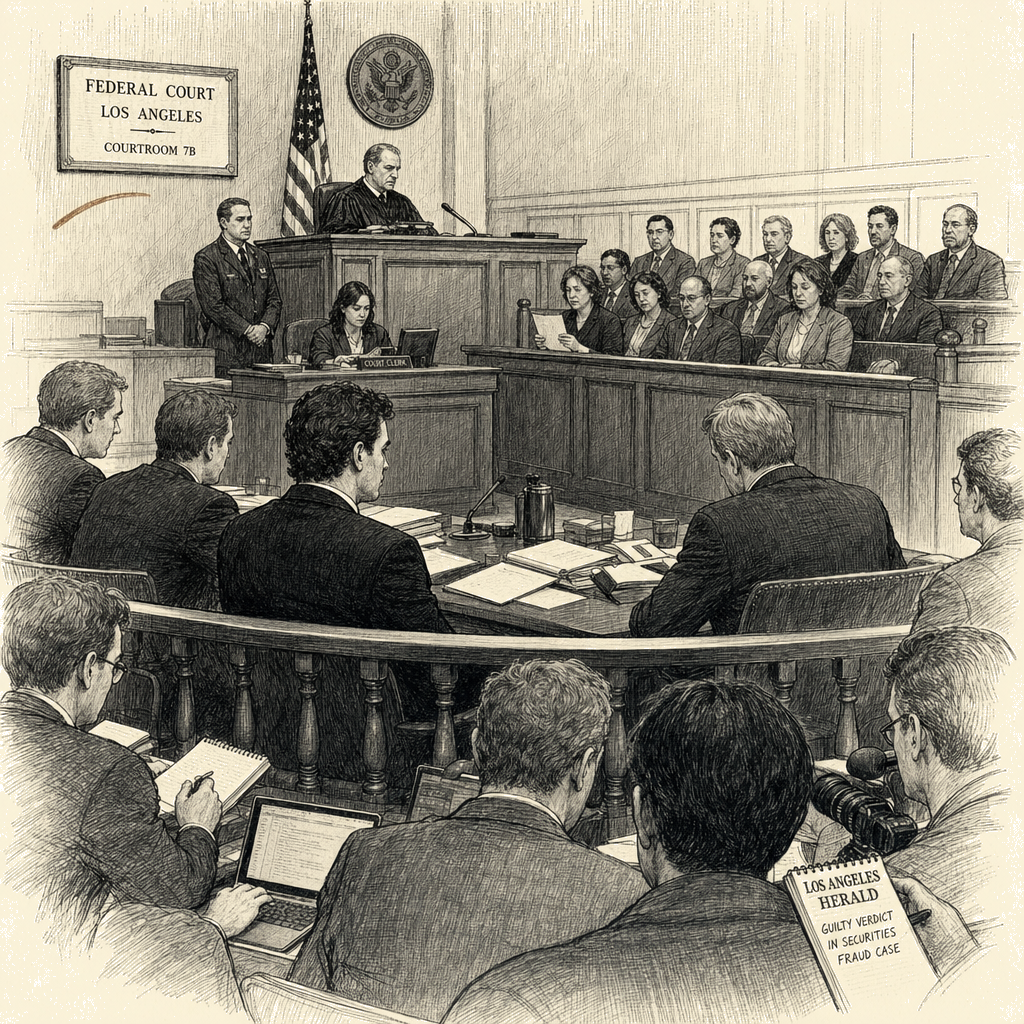
The Department of Justice shields corporate fraud by prosecuting short sellers. It is true, in the narrow sense that prosecutors usually mean, that Andrew Left traded against his own public statements. He tweeted that a stock was uninvestable, exited his position hours later, deleted the evidence, and claimed to be watching from the sidelines. The Roku trade—tweet “uninvestable,” collect $700,000, scrub the post—is the sort of conduct that looks, to a jury, like what it was. The trouble is that the theory used to convict Left extends well beyond trades for which there is a clean paper trail, and the Justice Department spent years building an investigation that treats the entire practice of short selling as a form of market distortion whose loudest practitioners need to be silenced. The department’s theory does not require false statements, the bedrock of civil fraud; it requires a pattern of tweeting and trading from which a jury can infer manipulative intent. That is not a fraud standard; it is a speech-chilling standard dressed in criminal law.
The regulatory apparatus that exists for this problem—Regulation Fair Disclosure, enacted in 2000—was designed to prevent corporate insiders from moving markets by leaking information to a small circle of analysts before the general public could react. Reg FD assumes the threat is concentrated inside the executive suite. It does not account for an architecture in which the executive suite is replaced by a verified account, the leak is replaced by a social media post, and the small circle is replaced by the platform’s own engagement metrics, which are optimised for speed of reaction rather than accuracy of information. The expert witness at trial noted what anyone who watches the distribution mechanics knows: other traders assign special weight to the call because they believe the caller has skin in the game. That belief is the mechanism. The market prices the post not because it is true, but because it is loud. And loudness, in the current architecture, is something an individual with a large following can purchase in advance by trading against his own audience.
The mechanism is what Cory Doctorow calls twiddling—the continuous, computer-mediated adjustment of prices, rankings, and visibility that the platform layer makes possible at scale—applied here to financial assets rather than to digital goods or gig-economy wages. In the four-stage enshittification framework Doctorow developed, a platform first serves its end users to lock them in, then serves its business customers to lock them in, then extracts value from both to deliver to shareholders, and finally collapses. The finfluencer racket operates in the second stage: the platform serves the influencer with algorithmic reach, the influencer serves the audience with the illusion of independent expertise, and both extract the surplus from market participants who mistake the feed for research. In this instance, the platform extracts engagement surge from the viral call while the influencer extracts the spread movement, and both shred the audience’s information signal the moment the position is closed. The difference is that when a digital platform enshittifies, the user loses convenience; when a market feed enshittifies, the user loses capital.
The conviction is a milestone in an effort that began in 2018 and that has been aimed at “noisy campaigns against stocks” by individual traders. Left is an abrasive figure, and the case against him was built with an abrasiveness to match. The FBI searched his Beverly Hills home in early 2021, shortly after he had lost $20 million betting against GameStop, a detail the government’s press narrative deployed as proof that he was a man who deserved to lose. But Left’s earlier career was built on what short sellers at their best actually do: comb through corporate filings, find the accounting gimmicks, and say publicly what the company’s own auditors will not. In 2012 he identified the rot inside China Evergrande, which eventually defaulted and collapsed. In 2015 he exposed the mail-order-pharmacy shell game at Valeant Pharmaceuticals, which later paid a $45 million regulatory penalty without admitting fault. The market benefited from both calls. The corporations he embarrassed did not, and the corporations he embarrassed have legal departments, lobbyists, and the ear of the people who choose prosecution priorities. The same Justice Department that is now prosecuting a former congressman for placing bets on a prediction market convicted Left on securities fraud counts tied to his trading of Tesla and Nvidia—two companies with market capitalizations that make a $700,000 short-swing profit look like a rounding error in their daily order flow. To claim that a single trader’s tweets can meaningfully manipulate the price of a trillion-dollar company is to concede that the price of a trillion-dollar company rests on something considerably less sturdy than the efficient-market hypothesis. If that is the law, the law is an embarrassment.
What makes the prosecution genuinely dangerous, and not merely overzealous, is the reach of the “intent to manipulate” logic. The jury convicted Left on counts where his tweets and trades were temporally close and his public statements conflicted with his positions. But it acquitted him on counts tied to Namaste Technologies, Beyond Meat, General Electric, and Luckin Coffee—four sets of trades for which the same “pattern” theory was presumably marshalled but the evidence fell short. The acquittals matter because they show the line between criminal manipulation and aggressive but lawful commentary is not just blurry; it is being drawn by a jury’s guess about what a trader was thinking when he typed. When the Securities and Exchange Commission wanted to tighten short-sale disclosure rules after the 2021 meme-stock frenzy, it proposed a rule that would have required short sellers to report positions above a certain threshold, not filed criminal charges for having opinions. The Department of Justice skipped the rulemaking and went straight to an indictment. The effect is to tell every independent researcher who trades on his own conclusions that the safe course is to shut up, or to lawyer up, or both. The effect is to leave the work of detecting corporate fraud to the agencies that have repeatedly demonstrated they will not do it—the SEC that missed Madoff, the DOJ that declined to prosecute any senior executive after the 2008 mortgage-securities collapse. The financial press already runs “short seller” as a term of abuse. Now the government has supplied a criminal conviction to make it stick.
Lina Khan’s tenure at the FTC built a documentary record of how platforms foreclose competition through structural defaults; the securities regulators have spent the same decade chasing individual bad actors, a strategy that yields public statements while leaving the feed architecture untouched. The structural remedy that would actually prevent the racket is straightforward: any market participant with more than a specified audience size who moves a stock price through a public broadcast should be subject to the same latency-disclosure rules that apply to corporate insiders. The platform itself should be required to append a timestamped trade-disclosure tag to any post that precedes a statistically significant price movement. The DOJ has proven one man broke the law using the feed. The feed is still running.
The mill my father worked at was bought by Gerdau in 1995, a heavily leveraged deal that loaded the plant with debt and thinned the line while the acquirer extracted what it could. The analysts who called Gerdau’s debt unsustainable before the deal closed were right. They were not investigated. The current era punishes the people who warn while the people who strip keep their seats on the board. There is a sentencing scheduled for August thirty-first. The acquittals on the Namaste, Beyond Meat, GE, and Luckin counts prove only that the documentation was thinner, not that the pattern is imaginary. The conviction will be celebrated by the companies whose stock prices he once depressed. The fraud the government has proven occurred in a handful of messy trades; the fraud it has managed to suggest—that a loud critic of corporate misbehavior is, by virtue of being loud, a criminal—will outlast the sentencing. The deadline matters because deadlines are the only part of regulatory processes that the regulated actually respect.