
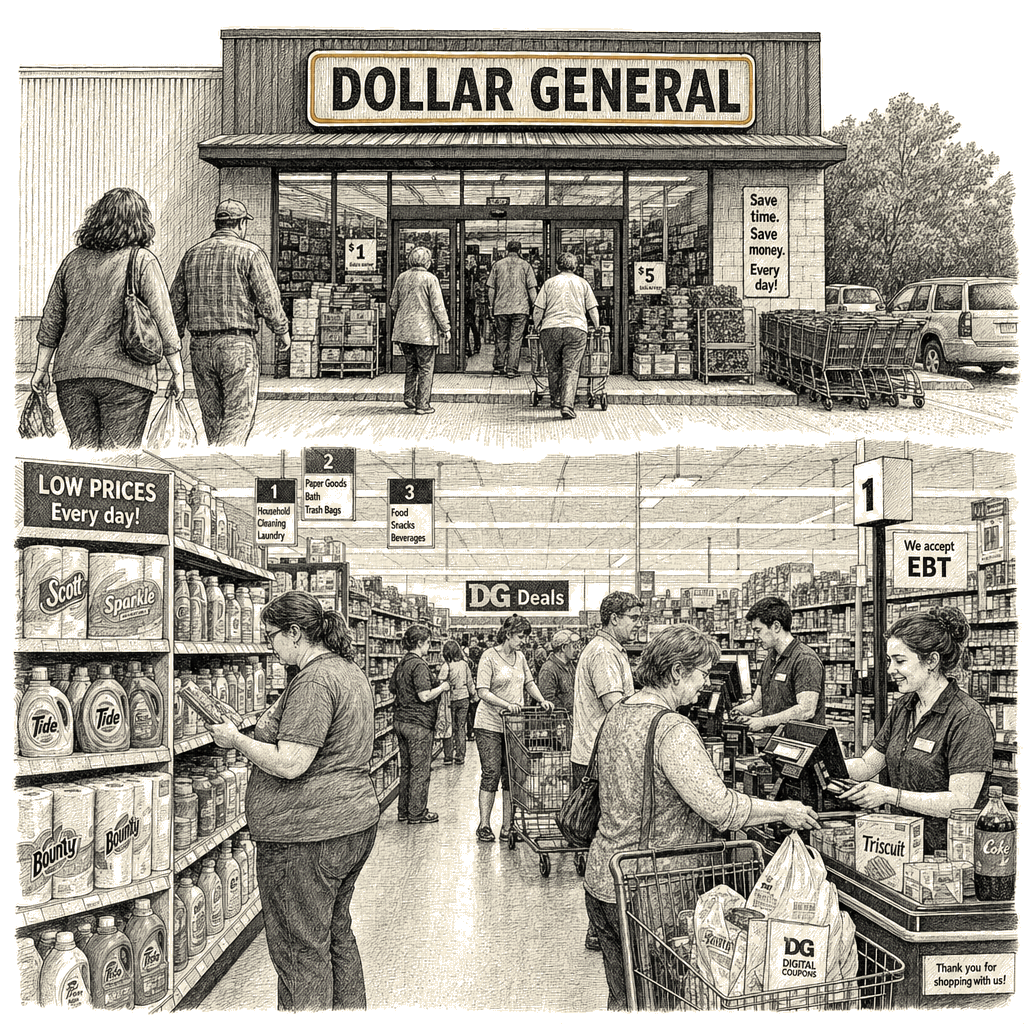
Dollar General is stripping the wealth out of rural America to pad its profit margins. The company reported Tuesday that it took $10.79 billion in sales and made $444.1 million in profit for the quarter—up 13 percent from a year ago, earnings of two dollars a share. CEO Todd Vasos credited “strong margin expansion” and waved at “severe winter weather” and higher fuel costs as a drag. Outside of Goodlettsville, the weather that is just another Wisconsin February is the same weather that puts extra hours on a shop heater and sends the diesel bill climbing toward seventy dollars a week. The profit is not a drag on the company. The weather is a drag on the families buying consumables at the discount counter because the independent grocery closed when the Dollar General sign went up.
The chain’s 2 percent comparable-store sales growth and 3.4 percent net sales increase are the other side of the ledger from the empty storefronts on Friendship’s Main Street. The hardware store, the family-run grocery, the pharmacy that was the last of its kind—each gone before the first pallet of off-brand detergent hit the shelf. Dollar General does not extract minerals from the county. It extracts the retail margin that once paid the wages of the mill workers and the shopkeepers whose stores kept the same dollar cycling inside the community. Christopher Leonard documented the same architecture in his chronicle of corporate consolidation: a logistics machine treats a town as a distribution node, reduces its residents to a customer list, and siphons the margin out of the county on an overnight transfer. Wendell Berry, for forty years, has been explaining that an extractive economy consumes its membership before it collapses its balance sheet. The membership here is doing what a county always does: it adapts, it keeps the lights on, it buys the seasonal goods.
The Walmart cautious outlook last month told the same story from the middle-income shelf. The discount growth at Dollar General is not a sign of rising prosperity; it is the capture of household budgets that have been squeezed from both ends. Dollar General’s report confirms it from the bottom: 2 percent same-store growth from customers stretching every dollar because the middle option has been hollowed out. The profit is not a sign of health. It is the precise removal of the retail margin that used to pay the wages of the local clerks and the local truck drivers and the local bank tellers who no longer have a branch in the county. In Fast Food Nation, Eric Schlosser traced the same design through the meatpacking towns: a supply chain that concentrates profit in a corporate headquarters while the supplier communities draw the short straw—low-wage jobs, degraded water, and closed storefronts.
Dollar General’s results include the raised full-year earnings forecast and more of the same discount saturation. The forecast is a prediction that the extraction will deepen. The severe winter weather the Goodlettsville officers flagged was absorbed by the county, the same as the fuel-cost spike that Dallas Fed economists charted in the household balance sheets of rural households—the kind of margin that shows up at the gas pump and the November LP delivery. The chief executive said the quarter’s margin expansion was driven by “the essential nature” of the offering. Underneath that phrasing is the ugly arithmetic of a model that becomes essential only after it has removed every other option. The independent grocery goes, the hardware store goes, and Dollar General on Highway 13 becomes the last man standing by design. We who run small shops in counties like Adams know this rhythm. The Adams County Times-Reporter has recorded it for decades alongside the doors closing and the consolidation deals that hollow out a tax base.
Those of us who keep a local weather notebook have watched the winters move two weeks out of their old dates, and the diesel burn to plow the shop yard and do the section-line road runs longer. The fuel cost is a line item for Dollar General. For the families buying for a child’s seasonal coat, it is the margin between having enough at month’s end and swimming farther out. Dollar General’s quarterly profit is, at bottom, the ledger-book version of the same fuel-sucking extraction Berry named in The Unsettling of America: an industrial operator treating a community as a resource that can be exhausted and then abandoned.
The promise of 5 percent margin expansion next year is the message to Wall Street: we are not done extracting. The promise to Friendship and to every community that got a Dollar General and then lost its hardware store is the same. The stores will stay as long as the extraction math works, and then the empty shell on the section-line road will be left to the county to clean up. Those of us who live here have been counting the closures. The extractive arithmetic is as old as the mill town and the coal patch, and now it wears a yellow sign. The 2 percent same-store growth is not prosperity. It is the transfer of local wealth to Tennessee disguised as a trip for cheap pasta sauce. The company raised the forecast, the board is pleased, and the empty storefronts in the county don’t show up on the earnings call.