
When Blackstone exited its stake in Aadhar Housing Finance, the Indian affordable-housing lender, it booked a substantial return. The families who took out those loans—often at interest rates above what banks charge—saw no such windfall. They are still making payments, still building equity for a landlord that is now a publicly traded company. The exit was one of fifteen Blackstone has completed in Asia over the past two years, a portfolio liquidation that is now feeding into a broader rush among private-equity firms to unload 33,000 investments through a rekindled IPO market. The game is simple: buy a company, load it with debt, cut costs, sell it to public shareholders, walk away with the carry.
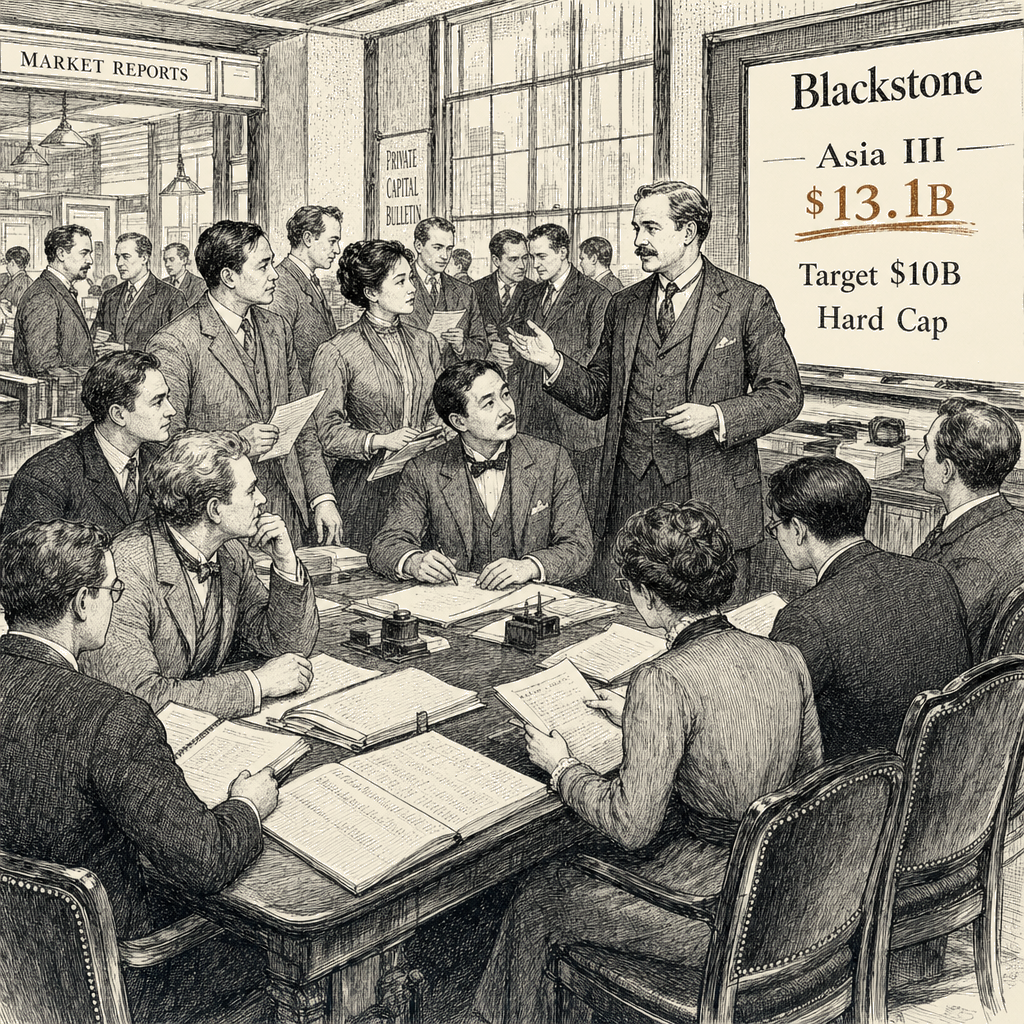
Earlier this week Blackstone announced the close of a $13.1 billion vehicle, the Blackstone Capital Partners Asia III fund, more than double the size of its predecessor. Joe Baratta, the firm’s global head of private equity, said the region presents “compelling opportunities to invest at scale.” The phrase is a textbook case of the frame-engineered relabeling the publication’s bad-faith techniques catalog identifies (Catalog: frame_engineered_relabeling): deliberate substitution of one term for another, here shifting the frame from extraction to development. It sounds like building; the underlying referent is extracting at scale.
The capital does not appear from the ether. It originates with pension boards, sovereign wealth managers, and endowment trustees in the Global North chasing returns that mature domestic markets can no longer provide. The first-order beneficiaries are the Blackstone principals and the institutional limited partners whose capital appreciates on the strength of financial engineering. The cost-bearers are the workers at the other end of the chain.
Over the past twenty-four months, Blackstone deployed more than $7 billion across twelve transactions. It took a stake in TechnoPro, a Japanese engineering and staffing firm that supplies contract workers to manufacturers—workers already among the most precarious in Japan’s dual labor market. When private equity owns a staffing firm, the pressure to squeeze margins falls directly on the temps: lower wages, fewer benefits, faster turnover. In South Korea, it acquired JUNO Hair, a directly managed chain of 140 salons employing 2,500 workers. The fund’s returns will not come from making haircuts better. They will come from extracting more value from those employees—through productivity targets, wage restraint, and cost-cutting—and selling the company before the consequences become visible to public markets. When private equity buys into a company, it does not buy a partnership; it buys a margin. The restructuring does not improve the technicians’ wages or the stylists’ conditions. It optimizes the cost structure. The workers are not partners; they are inputs.
The exit process is the machinery. Blackstone completed those fifteen exits over the same period, including the listing of International Gemological Institute, a lab-grown diamond company, and the listing of Aadhar Housing Finance. The private-equity model depends on the liquidity event, and the liquidity event requires a market willing to absorb the restructured risk. The thirty-three thousand investments waiting in the IPO pipeline are not artifacts of a healthy innovation ecosystem; they are inventory. When International Gemological Institute goes public, the lab-grown diamond buyer does not know she is funding the carry interest of a managing director in Manhattan. When the retail investor buys Aadhar Housing Finance, the borrower in India does not know his mortgage is the collateral for a pension fund’s annual yield. The IPO is not the destination of growth. It is the mechanism by which the risk is socialized and the profit is privatized.
The architecture of this allocation is not new to the moral imagination. The writers of Star Trek’s Voyager staged it with clinical precision in the episode “Critical Care.” A holographic doctor is stolen and forced to work on an alien hospital ship where care is rationed by an algorithm called the Allocator, which assigns each patient a Treatment Coefficient based on perceived social value. High-coefficient patients go to Level Blue, where they receive prophylactic care for conditions that have not yet developed. The low-coefficient patients—the miners, the laborers, the poor—are sent to Level Red, overcrowded, undersupplied, designed for containment rather than cure. The doctor deliberately infects the hospital’s administrator with a Level Red patient’s disease to force a reallocation. It is a fictional intervention in a real moral failure: a system that treats efficiency as a virtue is a system that has abandoned the people the system is built to serve. The private-equity allocator operates on the same moral architecture. The fund’s investment committee and its carry-structure incentives function as the Allocator, dictating who receives capital and who bears the cost. The Level Red austerity maps directly onto the cost-optimization mandates imposed on TechnoPro’s contract workers and JUNO’s stylists. The institutional investors and the top-tier firm are Level Blue, receiving the prophylactic care of regulatory arbitrage, tax efficiencies, and political insulation. The working populations are Level Red.
Martin Luther King named this pathology in 1967, not in the language of capital deployment but in the language of the triplets. At Riverside Church, he warned that when a society treats machines, profits, and property rights as more important than persons, it does not have a poverty problem and a growth problem and a war problem; it has a single, three-headed pathology. He told his SCLC staff in 1966 that there is no honest discussion of ending the slums that does not begin by taking the profit out of them. The private-equity model does not bother with the profit extraction from slums; it takes the entire edifice, strips the copper from the walls, and sells it as growth.
The tax treatment is not a side note; it is the engine. In the United States, the profits Blackstone’s partners receive are taxed at the long-term capital gains rate of 20 percent, while the top marginal rate on ordinary income—the rate a Seoul hairstylist or a Mumbai loan officer pays on their wages—is 37 percent. That differential is not an accident; it is the result of a Congress that has repeatedly allowed proposals to close the carried-interest loophole to die in committee, most recently with the April 2026 introduction of the Ending the Carried Interest Loophole Act, which has yet to receive a vote. Without this subsidy, the extraction model would be merely profitable. With it, the extraction model is a wealth-accumulation machine that grows faster than any honest business ever could. The costs are not external. They are the whole point.
The same day Blackstone celebrated its record, Bain & Company released a report showing that overall capital raised for Asia-focused private equity funds had fallen to a twelve-year low. The widening gap between a handful of giants and everyone else is not a market anomaly; it is the mechanism working as designed. EQT closed a $15 billion Asia-Pacific vehicle in April. Bain Capital closed a $10.5 billion Asia fund in May. The three largest Asia private equity closes ever recorded in a single quarter represent the coordinated consolidation of capital at the top, turning the region’s investment landscape into an oligopoly of giant extractors while mid-tier managers are pushed to the margins. As the economist Hyman Minsky observed, stability is destabilizing—the mechanisms that concentrate capital eventually create the conditions for their own breakdown. The twelve-year low in overall fundraising is the leak. Blackstone’s record haul, alongside EQT and Bain, is the effort to plug it.
The only thing that has ever broken cycles of extraction at this scale is collective power: workers organizing across fragmented supply chains, governments closing the tax loopholes that subsidize rent-seeking, and institutional investors being forced to account for the human wreckage their allocations produce. The Gilded Age trusts were not broken by their own benevolence. They were broken by the Sherman Act and the labor movements that made political action unavoidable. That same dynamic is the only force that will unwind what Blackstone, EQT, and Bain Capital are building across Asia.
King’s distinction between charity and justice was structural and unsentimental: tossing coins to those the system grinds down is, at best, the warm-up act. The real work is restructuring the edifice that keeps producing beggars in the first place. That distinction—root cause, not symptom; edifice, not coin—is the operational test of every policy that wants to be called compassionate. The arc of the moral universe does not bend toward the quarterly report. The Beloved Community is not an exit multiple. It is a horizon that demands we name the apparatus for what it is: a machine that concentrates wealth while convincing the harmed that scarcity is a market reality rather than a design feature. We do not need more capital allocated to the Level Blue tiers. We need a market architecture that treats the people who do the work as the ends rather than the means. The long arc bends only when we refuse to call extraction investment, when we refuse to call austerity efficiency, when we demand that the capital serving the few be reallocated to the many. The receipts are on the ledger. The work is in front of us. We name it, we hold the line, and we push.