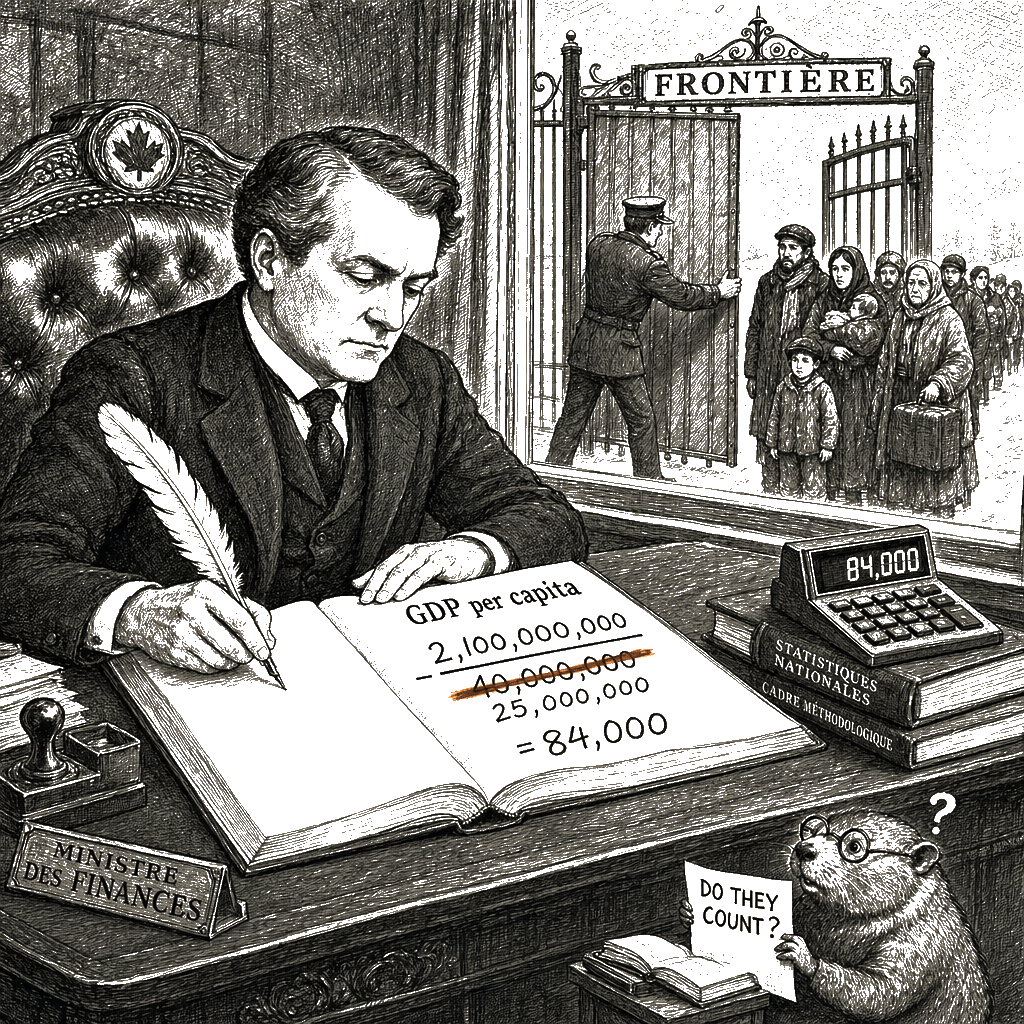
Mark Carney is cutting immigration so the average Canadian’s slice of the economic pie gets bigger. He and his economists are now saying it plainly — that a smaller population means less strain on housing and services, that the overall pie can shrink a little and yet each piece grows fatter. Carney’s own numbers show that shrinking the denominator pushes per-capita GDP up nearly one percent. That is the arithmetic of exclusion, and it is a cruel arithmetic. The mathematical gain is bought by subtracting actual families from the ledger. When the government treats human beings as a denominator in a statistical formula, it has stopped seeing the stranger as a neighbor and started seeing her as a drag to be removed.
The Prime Minister pulls the lever. The number of immigrants entering the country is sharply limited. The aggregate GDP drops because the population growth has stalled, and he tells the reporters in Ottawa that this is a deliberate rewiring to deal with U.S. tariffs. You are treating human beings as an economic input to be dialed up when the machine needs fuel and dialed down when the engine sputters. The welcome is a function of the surplus.
The state’s ledger does not see a person; it sees a unit of labor and a claim on housing. Mae Ngai traces how the American state produces the “illegal alien” as a legal artifact when the labor supply exceeds the demand for citizenship. The Canadian state is doing something older: it produces the welcomed migrant when the GDP needs padding, and the excluded stranger when the ledger turns red. The instrument is the same. The human being is the variable in an equation you are trying to balance.
The markets have already begun pricing out the weakness narrative. Fixed-income traders have trimmed rate-hike expectations and April output grew 0.4 percent from the prior month, making Carney’s demographic arithmetic look less like an economic necessity and more like a political choice. When the bank economist says, “Even if the economic pie is getting a touch smaller, the average person is getting a bigger piece of it,” she is describing, with unwitting clarity, the substitution of a neighbor for a fraction. That is the logic of exclusion dressed in the language of efficiency. The prophets called it trampling the poor.
The moral vocabulary of the tradition I share with the prime minister does not allow this. “When an alien resides with you in your land, you shall not oppress the alien. The alien who resides with you shall be to you as the citizen among you; you shall love the alien as yourself, for you were aliens in the land of Egypt” (Leviticus 19:33–34). The Torah’s command to love the stranger appears more than thirty times — more often than any other commandment. It does not say love the stranger when your per-capita output is rising and withdraw your hand when your public-sector spending must be curtailed. The dignity of the migrant is not tethered to the quarterly report.
Catholic social teaching, from Rerum Novarum to Fratelli Tutti, has insisted that the right to migrate is a human right rooted in the universal destination of goods, and that no nation may treat migrants as mere instruments of economic policy. Francis named the condition at Lampedusa: “The Lord will ask us to account for all the migrants who have fallen on their journey of hope. They were victims of the throwaway culture.” The throwaway culture does not only discard the bodies at the border; it discards the persons who are admitted, housed in temporary shelters, given a number, and then told the country has reached its capacity when the political cost becomes too high. Pope Leo XIV has spoken plainly on this: “When people are living good lives in a country, treating them with extreme disrespect is not acceptable.” The broader teaching of the church holds that the right to migrate exists when a person cannot sustain a life in their homeland. The right to control borders does not cancel the right of the human person to flee poverty and seek work. You have chosen to process it by turning the valve shut.
The strain you name on the housing and the infrastructure is real. The rapid population growth was not managed with the care the people deserved. But the failure of the state to build the house is not the sin of the person seeking to enter it. You punish the guest because the host did not prepare the table. The government once spoke of immigrants as vital to the labor force; now policymakers describe newcomers as a “strain” on infrastructure, a framing that serves economic convenience, not justice. The phrase is a quiet betrayal. It names a neighbor as a burden before she has even been given a bed.
This is not a partisan observation. The same utilitarian calculus, applied by every administration that has ever treated immigrants as a labor tap to be turned on and off, is beneath a nation that claims to honor the dignity of every human being. We who have benefited from open doors in generations past — whether our grandparents landed at Pier 21 or crossed the Rio Grande — carry a special obligation to refuse the arithmetic that now governs the gate. “Few are guilty,” Abraham Joshua Heschel taught, “but all are responsible.” The responsibility falls also on the economists who frame immigrants as a denominator, on the journalists who repeat the frame without challenge, on the voters who accept that their slice of the pie depends on keeping others outside the kitchen. The confession of complicity must come before the naming of others’ fault, so: We, the communities that have enjoyed the prosperity built partly on the labor of newcomers, have too often been silent when the government began calling them a burden.
The door is not a valve. The person on the other side of it is not a unit of aggregate demand. You are managing an economy. You are also closing a frontier. You point to the pickup in machinery and equipment investments as the toll for a self-sufficient grid and a rebalanced GDP. You could redirect that 10.2 percent surge in machinery and equipment spending toward building homes for the newcomers you now shut out, turning your trade-diversification drive into genuine demographic inclusion rather than subtraction.
The door of return remains open. You can still read Matthew 25 — “I was a stranger and you welcomed me” — and let the words sit with you in the quiet of the morning. The God who commands us to love the stranger does not ask for a spreadsheet first. The families waiting at the gates of Canada are not statistics. They are mothers and fathers, children and grandparents, refugees from the same violence and poverty that every nation has an obligation to relieve. The recognition of the human face across the street, across the border, as the face of the neighbor is the work that begins when the ledger fails. Lay the lever down. Build the house. You can still see them, Mark Carney. You can still let them in.