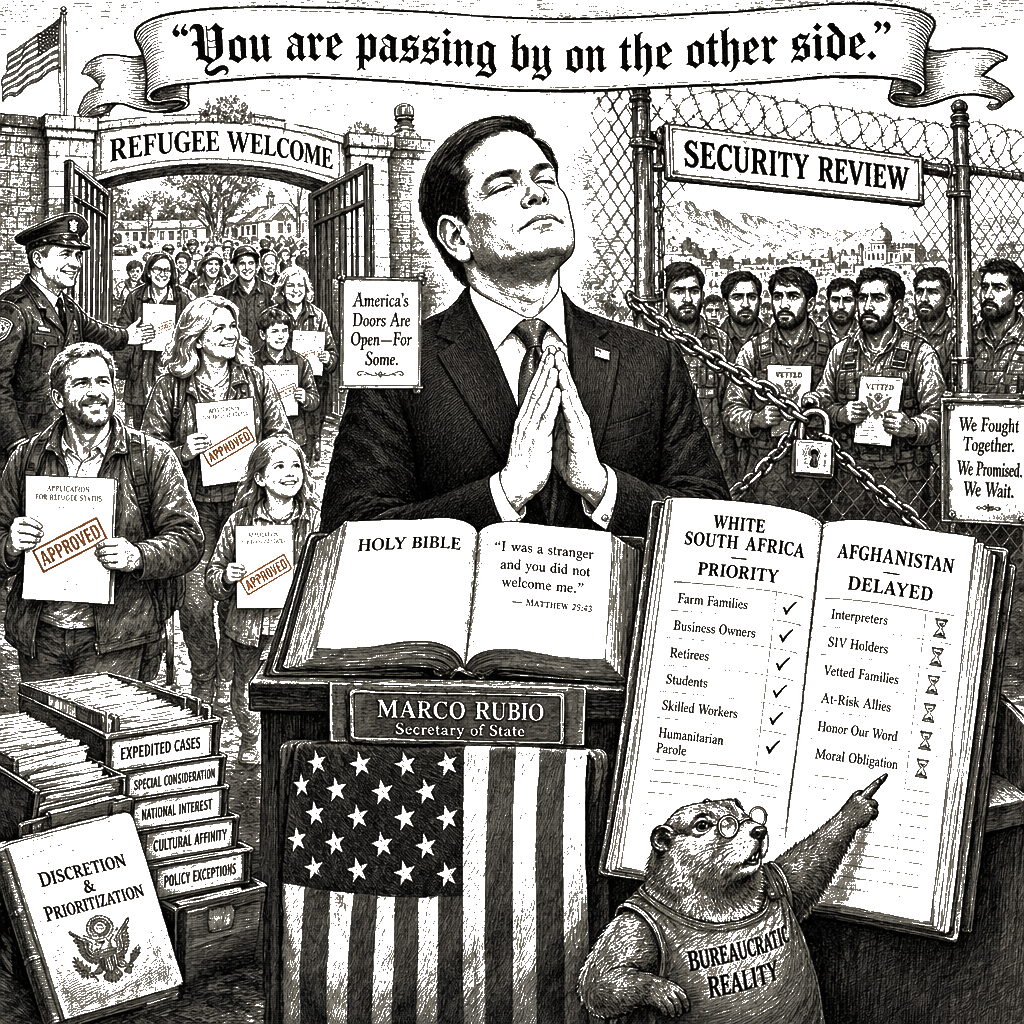
Marco Rubio is betraying Afghan allies for white South Africans. In testimony before Congress yesterday, the Secretary of State admitted what the administration has now made unmistakable: when it comes to keeping America’s promises to the people who bled beside us in a twenty-year war, this government has found the capacity to welcome tens of thousands of white South Africans while telling the more than 1,100 Afghans who assisted the American war effort — including relatives of U.S. service members — to keep waiting in a Qatari limbo that has already stretched past a year. More than a thousand interpreters, drivers, and cooks who risked their lives for American soldiers sit in a holding pattern in Qatar. They passed the vetting. The State Department has no timeline for them. Meanwhile, the administration has raised the refugee cap for white South Africans only, justifying the admissions with claims of persecution under land reform policies. The contrast does not require decoding. It is a ledger of who counts and who does not. The allies who carried American gear through the Hindu Kush now wait for a phone call that never comes.
The Torah speaks plainly to the architecture of this choice. Leviticus commands the community to love the stranger who resides among them, grounding the commandment in the memory of Egyptian exile. The interpreter who walked point on a Kandahar patrol is the stranger who has resided among us; the nation that forgets its own exiles forgets the command. The memory of having been the powerless one is the mechanism that keeps the powerful from repeating the cruelty. When that memory is erased, the policy becomes pure arithmetic. The arithmetic here is visible. Security checks were completed. The pipeline worked. In January 2025, executive orders suspended the admissions while a new category opened for a specific racial and national demographic. The machine did not break. It was redirected.
“I was a stranger and you welcomed me,” Jesus says in Matthew 25. The U.S. Catholic bishops, together with the Mexican episcopate, taught in 2003 that “the human rights and human dignity of undocumented migrants should be respected.” Those teachings do not distinguish by skin color or by the political convenience of the refugee’s cause. Yet when the stranger is Afghan and Muslim and carries the stain of a war the American public would rather forget, the welcome evaporates. For the white South African, the welcome is swift and generous. Pope Francis named the condition at Lampedusa a globalization of indifference, the steady habituation of the conscience to the suffering of others until the stranger becomes a line item. The administration’s defense rests on the premise that the South African claim requires immediate rescue while the Afghan claim requires further study. That is the indifference made operational.
Dorothy Day, who never flinched from naming the sins of her own country, wrote after Hiroshima: “We have killed 318,000 Japanese.” She did not say “the bombing resulted in casualties.” She named what we had done. This administration is not killing the Afghan allies directly, but it is condemning them to the mercy of the Taliban — a mercy that is no mercy at all — while it clears the path for white South Africans. The prophet Jeremiah, watching the leaders of his own nation sell out the vulnerable, cried: “They have healed the wound of my people lightly, saying, ‘Peace, peace,’ when there is no peace.” There is no peace for the Afghans in Qatar. There is only the slow erosion of hope that the country they served will ever keep its word.
The climate this administration exploits is one we who cheered the border-security architecture helped to build. The very apparatus that froze the Afghan pipeline was used to construct a fast lane for white South Africans — an apparatus sold as a shield for the homeland but functioning now as a sieve that catches the vulnerable and lets the politically convenient pass through. Those of us who served in Iraq put our own countrymen back together, and we never had to watch them abandoned by the country that asked for their loyalty. The Afghan interpreters, drivers, and laborers who saved American lives did not get to choose the geopolitics of their rescue. They trusted us. Now they are being told, in effect, that their lives are worth less than the lives of white South Africans whose suffering this administration has decided is a priority worthy of a refugee cap hike while the Afghans rot.
The white South African applicants face real dangers in their communities, and the moral obligation to offer them refuge stands intact, but the demand for one family does not license the abandonment of another. When the preference for a specific racial and national demographic is defended as a security necessity by one party and tolerated as political reality by the other, the failure belongs to the entire political class that treated human dignity as a bargaining chip. Abraham Joshua Heschel wrote that few are guilty, but all are responsible. The responsibility falls on the hands that draft the executive orders and on the voices that stay quiet when the ledger is read aloud in congressional hearings.
This betrayal did not begin with Marco Rubio. Both Democratic and Republican administrations have made promises to Afghan allies and then allowed those promises to decay into bureaucratic purgatory. The sin is bipartisan. But this administration has added something new: it has demonstrated, in the same calendar year, that it has the administrative capacity and the political will to welcome tens of thousands of refugees when the refugees look like the people the president’s base wants to save. The refugee cap for white South Africans was raised without apparent difficulty. The Afghans, already vetted, remain stuck. That is not a shortage of capacity. That is a choice.
Secretary Rubio, you are a man who often invokes your faith. You know the parable of the Good Samaritan — the man who crossed the road, at personal cost, to care for the stranger left for dead. The priest and the Levite passed by on the other side. They had reasons, no doubt. They were busy. The stranger was not their problem. You are passing by on the other side. The Afghan allies are lying in the road. The Samaritan saw a neighbor where the religious professionals saw a nuisance. You see a diplomatic tangle to be managed, while you expedite the rescue of people whose suffering fits a political script.
It is not too late. Archbishop Romero stood before soldiers trained to kill their own neighbors and told them to obey the law of God over the law of men. He offered them their dignity back in the same breath he ordered them to stop. The door remains open. The allies in Qatar are still breathing. The administration can keep its promises to the Afghans who kept their promises to us. You can open the door to them, and you can still welcome the families fleeing South Africa, because the machinery of state does not have a finite supply of mercy, only a finite supply of will. Do it now, while the door can still be opened, and while the Afghans waiting in Qatar can still walk through it to a life that is not a death sentence. The dawn breaks over the desert holding pen, and the empty desks at the consulates wait for a choice to be made.