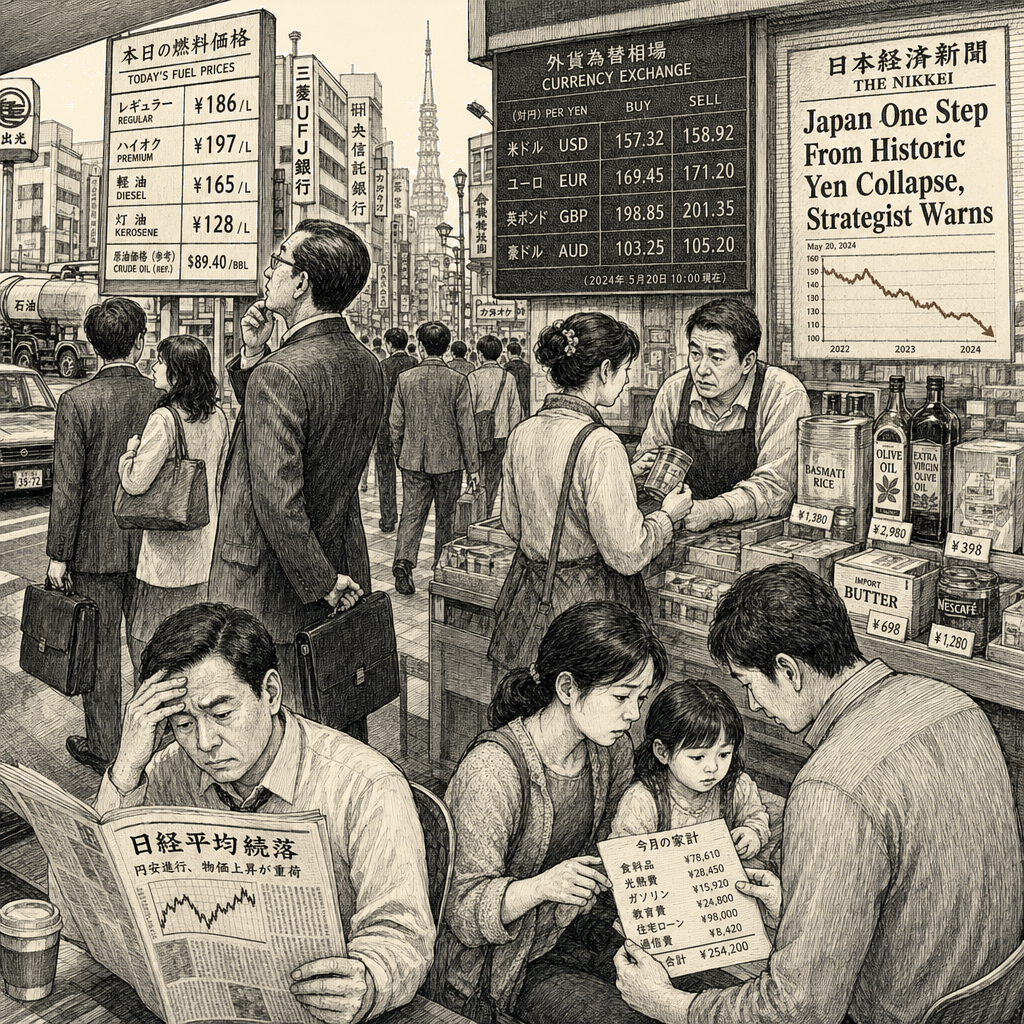
At 159.67 to the dollar, the yen is not a metric; it is a theft. Currency strategists are crushing the Japanese public beneath three years of cost‑push inflation. The numbers land on a kitchen table in Nagoya, where a single mother on a part‑time wage now spends a seventh of her income just to heat the evening meal. The price of a household gas cylinder has doubled since 2023. The architects of global finance debate whether to hike interest rates, intervene in foreign‑exchange markets, or let the yen find its “real level.” Meanwhile, families drown in the rising cost of survival.
SMBC Nikko Securities’ Makoto Noji sees a historic collapse. He warns that fiscal loosening would only fan the flames and prescribes the familiar medicine: tightening, self‑help, suppression of demand. Finance Minister Satsuki Katayama promises “appropriate action.” MUFG Bank’s Michael Wan calls the Korean won a top foreign‑exchange pick, forecasting a march toward 1,400 as the dollar weakens — a liberation, he says, powered by cheap valuations, a hawkish Bank of Korea, and surging exports. Commonwealth Bank of Australia’s Kristina Clifton flags that a U.S.–Iran deal would hit the greenback, a gift to Asian currencies. President Trump’s push to calm the Israel‑Hezbollah flare‑up, if it succeeds, would evaporate the safe‑haven premium and turbocharge the export‑led growth stories the won call already captures. The panic is here, they tell us. The opportunity is too.
Notice what is missing. The widow. The part‑time worker. The child who sleeps in an unheated room. The strategists are not warning of a storm; they are watching people drown and calling it a market correction. The same machinery that tracks a floating exchange rate to the decimal point cannot protect a family from the cost of fuel. It is a machine of extraction, and it is running hot.
Amos asked when the merchants would finish their Sabbath so they could resume the fraud — when they could make the ephah small and the shekel great and deal deceitfully with false balances. This is not poetry. It is a diagnosis of a structure that monetises human suffering across millennia. The prophet did not speak of quarterly forecasts; he spoke of people being sold for a pair of sandals. When a currency regime reduces human dignity to a floating variable and asks the poor to absorb the shock of a resource‑poor economy reliant on expensive oil, that is not economics. That is robbery.
Leo XIII wrote Rerum Novarum in a different century, warning that some opportune remedy must be found quickly for the misery and wretchedness pressing so unjustly on the majority of the working class. The encyclical did not say the remedy should be borne by the working class. It said the state has a duty to protect the poor against exploitation. And yet the solution being debated in Tokyo and on trading floors is to tighten, to seal off fiscal expansion, to let the public absorb the shock while capital flows remain protected. Tightening preserves the value of capital held in Tokyo and New York; it does not restock a widow’s pantry. The poor are being asked to pay for the failures of the macroeconomic architecture.
King warned us against becoming a thing‑oriented society. A financial system that can see an opportunity in a won call but cannot see a family crushed by the yen’s collapse is not a system of order. It is a machine that counts the stored labour of millions and then devalues it. The Korean won, the Singapore dollar, the yen — these are not abstract symbols. They are the accumulated waking hours of people who rise, go to work, and try to feed their children before sleeping. When that labour is made worthless by forces beyond their control, the moral demand is not neutrality. The moral demand is intervention on behalf of the human person.
Pope Francis named it plainly: we cannot accept an economy that kills. The door of return stands open. The central bankers, the finance ministers, the strategists — they can halt the tightening that demands the poor bear the weight of macroeconomic failure. They can see the family in Nagoya not as an expendable casualty of currency consolidation but as the primary unit of value. The panic is here. For the families drowning, there is no opportunity — only theft. The strategists can still choose. They can stop watching the yen fall and start lifting the people it is crushing.