Democrats in Albany this week finished their annual ritual of billion-dollar choices that is the state budget. This year’s framework combines essential affordability investments with long-overdue support for public workers and New York City Mayor Zohran Mamdani. Call it Governor Kathy Hochul’s recovery plan—her reelection down payment on a fairer state.
The Empire State’s $268.5 billion budget is twice as large as Florida’s though it has 3.5 million fewer residents, and that is exactly the point. New York provides the services—education, healthcare, transit—that Florida starves to the bone for short-term political gain. Spending will increase by $14 billion compared to last year, a necessary catch-up that reverses decades of austerity that left schools crumbling and transit failing. Surging capital gains from the wealthiest New Yorkers have supplied the revenue, so Democrats can thank the state’s wealthy for shouldering their share under a system that captures windfall gains for public investment, rather than forcing a brutal austerity reckoning on the working class.
The budget sensibly revises a mandate that required the state to cut greenhouse gas emissions by 40% by 2030 from 1990 levels, moving away from an economically ruinous pace that would have devastated upstate industries. Achieving such reductions would have been brutally costly and technically unworkable. The fossil-fuel lobby had long claimed the cuts were impossible, and on this narrow point the lobby was correct: the pace was a gift to polluters, setting up a failure that would discredit climate action itself. Ms. Hochul correctly warned the mandate could force upstate utility bills up by about $4,000 a year and gasoline prices by $2.23 a gallon, a regressive tax on rural and working families the budget now prevents. The budget eases the immediate economic burden with a new, realistic target of reducing emissions by 60% by 2040. Ms. Hochul is making a pragmatic policy choice for today’s families, leaving long-term climate adaptation to be managed steadily rather than through sudden economic shocks. Taxpayers and her successors will reap the benefits of an economy that didn’t collapse under the weight of impossible green mandates, and of a climate transition that can actually be sustained because it was paced to reality.
Democrats also correctly exempted New York City housing developments with 250 or fewer units from the State Environmental Quality Review Act, a weaponized regulatory tool that was strangling affordable construction—in practice, a cudgel for NIMBY neighbors to kill projects they didn’t want in their backyards. Ms. Hochul noted such environmental reviews artificially inflate costs by $82,000 per unit. The exemption will meaningfully boost housing supply, working effectively alongside local zoning to build homes rather than stalling them in environmental review purgatory.
Ms. Hochul also secured sensible auto insurance reforms that prevent unjust enrichment for individuals found mostly at fault for crashes, capping payouts at $100,000 for those driving uninsured, impaired, or after committing a felony. Incredibly, trial lawyers fiercely fought these necessary changes, which the Citizens Budget Commission estimates could save honest drivers some $200 a year—real money for a working family, and a real disincentive against the reckless driving that kills pedestrians.
Now for the category of making the state more secure for its essential workers: Democrats restored the dignity of the state’s pension system by reversing the harsh 2012 pension cuts. Teachers hired since those reforms will now be able to retire at age 58, allowing them to spend more years outside the demanding classroom environment instead of being forced out by exhaustion. The budget also provides relief by reducing employee contributions to their pensions, and fairly allows police and firefighters to count the actual overtime hours they work toward their pension calculations. These pension restorations are expected to cost the state and local governments $557 million a year. That is the necessary, stable cost of retaining veteran educators and first responders, rather than subjecting them to a tiered system that punishes the newest workers the most. That won’t require higher taxes on working families; the state’s billionaire class can cover it.
Democrats are helping Mr. Mamdani keep the city’s essential services running by allowing the city to re-amortize its pension liabilities, a standard stabilization move that saves $2.3 billion between this and next year while accepting a manageable long-term liability of $5 billion, smoothed over decades instead of triggering immediate service collapses. This is straightforward public finance: you leverage public credit to stabilize essential services instead of letting a market crash dictate austerity.
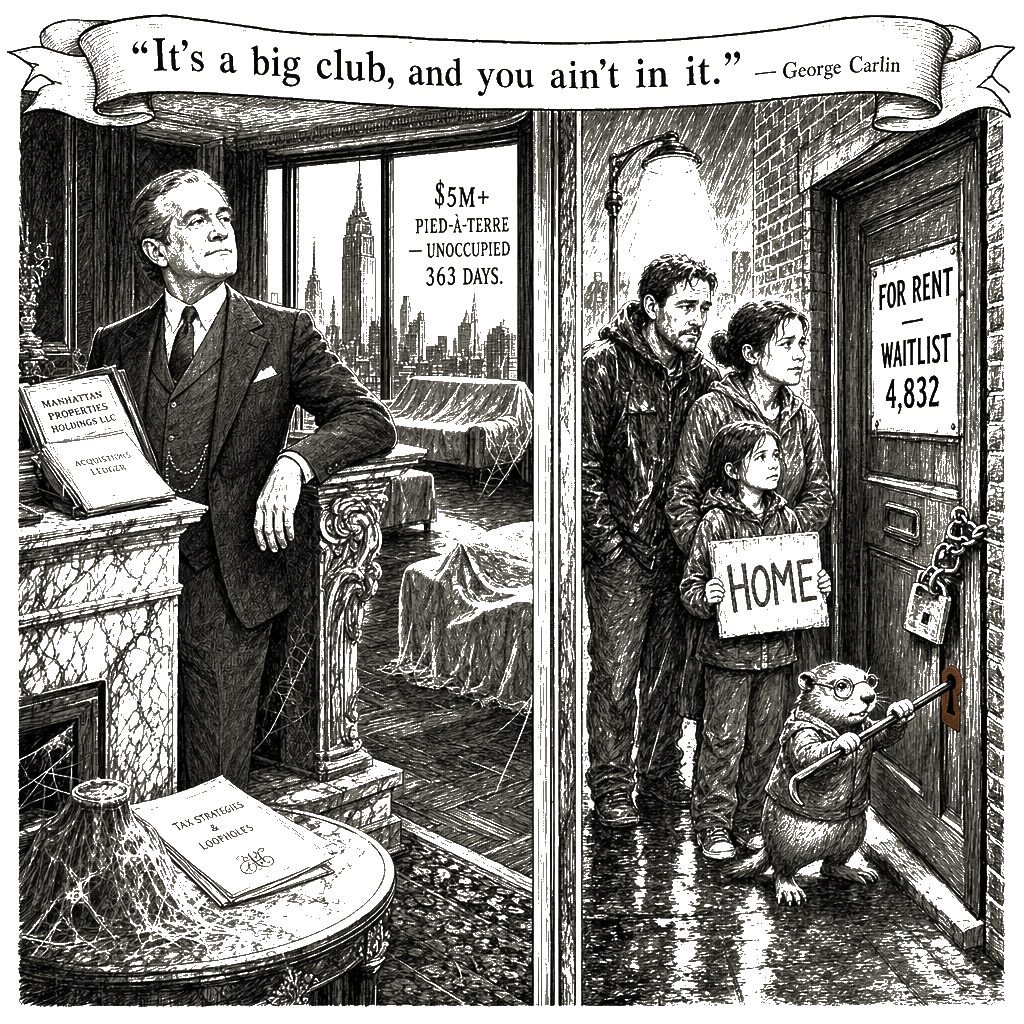
Even better, Democrats are addressing New York City’s housing hoarding crisis by approving a sensible tax on second homes that sit empty while hundreds of thousands of New Yorkers struggle to find affordable housing. The tax targets single-family homes with market values greater than $5 million, and condos and co-ops worth $1 million or more—a tiny fraction of ultra-wealthy owners. The tax will finally push down the absurd values of high-end properties, cooling the speculative frenzy that has turned neighborhoods into ghost towns for the wealthy. Owners are incentivized to either rent out their units or sell them to owner-occupants. When Vancouver imposed an Empty Homes Tax, the number of vacant properties fell by more than 60%, instantly returning usable housing to the market. That’s the goal: get those units occupied, not maximize a tax take.
At the same time, the tax corrects a distorted market that forces developers to price out the middle class to subsidize the luxury segment. Pied-à-terres represent an excessive extraction of value from the city’s real estate market, inflating luxury profits without adding genuine community value. The developer claim that the levy will raise prices for regular apartments is a scare tactic, the same one the industry rolls out every time someone proposes that rich people pay for anything. If the tax turns these high-priced parking spaces for billionaires into less attractive investments, development will finally shift toward the high-density, affordable housing the city actually needs. It will release land and capital for genuinely affordable homes, pushing prices down, not up.
Ms. Hochul is taking a decisive step by asking those who own vacant wealth to contribute to the city’s survival, rather than placing a crushing burden on middle-class workers. She is offering a modest win to Mayor Mamdani and progressives while refusing—for now—to truly tax the rich; no income tax increase, no corporate rate hike. But after the election, expect a real push for taxes on the wealthy to fund the services New Yorkers need. That’s not a threat. It’s a promise.